Invisible Hands and Brandished Fists: The Three Dimensions of Power

by Jochen Szangolies

If you started saving one dollar every second ever since the first ground was broken at stonehenge, you would now have saved as much as the US loses thanks to tax avoidance by the top 1% of earners per year. Image credit: Priyank V on Unsplash

I have once again been thinking about power, and once again I feel ill at ease with it. Yet while I do consider myself somewhat badly equipped for this pursuit, I nevertheless feel, “in these trying times”, a certain responsibility to not cozy up with pursuits closer to my heart and talents, but invest some portion of my time and ability into examining the mechanisms of control as they are exerted in the world. After all, as before, one may hope that slow and steady going may substitute for knack and knowledge, and perhaps even help those otherwise sidelined to enter the conversation.

The prompt for the present swerve out of my lane was provided by a colleague’s lunchtime question, after the conversation had inevitably landed on the topic of what flavor of future dystopia awaits. “But how,” he started (or nearly enough so), “are the billionaires in their bunkers going to keep themselves in charge?” After all, what’s to stop the armies of servants they depend upon to uphold their lavish lifestyles from just, well, murdering them and taking their shit?

The question invites an immediate followup: what’s stopping us now? Not murdering, as such—but even just applying equal standards to the wealthy stands to free up resources capable of addressing a great many injustices in the world. According to a recent estimate by the US Department of the Treasury, the top 1% of earners dodge about $163 billion in annual taxes. (If you, like virtually everyone, have trouble conceptualizing these sorts of numbers, I find it helps to convert them to time scales: if a dollar is a second, then a million dollars are about eleven and a half days, while a billion dollars are roughly 31.7 years; the avoided sum of taxes then takes us back 5165 years, back to when the first phases of Stonehenge started construction. By contrast, the median US income for a full-time worker is about $63,000, or roughly 17.5 hours.)

Clearly, there is much good that could be done with that sort of money. As a semi-random example, according to estimates it would take from 10 to 30 billion dollars annually to end homelessness in the US, essentially eradicating a major source of suffering. And nobody would have to get murdered—or even unduly inconvenienced: this is money that is already legally owed, simply by having the 1% pay their fair share. Studies project an added revenue of up to $12 dollars per dollar invested in audits of high income individuals. So why aren’t we out there demanding equal treatment for the wealthy? Read more »

On Leave in this World

by Derek Neal

A group of workers push Ershadi’s car back onto the road

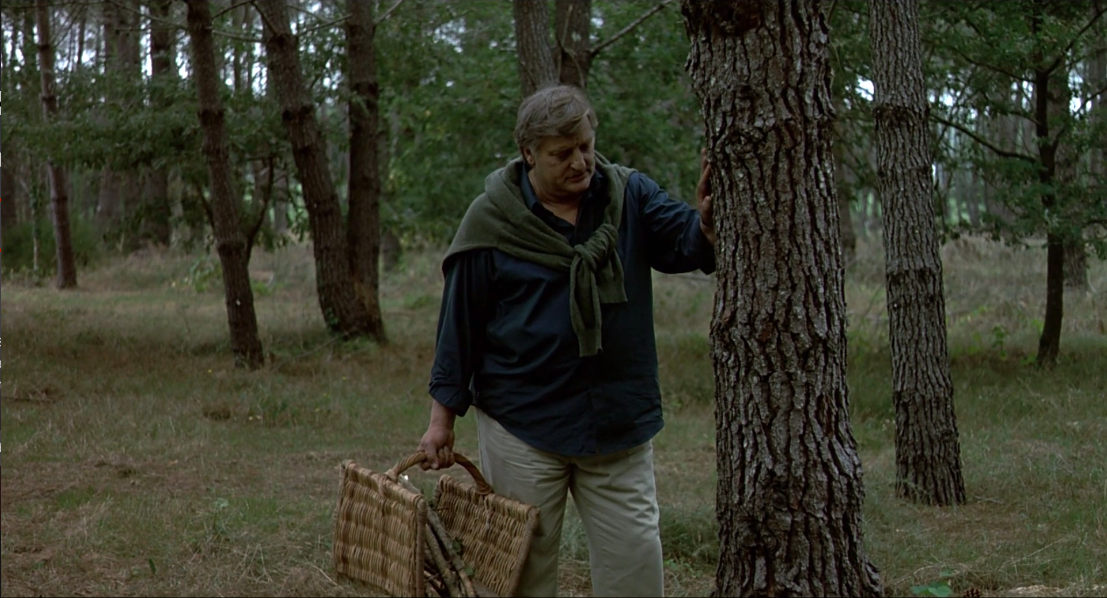
If one on the goals of art is to wake us up, to remind us what it is to be alive, one of the main ways of doing this is by bringing us as close to death as possible. This is why suicide is such a fruitful and, paradoxically, invigorating artistic subject. For the suicidal character approaching death, sensations are heightened, and life becomes fecund and tactile. One scene that captures this is in Francois Ozon’s Under the Sand (2000), just before Charlotte Rampling’s husband (Bruno Cremer) disappears into the ocean while she naps on the beach. The film never explains the husband’s disappearance—never confirms that it’s suicide—but the evening prior, the camera follows Cremer as he gathers firewood in the forest surrounding their vacation home.

He picks up a few sticks, then pauses at a tree and feels its bark, runs his hand down its trunk, as if he wants to feel the rough surface one more time before dying. The camera follows him as he passes behind another tree, then something unexpected happens: the shot stops on the tree while Cremer passes out of view, lingering in sharp focus on the nooks and crannies of the tree bark, showing the viewer just how wondrous a tree is, if only we could stop to see it. This is also a great example of Deleuze’s concept of “time-image,” when a film emphasizes time or duration rather than the movement of characters and plot. We then return to Cremer, who has crouched down and turned over a rotting log. Hundreds of ants scurry around—so much life, right there!—in juxtaposition to Cremer, alone in the forest.

Cremer touches a tree

This contrast of the isolated individual and the group is a recurring theme in Abbas Kiarostami’s Taste of Cherry (1997) as well. Paul Schrader famously imagined a man in a yellow cab as a symbol of loneliness and alienation, but Kiarostami took this idea even further—what if an entire movie was just a man in a car, driving around? That’s Taste of Cherry. The film is a series of vignettes as the main character (Homayoun Ershadi) motors around the outskirts of Tehran picking up one passenger after another, not as a taxi driver, but in search of a person he can convince to do a special job. Read more »

15 Random Thoughts About AI

by Eric Schenck

The last few years I have been deep in the world of artificial intelligence. Using it. Reading about it. Learning from people who are experts.

What follows are 15 random thoughts about AI. What it means for us, what the future might look like, and different things I’ve reflected on recently. Some are negative. Some are positive. Use them as thoughts for reflection, or if nothing else – a little entertainment. 

(Disclaimer: I am not a professional. These are the opinions of an amateur that’s interested (and skeptical) of AI. Please keep that in mind.)

1) Right now, every incentive is to make AI look like it is absolutely necessary.

This is the first idea I want to start with. These days, the only economic news that seems to matter is how companies are adding AI to their products. 

Just follow the incentives. There is more money to be made (and invested) when companies overstate the value of AI. Just something to consider the next time news of the latest AI accomplishment makes you feel anxious.

That said-

2) More people should be using AI.

Think about people that hated on the internet. Or a couple thousand years ago, that were skeptical of books. We reflect on that now and laugh. 

How horribly outdated, we say. 

But that’s exactly what’s happening with AI right now. Most people aren’t using it for anything substantial. The obvious risk here? That those people refuse to learn a technology that will eventually become necessary, and get left behind as a result.

(Imagine not knowing how to access the internet now.) 

If you aren’t using AI for anything, start. Even just once a week going back and forth with ChatGPT can start to build the skillset. 

3) The school system will be forever changed.

I think of schools and how inefficient they are. (The “modern” school system was designed to fit into an industrial society.) 

But what if each student had their own AI-powered teacher? What if we got rid of our “go as fast as the slowest student” system – and replaced it with “go as fast as your custom-made AI teacher lets you?”

Each student would learn in the way that was perfectly suited to them. Not just the average intelligence of their class.

The implications of this could be huge. School less as a place of learning, and more as a place for kids to socialize.  Read more »

Thursday, December 11, 2025

Two Cheers For Ned Ludd – With A Note On The Coming Apocalypse

by Richard Farr

In this, the most famous image of Nedd Ludd, I don’t believe anyone has yet commented on the presence in the background of a burning data center.

My family jokes that I can break a computer by looking at it; God knows, I’ve tried. They also say that I hate technology, and would rather have lived two hundred years ago — wooden table, candle, quill pen — but that’s a slight exaggeration. Once in a blue moon I will acknowledge that some aspect of our vaunted progress is real. Speaking of computers: my new Chromebook has a great screen, a great keyboard, does everything I want, is more secure and more stable than any PC or Mac, and was $249. Amazing. 

But my mellow is rapidly harshed when, as so often, I perceive a yawning gap between the hype surrounding a technology and its performance. Or perhaps it’s more that I’m depressed by the thirst with which so many of us guzzle the hype, unable or unwilling to countenance the possibility that a new app or gizmo we’ve been instructed to consider marvellous might actually be saving less time and trouble that it costs.

Back in the 1990s I spent an hour or three every day with this thought, because 27.9% of my productive potential and probably yours was being vacuumed up into the business of installing, uninstalling, reinstalling and then screaming at the latest iteration of ****ing Windows. Was this perhaps the single worst consumer product ever to have become unjustifiably popular? Not quite! Adding insult to injury, once the cursed Frankensoftware was up and lurching I’d typically spend most of the precious minutes before the next crash using it to support Word — which, from the viewpoint of a working writer, was even worse: a nightmare of bloat and overkill and thoughtlessness, like a ten gallon espresso cup made of wool. The free market being the miracle that it is, Microsoft managed to create enough of a monopoly with Word that using an alternative was for many years not a real option, and thus did it become the QWERTY keyboard of the modern era. Read more »

The Murder Memos

by Barry Goldman 

At the time of this writing, Thanksgiving week 2025, the Trump administration has launched 21 strikes on boats in the Caribbean and eastern Pacific and killed 83 civilians. According to the administration, the US military has legal authority to conduct these strikes. That authority is outlined in a memo from the Office of Legal Counsel, the OLC. But the memo has not been released to the public. It is a secret memo.

We have seen this movie before. Twenty-some years ago, there were secret memos from the OLC that authorized the CIA to torture prisoners at Abu Ghraib and Guantanamo. Those became known as the “torture memos.” These OLC documents are likely to become known as the “murder memos.” The process that generated them is the same.

As Sen. Chris Van Hollen (D., Md.) said:

[T]he decision was made, and someone was told to come up with a justification for the decision. It is a lot of legal mumbo jumbo.

No one should be surprised.

They told us a story about this process when I was in law school. It seems once upon a time many years ago a lawyer told J. P. Morgan there was no legal way he could do something he wanted to do. Morgan said, “I don’t know as I want a lawyer to tell me what I cannot do. I hire him to tell me how to do what I want to do.” The lesson was clear. Morgan was one of the richest men in the world. He could hire any lawyer he wanted, and he could pay more than anyone else. If this lawyer didn’t want to do the job, Morgan would find someone else who did. Law is no different from any other field. The Golden Rule applies: Whoever has the gold makes the rules. Read more »

Wednesday, December 10, 2025

Algorithms Don’t Care

by Rachel Robison-Greene

The Trolley Problem, once a thought experiment students encountered for the first time in an Introduction to Philosophy classroom, has become a well-known cultural meme. It is depicted in various iterations in cartoons across the internet. The standard story involves a person choosing to pull a lever so that a trolley runs over one person tied to the tracks rather than five. People have imagined all sorts of identities for the individuals involved, up to and including a billionaire at the lever choosing to direct the trolley to run over many people in order to protect bags of money. All of these scenarios share a key feature in common—they encourage those contemplating them to consider the consequences that might result from the decision the lever-puller makes.

Much emerging technology encourages people to reason along similar lines. Consider the case of autonomous vehicles. Critics and ethically inclined collaborators have been quick to point out that these vehicles will not be naturally inclined to make decisions guided by moral considerations. If we want these vehicles to make defensible moral decisions in tricky circumstances, we’ll need to program them to do so. Discussion of these issues often proceeds along broadly consequentialist lines: identify things that are valuable and maximize them and identify things that have disvalue and minimize them. If we think that the life of a human is more valuable than, say, the life of an ill-fated duck crossing the street, then the life of the human should be prioritized when there is a choice between them. If we value saving a greater number of lives rather than a lesser number, then perhaps we should program autonomous vehicles to sacrifice the driver when the choice is between the death of the driver and the deaths of a greater number of people. In any case, the decision-making metric involves weighing consequences. The same is true with algorithmic decision making made by other forms of AI. This includes AI used in our most important institutions: education, health care, the criminal justice system, and the military. Read more »

Eight Voices

by Laurie Sheck

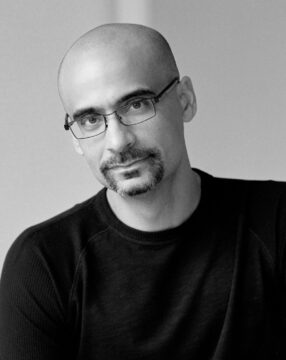
Junot Diaz

For the past couple of decades, I have been a member of the MFA Creative Writing faculty at the New School in New York City. Before that I taught at Princeton, Rutgers, Columbia and CUNY. I have had many remarkable students, among them the Pulitzer Prize winning novelist Junot Diaz who I met in my mid-20’s when he walked into the undergrad creative writing class I was teaching at Rutgers and handed in, for his first assignment, an extraordinary short story which I remember to this day.

One of the many pleasures of teaching college, and now graduate school, is getting to learn what a group of people in their 20’s and 30’s are thinking; learning, even, what newly-coined words they are using. Over the past couple of years, I have noticed a darker cast to much of their writing. Thinking about this, and wanting to know more, a few weeks ago I invited a group of them over to my apartment to talk among themselves about what’s on their minds, what their daily lives feel like, and to figure out how they might write about this in short pieces that I could share here. What emerged most prominently aside from the global political situation, was a sense of loneliness and isolation and a wary attitude toward AI and social media. I also asked each of them to give me four or five words that apply to the time we’re now living in, and, as Walt Whitman so wisely knew, to allow for those words to be contradictory. Here are some of them: “Lonely, fractured, addicted, expressive, inventive”; “Scary, dramatic, fever-dream, awakening”; “Digitized, commodified, tender, resilient, evolving.”

When I asked what makes them feel most hopeful, their answers included, “evil’s inherent tendency toward failure,” and when I asked what makes them least hopeful, they said: climate change, global change, the future.”

What follows are their short pieces. Read more »

Tuesday, December 9, 2025

Thoughts On Neurodiversity

by Martin Butler

Neurodiversity, a term first coined by the sociologist Judith Singer in the 1990s, is the idea that human beings think and act in a wide variety of ways which extend well beyond the narrow, stereotyped conception of ‘normal’ that most people take for granted. It has come to be regarded as a matter of minority rights, according to which people whose personalities or behavioural tendencies are atypical should be granted equal rights and the same respect as anyone else. Neurodiversity is an obvious reality to which there are two rather different approaches.

The first argues that we simply need to be more accepting of those who do not fit the standard way of being. It’s about overcoming the kind of prejudice we all know from the school playground against those perceived to be different. We might see this as widening the idea of what is acceptable and thus extending the spectrum of what is ‘normal’, for even within the range of what is described as ‘neurotypical’ there is diversity. There have always been different personality types – extrovert, introvert, impulsive, aggressive, thoughtful, calm, clumsy, methodical, and so on. These, however, are not described as neurodiversity but simply as human difference. Neurodiversity then, according to this first approach, simply means admitting more individuals into the normal range, such as  those who have ADHD or those on the autism spectrum. It’s part of the wider ethic that being different, unusual, or even ‘odd’ is not in itself a reason to judge a person negatively. Importantly, this approach is an attempt to break down categories. Differences are seen as irrelevant to the way we judge, just as ethnicity or sexual orientation should be regarded as irrelevant. To borrow a quote from Martin Luther King, it is the ‘content of their character’ that matters rather than the degree to which someone shows neurodiversity.

The second approach is quite different. This is not enough, it says. Having a positive and accepting attitude still does not allow someone with, for example, ADHD to succeed in an education system which does not recognise or understand the needs associated with their condition. Rather than underplaying the differences displayed by a neurodivergent individual, this approach advocates a need to fully recognise them. Unlike ethnicity or sexual orientation, it argues, neurodiversity does actually affect the way you interact with other people, how you respond to education programmes, employment roles and social situations more generally, and it is not something the individual concerned can voluntarily alter. Society, therefore, needs to adapt to accommodate these differences, and perhaps even to judge performance by a different yardstick from the one used for neurotypical individuals. According to this approach, we cannot simply be blind to these differences, as the first approach would suggest, seeing through them to the ‘normal’ human being inside. We need to recognise that being neurodivergent is part of an individual’s core identity.

The problem with this is that it leads to the medicalisation of conditions through the creation of artificial categories. Where do we draw the line between someone who could be described as neurotypical but nevertheless shows features of a recognised neurodivergent condition, and someone who only just meets the criteria for that condition? It seems a little arbitrary. Surely all human beings sit somewhere on a complex spectrum rather than in neatly defined categories. Is it fair to give special consideration to those just inside the category but not to those who fall just outside it? Read more »

Depending On The Kindness Of Strangers

by Mike O’Brien

Like many other video gamers (nearly eight million, in fact), I have spent no small portion of recent weeks in the robot-infested, post-diluvian wastes of late-22nd-Century Italy, looting remnants of a collapsed civilization while hoping that a fellow gamer won’t sneak up and murder me for the scraps in my pockets. This has been much more fun than the preceding description might lead you to believe, if you are not a fan of such grim fantasy playgrounds. It has also, interestingly, afforded rather heart-warming displays of the better side of human nature, despite the occasional predatory ambush or perfidious betrayal. It helps somewhat that nobody really dies in this game; they just get “downed” and then “knocked out” if not revived in time, leaving behind whatever gear they were carrying (except for what they were able to hide in their “safe pocket”, the technical and anatomical details of which are left to the player’s imagination).

This is the world of Arc Raiders, a game that has been in development and re-development for about five years, finally releasing at the end of October after a few public testing sessions elicited an outburst of anticipation from professional and recreational gamers alike. Developed by Sweden’s Embark Studios, it was created by veterans of the Battlefield series of military shooters, who left Battlefield developer DICE when it was clear that the company was losing the plot to its own franchise. Battlefield 4, released in 2013, is still my favourite game of the series and of the genre (that genre being large-scale military shooters pitting one team against another in a combined arms conflict, with soldiers, planes, tanks, boats and other bits of kit fighting for control of various points across a sprawling map).

Arc Raiders is a very different game from Battlefield. Players are not assigned to opposing teams in a binary struggle for victory. There are no flags to capture or defend. It is a wide-open experience with little in the way of explicit instructions or rules. It was originally conceived as a player-vs-enemy (PvE) cooperative multiplayer game, where human players joined together to fight the robots that have taken over Earth’s surface. In this original conception, it bears much similarity to another favourite game of mine, Generation Zero. Read more »

Monday, December 8, 2025

Why We Sleep

by S. Abbas Raza and ChatGPT 5.1

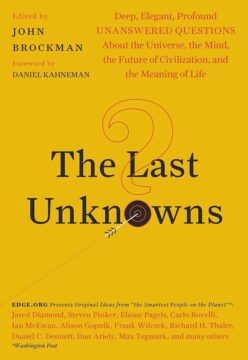
S. Abbas Raza: You may have heard of John Brockman who is a well-known American literary agent and author specializing in scientific literature. Brockman led a scientific salon for 20 years, asking an annual question to a host of scientists, philosophers, and other thinkers, and publishing their answers in book form. For the last such book, instead of asking for answers to a question, he requested that the contributors each submit one question to which they would like to know the answer, and the resulting list of questions was once again published as a book in 2018 entitled The Last Unknowns with a foreword by Daniel Kahneman. Here is the question that I submitted and was published in that book:

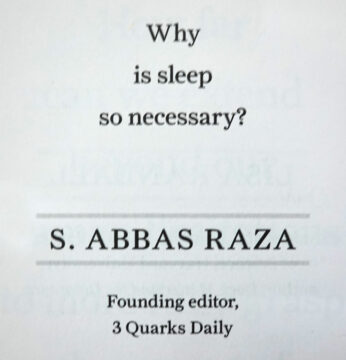
Why is sleep so necessary?

My page in the book.

The questions were simply printed in the book with the author’s name, one to a page, without any commentary or explanation but let me give a short explicatory comment here. Much of my curiosity about sleep had to do with the word “so” in my question and the work it is doing there. One reads many accounts of what happens when we sleep. For example, the flushing of toxins from the brain, cellular repair, etc., but what I found unsatisfying was that none of these seemed to me to give good reasons we necessarily have to be unconscious for the process to take place. And the advantage one would gain from not having to be asleep for a very significant portion of one’s life would clearly be so profound that if there were any easy way evolution could have found a way around sleep, over hundreds of millions of years of reproducing different kinds of brains, it would have. But we see that any animal with a brain, no matter how tiny or complex, from fruit flies to humans, needs to sleep. That is why I asked why sleep is “so necessary”, because I suspected that the answer to that question would tell us something very fundamental about the design of the brain.

A couple of days ago, I mentioned to my wife, Margit, that a few months after GPT3 was released to the public by OpenAI at the end of November in 2022, months that I spent intensively learning about how transformer models like ChatGPT work (transformer is the “T” in GPT and a particular architecture of artificial neural networks), it suddenly occurred to me that AI models may have provided us with the conceptual vocabulary to more easily understand what is happening in the brain when we sleep. I then went on to explain to her what I meant in the following way:

Human brains are not “pre-trained” with data the way a large language model (an LLM like ChatGPT) or other types of deep-learning AIs are. Instead, the synaptic weights throughout our “thinking brain”, probably the neocortex at least, are adjusted according to our experiences throughout our life. But while we know what an artificial neural network’s learning algorithm is during pre-training (it’s called “backpropagation“), we know that in our case it is not backpropagation, but we also do not know exactly what the learning algorithm (which goes and adjusts the synaptic weights) for human brains is. Read more »

Poem by Jim Culleny

—on a painting by Edward Hopper

Pegasus

A flying red horse
was a sign of my time.
On drives anywhere
along a center white line
with mom and dad, when
we rolled in to fill-her-up
I’d see him there through my
backseat window as on my
couch-like seat I laid supine,
and there he’d be,
flying high
way up there on a Mobile sign
on a
tall white post in an
olden time
when I innocently
thought life was truly sublime
when horses could fly and
all things rhymed

Jim Culleny
12/5/25

Enjoying the content on 3QD? Help keep us going by donating now.

Sunday, December 7, 2025

Generation 6-7

by Jeroen Bouterse

Preparing a worksheet with negative-number calculations where all the digits are sixes and sevens. Telling myself it’s meant to take the fun out of it for them – like a sex ed teacher having their students say ‘penis’ one hundred times before starting the unit. Definitely not the whole story, but plausible: as a middle school math teacher I am more than justified in trying to tame the phenomenon. In fact, I have drawn a firm line; just seeing a 6 anywhere in an exercise is decidedly not an appropriate reason for doing the meme. Really, we need to get on with the lesson now; I will count to five.

The ‘six-seven’ thing is one of those trends that remind adults they have lost connection with what it is like to be a teenager. For me, it is actually a far less baffling one than the draining ‘skibidi’ and ‘what the sigma’ cycles – I quite understand that it is fun to say. No, more than that; it has made something about Generation Alpha positively click into place for me. Let me enlighten you.

But before I do that, let me remind you that as a teacher, I am one of the least suitable people to look at the current cohort of middle-schoolers with any objectivity. Ten years into teaching math, part of my brain is definitely wondering why they still don’t know how to find the lowest common denominator, forgetting that every year, ‘they’ are different children who are simply learning these concepts for the first time. Also, with more teaching experience comes more confidence, so that I now tend to attribute failures in skill transfer less to my own didactic shortcomings and more to whatever is going on with kids these days.

My point is not, however, about what may or may not actually be wrong with this generation – in fact, I intend to end this essay with some starry-eyed optimism; rather, I want to proceed from the observation that this generation is the object of deep cultural worries in a way that we haven’t seen in a while. Those worries are tied to the technological revolutions that have led to kids being perpetually online. Read more »

Gramscian Hegemony and American Justice: The Myth of Individual Moral Blame

by Daniel Gauss

Antonio Gramsci’s theory of hegemony helps explain how the power structure of modern liberal-democratic societies maintains authority without relying on overt force. Many definitions of hegemony point out that it creates “common sense,” the assumptions a society accepts as natural and right.


It works by getting inside our heads and convincing us of concepts that would not hold up under rigorous investigation. Our criminal justice system is built on such taken-for-granted principles, many of which go unchallenged despite producing deeply inhumane consequences.

Crime, for example, is assumed to be a personal “moral failing” rather than a systemic problem. Why some people (mostly poor and marginalized) fail morally is not understood or explained. Instead of understanding crime as a product of poverty, racial segregation, inequality and limited opportunity, our system treats it as evidence of bad individual character or individual moral flaws, basically recycling old theological ideas while ignoring more than a century of psychology and sociology.

The judicial system still draws from an outdated worldview, uninformed by social science, that assumes the validity of an unquestioned social hierarchy, based on inequality of opportunity, and shifts responsibility onto individuals who are often living in trying and corrosive conditions. This amounts to a form of blaming the victim instead of accepting social and economic responsibility for others. Read more »

Friday, December 5, 2025

Damned If You Do, Damned If You Don’t: An Open Letter to Gov. Schwarzenegger and Common Cause

by Jerry Cayford

Dear Governor Schwarzenegger and Common Cause,

California redistricted using the method of Cohen-Addad, Klein, and Young

California just passed Proposition 50 to resurrect partisan gerrymandering. The two of you had worked hard and worked together, in 2008 and 2010, to take electoral redistricting out of the hands of partisan legislators and give it instead to a citizens commission. You shared the goal of saving our democracy from the anti-democratic one-party rule you both saw coming. Yet, in 2025, you were on opposite sides of the Prop 50 battle. Although you collaborated to create citizens commissions, you worked against each other in the decision to tear those commissions down.

There is nothing mysterious about your change from collaborators to opponents. That decision on commissions presented the classic dilemma: damned if you do and damned if you don’t. There’s no surprise that you chose differently when only bad choices were available.

Prop 50 explicitly announces that gerrymandering California for the Democrats is a response to the Republican Texas gerrymander. With eyes wide open, everyone knows this race for partisan advantage is a race to the bottom for democracy, and that large parts of the American public will find themselves unrepresented and powerless. It’s a bad course of action. Damned if you do. However, not entering this race to the bottom would, Common Cause reasons, “amount to a call for unilateral political disarmament in the face of authoritarian efforts to undermine fair representation and people-powered democracy.” Damned if you don’t.

You are leaders who understand the bottom we are now racing toward. I write to argue that there is still a path out of damnation, a path America can take before the 2030 census. I ask you to lead us on it. It is a straight and narrow path, as paths from damnation often are. You have both already seen the narrow part: redistricting must be national, the same in all states. I hope to convince you that the straight path to a nation-wide end to gerrymandering, our best path to a healthy democracy, does not wind through citizens commissions. I will touch on morals, masculinity, math, and more to describe this better path. Read more »

Of Strikes and Storms: Senegal 2009

by David Winner

Having reached the ripe old age of sixty-one more or less in one piece, I wonder at which moments I may have been most in danger. Were there ever rogue cancer cells that never quite manifested? Planes or cars or buses that almost crashed. Appearances can be deceptive. The safe can be deadly, the deadly safe. The farther you are from the predictability of home the harder it is to figure out what is dangerous and what is not.
Goats in Saint Louis, Senegal 2009

August 2009, rainy season in Senegal, my friend Robert and I are trying to get from Dakar to Saint Louis, the former capitol of French West Africa. We take the taxi parked outside of our hotel to the Gare Routière where sept-places (old station wagons with their backs carved into claustrophobic seats) head to destinations across the country once seven passengers have assembled. On the way, the driver explains a problem to us, a difficulty that lies outside the realm of my limited French.

Inside the Gare, we see cars, drivers, and even the names of destinations (including Saint Louis) but something is off. There are hardly any people about.

Following us into the station, the driver repeats what he’s said before. And a word that I had not grasped, greve, strike, finally penetrates my foggy brain. No sept places are running today because they are on strike.

According to what I’ve read, police harassment, unlicensed vehicles, bad roads hound Senegal, transportation a chronic challenge.

What the driver wants, I assume, is for us to pay him to take us all the way to Saint Louis.  But he seems hesitant when I make that suggestion. And when he finally agrees, he only asks for only a hundred dollars for the nearly four-hour drive there. And back, as he surely lives in or around Dakar. Read more »

Thursday, December 4, 2025

From Rio to Stavanger

by Charles Siegel

Last month I attended two conferences a week apart, one in Norway and one in Italy.  The first conference was held in Bergen.  From there, my law partner and I proceeded down the coast to Stavanger, for a meeting with a lawyer there about some potential cases.

Our meeting was late on the afternoon of November 16th. When we finished, we looked around for somewhere to have dinner. Most restaurants were closed on a Sunday evening in autumn, but eventually we found a decent place. As we walked back to our hotel afterward, we passed a pub and decided to go in and watch the soccer match that was playing on TV.

This turned out to be a World Cup qualifying match between Norway and Italy. There wasn’t actually much riding on the outcome; Norway was going to qualify unless it lost by nine goals or more, and Italy was going to stay alive but have to win an extra two matches to qualify, as part of an additional playoff round for European teams. But the fans in the pub were excited nonetheless.

When we sat down, the game was about midway through the second half, and the score was 1-1. It was clear, of course, that Norway was not going to lose by nine goals or anything close to that, and so they were going to the World Cup for the first time in 28 years. But even as the clock ticked down toward qualification, those in the pub still were hoping for a win.

And they got it, in lightning fashion: Erling Haaland, the bustling striker who plies his trade in the Premier League for Manchester City, scored two goals in two minutes. Norway added a fourth in stoppage time, and that was it. Jubilation for the Norwegian players, many of whom weren’t alive the last time Norway played in a World Cup, and humiliation for Italy, who were beaten at home and who now are in danger of missing the tournament for a third time running. Read more »

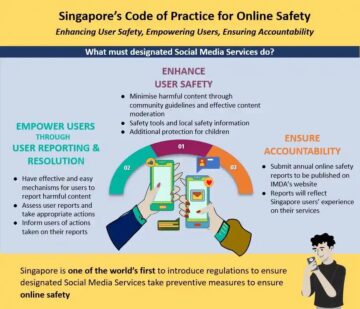
Lesson From Singapore: Perspectives On Media And Disinformation

by Eric Feigenbaum

Singapore’s domestic debate is a matter for Singaporeans. We allow American journalists in Singapore in order to report Singapore to their fellow countrymen. We allow their papers to sell in Singapore so that we can know what foreigners are reading about us. But we cannot allow them to assume a role in Singapore that the American media play in America, that is, that of invigilator, adversary and inquisitor of the administration. No foreign television station had claimed the right to telecast its programs in Singapore. Indeed America’s Federal Communications Commission regulations bar foreigners from owning more than 25 per cent of a TV or radio station. Only Americans can control a business which influences opinion in America. Thus, Rupert Murdoch took up US citizenship before he purchased the independent TV stations of the Metromedia group in 1985.

When Singapore’s Founding Prime Minister Lee Kuan Yew spoke these words to the American Society of Newspaper Editors meeting in 1988, he could scarcely have imagined how the Internet and eventually social media would dramatically affect the very nature of the press and increase the number of voices engaged in political and other discourse.

Today not only is media ubiquitous but choosing your news and information sources to align with your pre-existing political and social outlook is not only available, but the norm. If the role of the Fourth Estate as a credible source of information has been compromised, it is equally undermined by hostile voices and even less credible sources able to find megaphones through social media. The information age is a din of voices making it harder than ever to get clear, unbiased news.

Media itself is now a topic in our national discourse. On October 29th, the Pew Research Center published findings that “only 56 percent of American adults now say they have a lot of or some trust in the information they get from national news organizations – down 11 percentage points since March 2025 and 20 points since we first asked this question in 2016.”

Further, “fewer than half of Republicans and Republican-leaning independents (44 percent) now say they have at least some trust in the information that comes from national news organizations. This is down from 53 percent in March and 70 percent in 2016, but it’s still above its lowest point in 2021, when 35% of Republicans expressed this level of trust in the national media.”

And Democrats? Read more »