by Jochen Szangolies
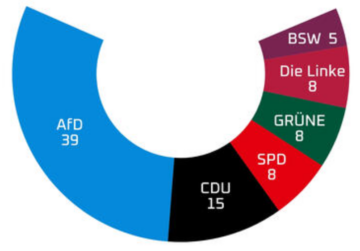
Last Sunday, on the sixth of September, for the first time in more than 80 years, a far-right extremist party won the majority of votes in a German state election, and has a realistic chance at leading the state government of Saxony-Anhalt. (They had previously won the majority in the 2024 Thuringian state election, but had no chance of forming a government because none of the other parties would join them in a coalition.) While narrowly missing the absolute majority, at 43.8% they very nearly equaled the combined result of the CDU, SPD, Grüne, and Linke (of 44% according to the preliminary count). In particular, the conservative CDU, party of Chancellor Friedrich Merz, has lost more than half their share of the vote compared to the last election. These losses are attributed by many to vastly unpopular reform plans and a general perception of failing to meaningfully engage with the needs and concerns of the majority of the electorate (mostly those having to work for money, instead of having money work for them). Merz holds the historically lowest approval rating for any German Chancellor: around 80% of Germans are dissatisfied with his performance.
There are, as always in such a situation, conciliatory voices: perhaps the work of government might demystify (‘entzaubern’) and expose a party that has little to offer except inflammatory rhetoric and beer hall populism. Perhaps the promises made on the campaign trail will evaporate in the harsh light of political reality. Perhaps disillusioned voters will turn away again from a party that fails to deliver. Perhaps, that is, no Bad Thing will happen. I deeply hope this optimism will prove true. But I do believe it is misguided: in Germany, a democracy explicitly engineered to prevent a repeat of fascist terror, a ‘confirmed right-wing extremist’ (‘gesichert rechtsextrem’) party will most likely lead a state government. That is the Bad Thing, happened.
Germany, here, is not an isolated case. Democracy has been on retreat in large parts of the world. Autocrats, and particularly right-wing populist movements in Europe and beyond, are on the rise. After the fall of the Soviet Union in the 1990s, narratives of ‘the end of history’ and the victory of liberal democracy seemed to herald an era of global democratization. But history seems to stubbornly continue. So how did we get here from there?
Erik Hoel, neuroscientist and occasional cultural commentator at his substack The Intrinsic Perspective, pinpoints the year 2012 as the turning point for many long-running trends, especially in regard to a shocking decline of mental health, particularly pronounced among teenagers and young adults.
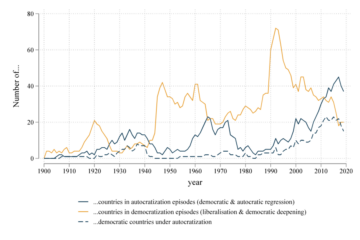
And indeed, looking at long-running trends of autocratization vs. democratization, we again find the approximate turning point in the year 2012. Is this an accident, or is there something more behind it? I think that the possibility of a link here is at least worth investigating.
Now, if there is a correlation between A and B, and you suspect this to be more than chance, you can either look at possible ways that one causes the other, or you can look for a common cause of both. While it is not completely implausible that democratic backsliding has effects on mental health (mine certainly took a hit last Sunday), nor that a widespread mental health crisis fuels at least some form of dissatisfaction with the status quo, the causal story seems weak in either case. Autocratization may lead to mental health decline, but what explains the rising autocratization? Declining mental health might make one vote against the current order, but why is mental health declining in the first place? Read more »
 I read Ben Lerner’s new novel, Transcription, in one day. I started reading it on my iPad at around 7:30 am as I sat at my kitchen table, sipping coffee and eating a piece of cake that my partner had made. Later, I continued the novel during my lunch break as I ate leftover sausage and rice. Near the end of the workday, after I had finished all my meetings, I finished the novel, then I rode my bike home, looked at my phone for a bit, ate some chocolate covered coffee beans, drank a glass of orange juice, and started writing. I don’t feel like I have much to say about Lerner’s novel except that it’s largely about screens and food, so it’s fitting that I mostly read the novel on a screen while eating. Is this profound? No, not really. Lerner’s novel, I feel, is not so profound either. It’s an internet novel, and a pandemic novel, and there’s a lot of doubling (as in his other novels), but it all feels rather lightweight. When I got to the end of the 144-page book—which is mostly dialogue—I thought, hey, this is Sebald-lite! There’s a revealing anecdote that connects previous events in the novel to the Nazis, but whereas in Sebald’s Austerlitz I felt actual shock and terror at the revelation of Austerlitz’s past as a Jewish child escaping the Germans, here I simply acknowledged Lerner’s cleverness. Part of the reason is that Lerner’s intelligence can feel like a parlour trick, and it’s perhaps not surprising that Lerner is a former debate champion, that activity that prizes the appearance of intellect and erudition over any real substance or conviction.

 prince. The prince convinces Jones that if he provides access to his checking account, the prince will deposit $5 million ($5,000,000.00 USD) in it. Jones finds this proposition attractive and provides his account number, login credentials and password. Much to Jones’s surprise, however, instead of depositing $5 million ($5,000,000.00 USD) as he promised, the prince uses Jones’s credentials to empty Jones’s account. Now suppose Jones files a complaint against his bank alleging that the bank improperly allowed an unauthorized withdrawal from his account. What should be the result?
 At this point in time, I would have expected to see more “AI religions”, or religious movements focused on AI. Why are there no churches of AI or scriptures of AI worship? I don’t mean use of AI in traditional organized religion, such as the German and Finnish churches experimenting with ChatGPT-written sermons, or bots trained on Jesus or Buddha’s teachings. Rather, I mean movements that treat AI as divine and sacred, a source of revelation, as the vessel for humanity’s salvation.
 Roldy Aguero Ablao. Talaya’ 3000, 2023.


 A few years ago I shared a draft of a sonnet sequence with a poet from the Northwest I had followed for a while. I asked him if he’d give the piece a once-over and provide some critique, and his reading was perceptive and useful for me. One comment drew my attention in particular: “I fall flat on ‘beauty,’ ” he wrote. “This is the one place in the poems the image turns outward into metaphor that cannot be touched — ‘beauty’s hidden folds’ is a no-thing” he wrote, pointing out at the last line of the second sonnet.


 Finish the book manuscript