by Shadab Zeest Hashmi
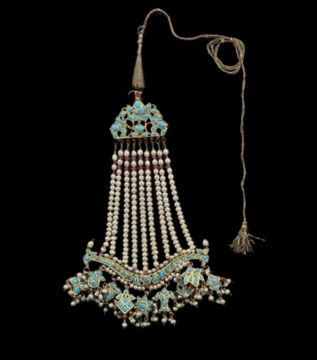
Having never left town, Marjiana is an oyster, a watchful oyster, though her name means “small pearl.” She has read countless books to Ali Baba, books about lands and seas, their fruits and snakes, gems and poisons, and the skies and their mysteries. While Ali Baba dreams, Marjiana watches the world turn, quietly studying the monsters as she balances on the beam between night and day.
Lately, the veils hanging between worlds have thinned, they billow, they flutter. She hears the whispers inside the whispers: schemes, directives, protests, pleadings, prayers, rapid-fire data, lullabies. Her heart is pierced once every 9 minutes when a child is murdered and the cries of the mother pass through her body. She feels the tonnage of bombs shaking the earth with the same force as the soundless gasps under the rubble.
A savage thirst for oil, a hunger for petrodollars have subsumed the world, and Hormuz, once home to the largest harvest of pearls, is now a slice of fortune where land meets water and ships must pass for oil. Marjiana of coral cheeks and sleepless eyes, Marjiana, woman who stays awake in guard, lays a net where every kind of slaughter is recorded, and every sleeve hiding a weapon becomes transparent. She glides by escalators descending to the pit where the aria of money rises and there are luxe suits turning blood to cash. When she lifts her lamp, the suited ones slink away.
Tonight, Marjiana is walking by forty canisters of oil lined up in the cellar. In the quivering light, she is suddenly realizing the past has come to meet the future. Her foot is on the threshold. The lamp in her hand, a thing of beauty by which the night becomes a boat shimmering in ink– will not last this night. Her house is full of thieves. Gently she will take as much oil needed to refill her lamp and pour the rest on the greed of 39 thieves. The 40th one, the leader of the thieves will meet his end with the sword that belongs to her master who is so full of sleep he cannot see enemies that come as friends.
Tomorrow the lamp will need to be filled, tomorrow a small pearl will have saved the sea and land.
***
 OpenAI released

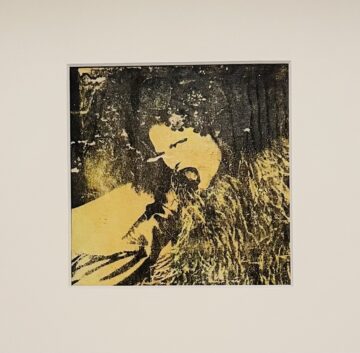



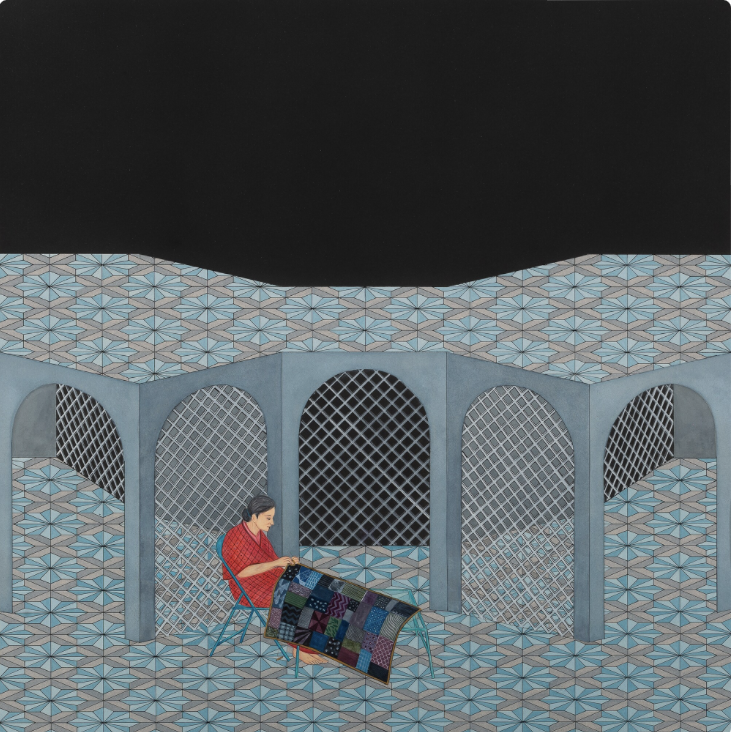 Utkarsh Makwana. Detail from ‘Finishing Touches’, 2022. Courtesy: Akara Art.

 In his Confessions, Augustine remembers his state after the death of a beloved childhood friend. He writes: “Everywhere I looked I saw death. […] My eyes sought him everywhere, and did not see him. I hated all places because he was not in them.” An unfailingly moving passage, and a testament to Augustine’s power as a thinker – for profound as his account of his loss is, we are already being led along for a much bigger point. Almost immediately, Augustine moves on to chastise his former self: “fool that I was then, enduring with so much rebellion the lot of every man”. A soul that tethers itself to mortal things, rather than lifting itself up to God, will naturally be bloodied when it inevitably loses them.
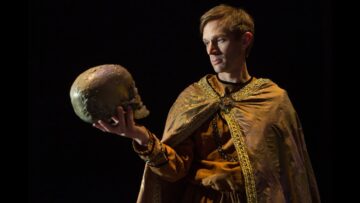 Something about Hamlet makes us want to love him, some mysterious quality of his being. I was maybe 15 or 16 when I first met the Prince and sitting next to Boots Schneider at the Olivier movie which had just opened in New York. Yet Hamlet held my attention even more than her hand because somehow he was saying things I had always wanted to say, but not only did I not know how to say them, up to that moment I didn’t know I wanted to say them. What I wanted to say had something to do with authority, something to do with those large figures who hold in their hands the powers of the world, something to do with the joy of saying to Polonius “Excellent well, you are a fishmonger,” and some kind of recognition of Hamlet’s deep sense of betrayal. This is the Prince’s dominant emotion, the feeling that lacerates his being, and his perception of the world is accurate; he has been betrayed.