
| ABOUT US | ARCHIVES | LINKS | RSS FEED | MONDAYS | |

3quarksdaily

An Eclectic Digest of Science, Art and Literature

« A Profile of Sonali Deraniyagala | Main | Slapping Cabbages »

March 10, 2013

Slaves of Defunct Economists

1303-farrell_bk_article

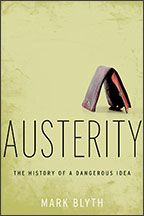
Our friend Mark Blyth's new book Austerity: The History of a Dangerous Idea is to be released soon. Henry Farrell has a review over at Washington Monthly.

On January 25, the British statistics office announced that the United Kingdom’s economy had shrunk by 0.3 percent in the last quarter of 2012. After enduring two recessions in the last four years, Britain is now well on its way into a third. The pain has been compounded by a succession of austerity budgets, in which Britain’s Conservative-led government has tried to hack away at spending. Repeated rounds of cuts have battered the British economy. However, Britain’s chief economic policymaker, Chancellor of the Exchequer George Osborne, wants still more pain. He is pushing the government to identify £10 billion more in cuts this year.

This makes no economic sense. Olivier Blanchard, chief economist at the International Monetary Fund, has pleaded for Britain to start focusing on growth rather than fiscal virtue, claiming that “we’ve never been passionate about austerity.” It doesn’t make any political sense, either. Voters like vague proposals for “reducing government waste” in the abstract, but hate cuts to programs that they care about. Why do so many members of the political elite disagree with Blanchard in their visceral passion for austerity? Why do they keep on pushing for pain when it threatens economic ruin and hurts their election chances?

Mark Blyth’s new book, Austerity: The History of a Dangerous Idea, gives us some important clues. Many books have been published in the last few years explaining why some economic ideas (the efficient markets hypothesis; the Black-Scholes option pricing model) are dangerous. Blyth, a professor of international political economy at Brown University (and a friend of mine), explains why a blind fixation on austerity is one of these terrible ideas. However, his book does two additional things that other books in this genre do not. First, it asks why bad economic ideas, like austerity, have such powerful consequences. Economists themselves do not think that ideas are powerful, and their models usually assume that people are motivated by straightforward self-interest rather than complicated notions. Second, it asks why these ideas keep on coming back. Every time governments have experimented with austerity, it has led to disaster, and yet a couple of decades later, their successors try again, with equally dismal consequences.

Posted by Robin Varghese at 08:32 PM | Permalink

Comments

"why these ideas keep coming back....with the same dismal consequences". I thought that was one of the definitions of insanity?
But the converse to austerity is stimulation, growth!
But isn't that idea a dismal failure too in the long term. Finite resources (living space, food production, population growth, climate change) can't support indefinite growth, or so the left wing tells us?
Sounds like we're between a rock and a hard place!
No wonder it's called the dismal science!

Posted by: Stuart Mathieson | Mar 11, 2013 4:03:37 AM

Post a comment


Subscribe to this blog's feed  

PayAnywhere with iphone credit card swiper

Android Tablet

Bluetooth Headset

2013 New Style Dresses

Compare Car Rental Prices

DHgate.com Wholesale

3QD on Facebook

3QD on Kindle

3QD by Daily Email

Receive all blogposts at the same time every day.

Enter your Email:


Preview 3QD Email

3QD on Twitter

Miscellany

Lijit Search

AddThis Social Bookmark Button

Add to Google

Recent Comments

Scrutineer on Why race as a biological construct matters

prasad on the culture animal

Mitt Romney's Dog on Why race as a biological construct matters

Elatia Harris on The Moral Status of Rocks

prasad on The Moral Status of Rocks

Raza Husain on The Moral Status of Rocks

Fred on Unknown Mathematician Proves Elusive Property of Prime Numbers

Joel Grant on Why Rational People Buy Into Conspiracy Theories

Tomboktu on Why is Europe so Messed Up? An Illuminating History

Joe on Why Rational People Buy Into Conspiracy Theories

Jalees Rehman on The Science Mystique

Dredd on The Moral Status of Rocks

sjg on Why Rational People Buy Into Conspiracy Theories

Dredd on Why Rational People Buy Into Conspiracy Theories

Ken Pidcock on The need for critical science journalism

Louise Gordon on Why race as a biological construct matters

Louise Gordon on The stories of two Palestinian villages: From Al-Araqib to Susiya

musafir on a pretty funny book

freddie on The stories of two Palestinian villages: From Al-Araqib to Susiya

freddie on The stories of two Palestinian villages: From Al-Araqib to Susiya

Junaida on Tuesday Poem

rafiq on Tuesday Poem

Raza Husain on the culture animal

Nebor on Tuesday Poem

Eleutheria on I am dust and ashes and full of sin

Acclaim For 3QD


"I couldn't tear myself away from 3 Quarks Daily, to the point of neglecting my work. Congratulations on this superb site."—Steven Pinker, Johnstone Professor of Psychology, Harvard University.

"I have placed 3 Quarks Daily at the head of my list of web bookmarks."—Richard Dawkins, Charles Simonyi Professor of the Public Understanding of Science at Oxford University.

"Just wanted you to know I’m one of many who reads and enjoys 3 Quarks....almost daily."—David Byrne, musician, former lead-singer of the Talking Heads, artist, intellectual.

Read more here.

The 3QD Prizes

Subscribe to this blog's feed