
| ABOUT US | ARCHIVES | LINKS | RSS FEED | MONDAYS | |

3quarksdaily

An Eclectic Digest of Science, Art and Literature

« Wealth Inequality in America | Main | eclectic inventories of consciousness »

March 06, 2013

Reviewed: The God Argument by A C Grayling

Bryan Appleyard in the New Statesman:
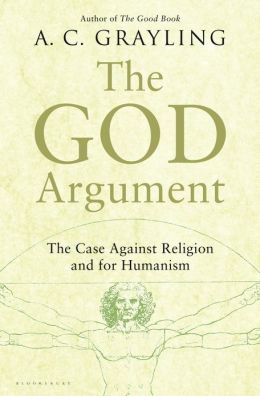
9781620401903_p0_v2_s260x420The book is in two halves – the first is Grayling’s case against religion; the second outlines the humanist alternative, which is “an ethics free from religious or superstitious aspects, an outlook that has its roots in rich philosophical traditions”.

First, to take the book on its own terms, this is a lucid, informative and admirably accessible account of the atheist-secular- humanist position. Grayling writes with pace and purpose and provides powerful – though non-lethal – ammunition for anybody wishing to shoot down intelligent theists such as Alvin Plantinga or to dispatch even the most sophisticated theological arguments, such as the ontological proof of the existence of God. That said, the first half, which is in essence analytical, is much better than the second half, which is rather discursive and feels almost tract-like in its evocation of shiny, happy people having fun in a humanist paradise. Nevertheless, this is rhetorically justifiable to the extent that it is an attempt to answer the question necessarily posed by any attempt to eliminate religion – what would be put in its place? Even the most rabid followers of the horsemen cannot seriously deny that religion does serve some useful purposes: providing a sense of community, consoling the bereaved and the suffering, telling a story to make sense of the world, and so on. Grayling tells a humanist story in the belief that it is perfectly capable of answering all these needs.

More here.

Posted by S. Abbas Raza at 07:13 AM | Permalink

Comments

Oh boy. Here we go again with the "nobody can live without religion; they're only pretending" and "once Voltaire and Kant, etc., launched the Enlightenment, Stalin and Mao were inevitable" and "Western humanism is only a very small group of nutters -- it means nothing to the vast majority of people" and "religion offers a vast store of insights into humanity, so atheists don't know beans about human beings" and on and on. All this kind of thing (which is obviously not original with Appleyard -- he copied it from many other writers) says is, "Atheism makes me throw up like kim chee; why would anyone eat that awful stuff?"

And the Sermon on the Mount teaches all kinds of profound stuff about the human condition? Please.

Posted by: JonJ | Mar 6, 2013 8:44:56 PM

Why is it that any article which finds faults with atheistic humanism results in over-the-top criticism?
Personally for me, both religion and humanism have reality and meaning. Anytime anyone in the atheistic or fundamentalist religious worlds begins to lambast the legitimacy of the other's beliefs, I tune out. It seems wrong to me, on several counts that if any theory must demand the the annihilation of the other position, it is generally questionable, especialy in a democratic society.

Posted by: Richard H. Randall | Mar 7, 2013 11:52:48 AM

"Even the most rabid followers of the horsemen cannot seriously deny that religion does serve some useful purposes: providing a sense of community, consoling the bereaved and the suffering, telling a story to make sense of the world, and so on."

Those are all very nice, but (though Ranning will trot out his Paul paper) multiple surveys indicate greater health, happiness, longevity, charity, and compassion, and lower levels of suicide, addiction, and whatnot, among the believers. These are more tangible than mere consolation, and all Secular Humanism needs to do is better, or at least as well, as a first step anyway. An unanswerable, and never asked, question is how Secular Humanism might do if there was nobody egging them on by setting a better example. Not very well, I suspect, no matter how well intentioned. The incentives are, oh I don't know...gormless?

Posted by: carlos | Mar 7, 2013 5:28:04 PM

What was Christ's or Buddha's religion? did they follow scriptures or priests?
And aren't we supposed to follow their example. I certainly try to - avoiding religious nutters in the process.

Posted by: Popelessly Devoted | Mar 7, 2013 11:14:51 PM

@Carlos
I'd be prepared to wager that those 'multiple surveys' also prove that the level of contentedness provided by religious belief is irrespective of which particular faith the person belongs to. If you are going to cite contentedness as proof of the truth of your religion, you are going to have to admit that all religions are equally true, but I doubt that you honestly can do that. If this is the case, then you have to admit then that the truth is not important, only the contentedness.

Posted by: Popelessly Devoted | Mar 7, 2013 11:26:13 PM

Agreed, Popeless, and I would presume health, recovery rates, and longevity are also among the positive benefits of a faithful life, regardless of the specifics. I haven't read the book yet, but I am assuming that Grayling is promoting the advantages Humanism offers over all religions, not just mine.

As far as charity though, Christianity wins hands down. It's a high bar for humanism to strive for.

Posted by: carlos | Mar 8, 2013 8:37:26 AM

@Carlos
You are right in saying that charity is a fundamental part of Christianity. It is interesting to note however, that according to the Organization for Economic Cooperation and Development, which defined charitable as the percentage of gross national income that a country collectively donates to charity, the top ten most generous nations in the world are also the amongst the least religious. Sweden is a good example, it's the most charitable country in the world, and is also the second least religious. Only about 15% of the population considers themselves religious, and the charitableness is growing with the loss of religiosity.
Secular aid organisations, actually work to address the underlying causes of poverty, whereas religious ones often encourage the causes eg by endorsing corrupt regimes and discouraging birth control.
Albert Einstein said, “if people are good only because they fear punishment and hope for reward, then we are a sorry lot indeed.” Let us refrain from looking to the supernatural to motivate our goodness, and instead, find the compassion within ourselves to help our fellow humans merely for the purpose of helping them. Much of the world is already doing it.

Posted by: Popelessly Devoted | Mar 8, 2013 9:06:47 AM

Post a comment


Subscribe to this blog's feed  

PayAnywhere with iphone credit card swiper

Android Tablet

Bluetooth Headset

2013 New Style Dresses

Compare Car Rental Prices

DHgate.com Wholesale

3QD on Facebook

3QD on Kindle

3QD by Daily Email

Receive all blogposts at the same time every day.

Enter your Email:


Preview 3QD Email

3QD on Twitter

Miscellany

Lijit Search

AddThis Social Bookmark Button

Add to Google

Recent Comments

Lusine on Syria: Inventing a Religious War

over here on The Nominees for the 2010 3QD Prize in Science Are:

Raza Husain on Syria: Inventing a Religious War

j_93 on Why Steven Pinker Is Wrong

martina_j on Syria: Inventing a Religious War

Raza Husain on Why Steven Pinker Is Wrong

Bill on Why Steven Pinker Is Wrong

roger gathmann on Why Steven Pinker Is Wrong

Doogle on Why Steven Pinker Is Wrong

Kyle on Syria: Inventing a Religious War

Peter John on Gezi Park

dthoko on The History of Typography - Animated Short

Richard on John Gray’s Godless Mysticism

Abbas Raza on Why Steven Pinker Is Wrong

nogodrod on Syria: Inventing a Religious War

Lusine on Quest for 'Genius Babies'?

Bill on Syria: Inventing a Religious War

j_93 on Gezi Park

j_93 on Syria: Inventing a Religious War

Norman Costa on The Insanity Virus

Dave Ranning on Political Ideology and the Avoidance of Dissonance-Arousing Situations

Sundar on Quest for 'Genius Babies'?

Sundar on Syria: Inventing a Religious War

gaddeswarup on What is ‘smart’ and how does it fit our consciousness?

gaddeswarup on What is ‘smart’ and how does it fit our consciousness?

Acclaim For 3QD


"I couldn't tear myself away from 3 Quarks Daily, to the point of neglecting my work. Congratulations on this superb site."—Steven Pinker, Johnstone Professor of Psychology, Harvard University.

"I have placed 3 Quarks Daily at the head of my list of web bookmarks."—Richard Dawkins, Charles Simonyi Professor of the Public Understanding of Science at Oxford University.

"Just wanted you to know I’m one of many who reads and enjoys 3 Quarks....almost daily."—David Byrne, musician, former lead-singer of the Talking Heads, artist, intellectual.

Read more here.

The 3QD Prizes

Subscribe to this blog's feed