From APS:
 We say that time flies, it marches on, it flows like a river — our descriptions of time are closely linked to our experiences of moving through space. Now, new research suggests that the illusions that influence how we perceive movement through space also influence our perception of time. The findings provide evidence that our experiences of space and time have even more in common than previously thought. The research, conducted by psychological scientist Eugene Caruso of the University of Chicago Booth School of Business and colleagues, is published in Psychological Science, a journal of the Association for Psychological Science. “It seemed to us that psychological scientists have neglected the important fact that, in everyday experience, people don’t evaluate the past and the future in exactly the same way,” says Caruso. From research on spatial perception, we know that people feel closer to objects they are moving toward than those they are moving away from, even if the objects are exactly the same distance away. Because our perceptions of time are grounded in our experiences of space, Caruso and his colleagues hypothesized that the same illusion should influence how we experience time, resulting in what they call a temporal Doppler effect.
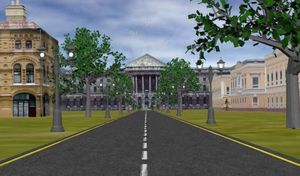
Surveying college students and commuters at a train station, the researchers found that people perceived times in the future (i.e., one month and one year from now) as closer to the present than equidistant times in the past (i.e., one month and one year ago). Similarly, participants who completed an online survey one week before Valentine’s Day felt that the holiday was closer to the present than those who were surveyed a week after Valentine’s Day. These findings hint at the relationship between movement in space and perceptions of time; to establish a direct link between the two, the researchers conducted a fourth study using a virtual reality environment.
More here.
