
| ABOUT US | ARCHIVES | LINKS | RSS FEED | MONDAYS | |

3quarksdaily

An Eclectic Digest of Science, Art and Literature

« Single Servings | Main | ON THE ENLIGHTENMENT’S ‘RACE PROBLEM’ »

February 13, 2013

Your Point Is?...If the universe cares about us, it has a funny way of showing it

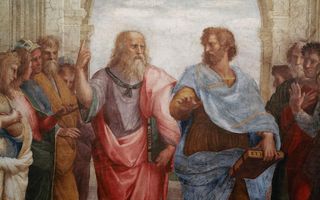
Plato-and-Aristotle

Steven Poole in Aeon:

It was an idea long consigned to the dustbin of scientific history. ‘Like a virgin consecrated to God,’ Francis Bacon declared nearly 400 years ago, it ‘produces nothing’. It was anti-rational nonsense, the last resort of unfashionable idealists and religious agitators. And then, late last year, one of the world’s most renowned philosophers published a book arguing that we should take it seriously after all. Biologists and philosophers lined up to give the malefactor a kicking. His ideas were ‘outdated’, complained some. Another wrote: ‘I regret the appearance of this book.’ Steven Pinker sneered at ‘the shoddy reasoning of a once-great thinker’. TheGuardian called it ‘the most despised science book of 2012’. So what made everyone so angry?

The thinker was Thomas Nagel, the book was Mind and Cosmos, and the idea was teleology. In ancient science (or, as it used to be called, natural philosophy), teleology held that things — in particular, living things — had a natural end, or telos, at which they aimed. The acorn, Aristotle said, sprouted and grew into a seedling because its purpose was to become a mighty oak. Sometimes, teleology seemed to imply an intention to pursue such an end, if not in the organism then in the mind of a creator. It could also be taken to imply an uncomfortable idea of reverse causation, with the telos — or ‘final cause’ — acting backwards in time to affect earlier events. For such reasons, teleology was ceremonially disowned at the birth of modern experimental science.

The extraordinary success since then of non-teleological scientific thinking and its commitment to forwards-only  ‘mechanistic causation’ would seem to support Bacon’s denunciation of teleology. But it continued to bubble under the surface as a live problem for some, particularly regarding descriptions of life. Immanuel Kant wrote that, when observing a living being, we couldn’t help thinking in teleological terms, and to do so was justified for its scientific usefulness. Even so, he concluded, an ultimately teleological explanation was unauthorised, since we could never know whether it was true or not. Friedrich Engels hailed the publication in 1859 of Darwin’s Origin of Species as the final nail in the coffin for teleology; yet one of Darwin’s admirers felt able to read it nonetheless as confirming a teleological view of life’s development, a position that Darwin himself (mostly) rejected.

Posted by Robin Varghese at 03:26 PM | Permalink

Comments

"acting backwards in time"
Assumes time actually exists; a rather naive assumption.

Posted by: Georg | Feb 14, 2013 1:49:27 AM

Try getting anything done without it.

Posted by: carlos | Feb 14, 2013 9:44:06 AM

Carlos, "getting anything done" implies a 'doer' who acts. There is no scientific evidence that doers exist. There is only evidence for processes taking place. I am guessing you mean that the doer is a 'soul'. What evidence can you present for the existence of a soul? If there is a doer, it is the entire universe.

Posted by: Georg | Feb 17, 2013 4:53:16 AM

Post a comment


Subscribe to this blog's feed  

PayAnywhere with iphone credit card swiper

Android Tablet

Bluetooth Headset

2013 New Style Dresses

Compare Car Rental Prices

DHgate.com Wholesale

3QD on Facebook

3QD on Kindle

3QD by Daily Email

Receive all blogposts at the same time every day.

Enter your Email:


Preview 3QD Email

3QD on Twitter

Miscellany

Lijit Search

AddThis Social Bookmark Button

Add to Google

Recent Comments

LWR on POETRY IN TRANSLATION: CORDOBA

Rashid on Aftermath: Pakistan Elections 2013

Yoann on The Bystander Effect in Medical Care. Why Do I Have So Many Doctors Not Taking Care of Me?

Dave Ranning on Aftermath: Pakistan Elections 2013

sadhana on Aftermath: Pakistan Elections 2013

Carol Westbrook on The Bystander Effect in Medical Care. Why Do I Have So Many Doctors Not Taking Care of Me?

Ken Bryant on Aftermath: Pakistan Elections 2013

Umer Vakil on POETRY IN TRANSLATION: CORDOBA

Kabir on Aftermath: Pakistan Elections 2013

Nina on White Indians

Nina on White Indians

Dave Ranning on If Only We Had A Leader Like Chavez, Who Solved Real Problems -- Instead Of Debating Fake Ones Like The Deficit

Mohammed Hassanali on Aftermath: Pakistan Elections 2013

musafir on Aftermath: Pakistan Elections 2013

Maniza on Aftermath: Pakistan Elections 2013

Ellen Perry on The Bystander Effect in Medical Care. Why Do I Have So Many Doctors Not Taking Care of Me?

waqnis on The Bystander Effect in Medical Care. Why Do I Have So Many Doctors Not Taking Care of Me?

Norman Costa on The Bystander Effect in Medical Care. Why Do I Have So Many Doctors Not Taking Care of Me?

Hannah Carlton on POETRY IN TRANSLATION: CORDOBA

Joe on Digging Up Bones or, The Labyrinths beneath Our Feet

JonJ on The Beautiful German Language

cpfaff on Passionate About The Actor's Art: an interview with Michael Howard

Sumiran on Sunday Poem

Ethan on Getting Smarter

Pacificklaus on NORTH KOREA’S NERVE WAR

Acclaim For 3QD


"I couldn't tear myself away from 3 Quarks Daily, to the point of neglecting my work. Congratulations on this superb site."—Steven Pinker, Johnstone Professor of Psychology, Harvard University.

"I have placed 3 Quarks Daily at the head of my list of web bookmarks."—Richard Dawkins, Charles Simonyi Professor of the Public Understanding of Science at Oxford University.

"Just wanted you to know I’m one of many who reads and enjoys 3 Quarks....almost daily."—David Byrne, musician, former lead-singer of the Talking Heads, artist, intellectual.

Read more here.

The 3QD Prizes

Subscribe to this blog's feed