| ABOUT US | ARCHIVES | LINKS | RSS FEED | MONDAYS | |

3quarksdaily

An Eclectic Digest of Science, Art and Literature

« Space-based solar farms power up | Main | Muzaffar Al-Nawwab: In the Old Tavern »

February 28, 2013

Why average novels are fodder for good movies but great books fail on screen

Madhavankutty Pillai in Open:
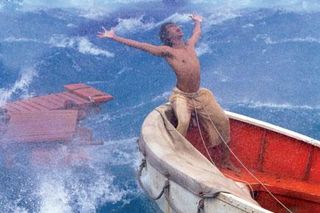
11141.angle-piA novel’s quality often does not matter to its movie adaptation because cinema works at the surface level—there is no sophisticated way to depict thought as thought. You can have a voiceover in the background or enactment of emotion or, like the Bollywood shortcut of the 60s and 70s, a reflection in the mirror telling the character what he is thinking. There is always another agency needed to show thought. And absence of thought makes characters shallow. Daniel Day-Lewis is one of the finest actors today and his portrayal of Lincolnis masterful, but it will always be incomplete because the viewer will never know what he is thinking.

A good movie can be made of an ordinary book as long as there are strong plot points or a grand theme or potential for spectacle. In Life of Pi, Ang Lee’s visual grandeur compensates for the book’s clumsiness. Ironically, the reverse is also true—great novels are often not fodder for great cinema. There have been many movie versions ofCrime and Punishment, but who remembers any of them? It is a work that hinges on inner monologue, which cinema cannot depict. Remove that and you have just the skin without the soul.

More here.

Posted by S. Abbas Raza at 11:02 AM | Permalink

Comments

Except for Pride and Prejudice of course.

Posted by: Luke Lea | Feb 28, 2013 11:09:05 AM

You can make a great movie out of a great play, Shakepeare's, for example, because the play is a theatrical device. The richness of a great novel cannot be conveyed by a theatrical device, which is why it is a novel and not a play or a movie. It's a bit like trying to translate poetry into another language. Never really works.

Posted by: Ted | Feb 28, 2013 12:00:57 PM

"There have been many movie versions ofCrime and Punishment, but who remembers any of them? "

Bresson's Pickpocket.

Posted by: Robin | Feb 28, 2013 12:26:47 PM

Philistine I may be but I enjoyed both the book and the movie. Eight years ago I forced myself to plow through the opening chapters and saw it more as a monumental piece of craftsmanship than any great piece of literature. In a day when the world goes batty over sudoku and Twitter, oohing and ahing over Rap lyrics, that level of creativity is like Rodin to a community ceramics club.

I surely never expected it to be a movie but Mr. Lee's taste may be pedestrian as well. Somebody felt the need to put a dollop of romance in the film that I don't recall from the book which annoyed me a little, but I decided it was added for tastes even more simple than mine.

Posted by: John Ballard | Feb 28, 2013 4:45:32 PM

Did most people misunderstand the book? I remember having the impression that the animal representations were a means used by the protagonist to cope psychologically with the horrible ordeal of being marooned in a boat with a murderer (I read it about 6 or 7 years ago, so I don't remember details).

I suspect Indians dislike the book mostly for reasons totally unrelated to this, namely, that its representation of their country and its customs wasn't convincing enough. Nevertheless, it seemed to me like a pretty good, solid novel. Perhaps not a masterpiece, but all being considered a worthy effort.

I have seen a few movies by Ang Lee (The Wedding Banquet, The Ice Storm, Brokeback Mountain and Crouching Tiger, Hidden Dragon). I liked them enough, but I'm not exactly a fan. I think the praise lavished on him has been exaggerated, but to each their own.

Posted by: Pepito | Feb 28, 2013 5:13:59 PM

Agree with John Ballard's comment above. The book was a monumental piece of craftsmanship. The same can be said about 'Cloud Atlas', (the novel, not the film). The movie version of 'Cloud Atlas' was terrible.

Posted by: Pepito | Feb 28, 2013 5:20:22 PM

"Ang Lee’s visual grandeur compensates for the book’s clumsiness"

What the...!! Did we read the same book? Clumsiness wasn't what went through my mind after reading the book. I agree with what Pepito says above.

Posted by: ganji | Feb 28, 2013 8:17:20 PM

I have neither read nor screened Life of Pi

"… there is no sophisticated way to depict thought as thought. …There is always another agency needed to show thought."

Frankly I'm baffled at this statement, and that it would be taken seriously here on 3quarksdaily. Picasso and Brackhage are the first two names that flash to mind, but they are followed by an avalanche of others.

However, one suspects that Madhavankutty Pillai has a much more prosaic idea of what thought is, and how it might be "depicted".

"And absence of thought makes characters shallow. Daniel Day-Lewis is one of the finest actors today and his portrayal of Lincoln is masterful, but it will always be incomplete because the viewer will never know what he is thinking."

I'm flummoxed by this. Characters are incomplete if we don't know what they're thinking? And this makes for poor cinema? I sense the man has never seen a Bresson film (mentioned above).

I think he needs to see more film, and think more about art, if he's going to write about it.

Posted by: Terrible | Feb 28, 2013 9:45:23 PM

The Godfather is the best example of a second rate (if popular) novel being made into a cinematic masterpiece.

Posted by: Eric | Feb 28, 2013 9:56:44 PM

This is why I was skeptical about turning Midnight's Children into a movie. I have heard it is quite terrible.

As for Indian viewers / readers being unimpressed by exoticized masala films / books, that is generally true. For example, I thought Slumdog Millionaire was a dog - saw the movie, never read the book. But I don't think Life of Pi (read the book, not seen the movie) falls in the category of an "Indian" story, Pi's origins notwithstanding.

I once wrote a blog post in which I attempted to describe several books in five words each. Life of Pi was among the selection. Note what I, an Indian, said about the book and what my America co-blogger Anna thought of it.

Posted by: Ruchira | Feb 28, 2013 10:03:37 PM

I agree with Pepito.
Books that explain their own metaphors are cheesy, but accusing Martel of this is a bit superficial. The protagonist of Life of Pi does explain that the animals are almost certainly figments of his imagination generated to help him through the trauma of losing his family. I think it's fair enough to have the protagonist explain to the narrator character that this is his conclusion. The thing is that there are metaphors upon metaphors in Pi, and they are only partly explained to get the reader to look deeper. The explanations raise more questions than they answer.
In one metaphor, the tiger represents God, in another, Pi himself is the tiger, and is therefore God. It's still up to the reader to decide how they will interpret the allegorical content.
The book and the film, if not masterpieces, are both good in different ways.

Posted by: Georg | Mar 1, 2013 12:56:01 AM

When you transcript from a form of art to another, you need to reduce the original artwork (here a book) to a script of ideas, to a grain from where the new will grow in other form (here a movie). When the original is too perfect (a great book) there is a certain fear from the creator part not to loose in this transition the ineffable, the genius, the miracle...
Even in my creations of sculpture when I'm working on assemblages where founded objects are used to create something, an artifact that is "too" beautiful can't be used; it has a presence and a life of himself, that is refusing the quality of transforming him in something else.
"Music, states of happiness, mythology, faces belabored by time, certain twilights and certain places try to tell us something, or have said something we should not have missed, or are about to say something; this imminence of a revelation which does not occur is, perhaps, the aesthetic phenomenon."
-- Essay: "The Wall and the Books" Borges

Posted by: mirel | Mar 1, 2013 2:01:16 AM

mirel,

Exactly right. A bad novel is already, in a sense, "reduced to a script of ideas" and may therefore good material for a film. A great novel is great because it is much more than a script of ideas and cannot be changed without diminishment.

Posted by: Ted | Mar 1, 2013 9:57:50 AM

Post a comment


Subscribe to this blog's feed  

PayAnywhere with iphone credit card swiper

Android Tablet

Bluetooth Headset

2013 New Style Dresses

Compare Car Rental Prices

DHgate.com Wholesale

3QD on Facebook

3QD on Kindle

3QD by Daily Email

Receive all blogposts at the same time every day.

Enter your Email:


Preview 3QD Email

3QD on Twitter

Miscellany

Lijit Search

AddThis Social Bookmark Button

Add to Google

Recent Comments

Dana on germ houses

musafir on Tuesday Poem

soubriquet on Tuesday Poem

Eli on Unknown Mathematician Proves Elusive Property of Prime Numbers

Jim on Tuesday Poem

Josef Stern on Unknown Mathematician Proves Elusive Property of Prime Numbers

Shelley on Is the Brain No Different From a Light Switch? The Uncomfortable Ideas of the Philosopher Daniel Dennett

Bill on The Beautiful German Language

Eleutheria on The Bystander Effect in Medical Care. Why Do I Have So Many Doctors Not Taking Care of Me?

Eleutheria on Tuesday Poem

Raza Husain on the culture animal

musafir on The Bystander Effect in Medical Care. Why Do I Have So Many Doctors Not Taking Care of Me?

KRS on Tuesday Poem

Félix E. F. Larocca, MD on Tuesday Poem

LWR on Tuesday Poem

Joss on Tuesday Poem

LWR on POETRY IN TRANSLATION: CORDOBA

Rashid on Aftermath: Pakistan Elections 2013

Yoann on The Bystander Effect in Medical Care. Why Do I Have So Many Doctors Not Taking Care of Me?

Dave Ranning on Aftermath: Pakistan Elections 2013

sadhana on Aftermath: Pakistan Elections 2013

Carol Westbrook on The Bystander Effect in Medical Care. Why Do I Have So Many Doctors Not Taking Care of Me?

Ken Bryant on Aftermath: Pakistan Elections 2013

Umer Vakil on POETRY IN TRANSLATION: CORDOBA

Kabir on Aftermath: Pakistan Elections 2013

Acclaim For 3QD


"I couldn't tear myself away from 3 Quarks Daily, to the point of neglecting my work. Congratulations on this superb site."—Steven Pinker, Johnstone Professor of Psychology, Harvard University.

"I have placed 3 Quarks Daily at the head of my list of web bookmarks."—Richard Dawkins, Charles Simonyi Professor of the Public Understanding of Science at Oxford University.

"Just wanted you to know I’m one of many who reads and enjoys 3 Quarks....almost daily."—David Byrne, musician, former lead-singer of the Talking Heads, artist, intellectual.

Read more here.

The 3QD Prizes

Subscribe to this blog's feed