
| ABOUT US | ARCHIVES | LINKS | RSS FEED | MONDAYS | |

3quarksdaily

An Eclectic Digest of Science, Art and Literature

« 'Kill Anything That Moves' | Main | Never on a Saturday »

February 10, 2013

What Galileo saw

Adam Gopnik in The New Yorker:
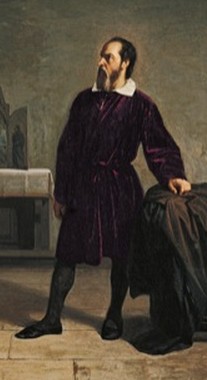
ScreenHunter_97 Feb. 10 18.36Although Galileo and Shakespeare were both born in 1564, just coming up on a shared four-hundred-and-fiftieth birthday, Shakespeare never wrote a play about his contemporary. (Wise man that he was, Shakespeare never wrote a play about anyone who was alive to protest.) The founder of modern science had to wait three hundred years, but when he got his play it was a good one: Bertolt Brecht’s “Galileo,” which is the most Shakespearean of modern history plays, the most vivid and densely ambivalent. It was produced with Charles Laughton in 1947, during Brecht’s Hollywood exile, and Brecht’s image of the scientist as a worldly sensualist and ironist is hard to beat, or forget. Brecht’s Galileo steals the idea for the telescope from the Dutch, flatters the Medici into giving him a sinecure, creates two new sciences from sheer smarts and gumption—and then, threatened by the Church with torture for holding the wrong views on man’s place in the universe, he collapses, recants, and lives on in a twilight of shame.

It might be said that Brecht, who truckled to the House Un-American Activities Committee—“My activities . . . have always been purely literary activities of a strictly independent nature”—and then spent the next bit of his own life, post-Hollywood, accessorized to the Stalinist government of East Germany, was the last man in the world to be pointing a finger at someone for selling out honesty for comfort. But then the last man who ought to point that finger is always the one who does. Galileo’s shame, or apostasy, certainly shapes the origin myth of modern science, giving it not a martyr-hero but a turncoat, albeit one of genius. “Unhappy is the land that breeds no heroes,” his former apprentice says at the play’s climax to the master who has betrayed the Copernican faith. “No,” Galileo replies, “unhappy is the land that needs a hero.” It is a bitter valediction for the birth of the new learning. The myth that, once condemned, he muttered under his breath, about the earth, “But still, it moves,” provides small comfort for the persecuted, and is not one that Brecht adopted.

More here.

Posted by S. Abbas Raza at 12:36 PM | Permalink

Comments

Post a comment


Subscribe to this blog's feed  

PayAnywhere with iphone credit card swiper

Android Tablet

Bluetooth Headset

2013 New Style Dresses

Compare Car Rental Prices

DHgate.com Wholesale

3QD on Facebook

3QD on Kindle

3QD by Daily Email

Receive all blogposts at the same time every day.

Enter your Email:


Preview 3QD Email

3QD on Twitter

Miscellany

Lijit Search

AddThis Social Bookmark Button

Add to Google

Recent Comments

Matt on The Science Mystique

Eleutheria on Why is Europe so Messed Up? An Illuminating History

Elatia Harris on I am dust and ashes and full of sin

PeteChapman on I am dust and ashes and full of sin

Raza Husain on the culture animal

Chris on Positive Failure - a review of "The Power" by Rhonda Byrne

DAS on Why is Europe so Messed Up? An Illuminating History

DAS on Is the Brain No Different From a Light Switch? The Uncomfortable Ideas of the Philosopher Daniel Dennett

DAS on the culture animal

Raza Husain on Unknown Mathematician Proves Elusive Property of Prime Numbers

Dredd on NORTH KOREA’S NERVE WAR

Dredd on Unknown Mathematician Proves Elusive Property of Prime Numbers

Raza Husain on Is the Brain No Different From a Light Switch? The Uncomfortable Ideas of the Philosopher Daniel Dennett

Dana on germ houses

musafir on Tuesday Poem

soubriquet on Tuesday Poem

Eli on Unknown Mathematician Proves Elusive Property of Prime Numbers

Jim on Tuesday Poem

Josef Stern on Unknown Mathematician Proves Elusive Property of Prime Numbers

Shelley on Is the Brain No Different From a Light Switch? The Uncomfortable Ideas of the Philosopher Daniel Dennett

Bill on The Beautiful German Language

Eleutheria on The Bystander Effect in Medical Care. Why Do I Have So Many Doctors Not Taking Care of Me?

Eleutheria on Tuesday Poem

Raza Husain on the culture animal

musafir on The Bystander Effect in Medical Care. Why Do I Have So Many Doctors Not Taking Care of Me?

Acclaim For 3QD


"I couldn't tear myself away from 3 Quarks Daily, to the point of neglecting my work. Congratulations on this superb site."—Steven Pinker, Johnstone Professor of Psychology, Harvard University.

"I have placed 3 Quarks Daily at the head of my list of web bookmarks."—Richard Dawkins, Charles Simonyi Professor of the Public Understanding of Science at Oxford University.

"Just wanted you to know I’m one of many who reads and enjoys 3 Quarks....almost daily."—David Byrne, musician, former lead-singer of the Talking Heads, artist, intellectual.

Read more here.

The 3QD Prizes

Subscribe to this blog's feed