
February 26, 2013
Transcending Matter
Our own Morgan Meis in The Smart Set:
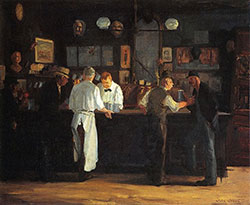
Human history is written from the perspective of the winners. But it is also the case that the winners are, more often than not, assholes. Looking back over the wreckage of past ages, losers can come off looking pretty good in comparison. The story of what-could-have-been sometimes beats the story of what-actually-was.
One scenario for meditations upon history's winners and losers took place in New York City, 1913 when a group of painters decided to put on a show at the Armory building. The idea behind the show was simple. One of the organizers, John Quinn, expressed it in his opening address, "The members of this association have shown you that American artists — young American artists, that is — do not dread, and have no need to dread, the ideas or the culture of Europe."
America was ready to confront the big boys (and a couple of girls) of European art. American art would no longer be perceived as the mostly provincial, second-order stuff of a colonial backwater. The Armory exhibit would display American artists like Oscar Bluemner, Patrick H. Bruce, James Earle Fraser, and Henry Twachtman alongside Cezanne, Redon, Gauguin, Van Gogh, Matisse, Picasso, Kandinsky, and Duchamp. Likewise, art enthusiasts in the U.S. would get their first glimpse of Continental art movements: Neo-Impressionism, Futurism, Fauvism, Abstraction, and Cubism.
Viewers of the exhibit were also going to see the newest creations of those American artists who had come to be known as The Ashcan School. Painters like William Glackens, Robert Henri, George Luks, Everett Shinn, and a young Edward Hopper.
More here.
Posted by S. Abbas Raza at 11:12 AM | Permalink


Comments
Enjoyed the first two sentences of your piece. Along the lines of the phenomenon of losers coming off looking pretty good: I recall a documentary about George McGovern in which the luminous Gloria Steinem serenely reflected that many members of the administration that humiliatingly defeated McGovern had subsequently done jail time; whereas all the veterans of the McGovern campaign are now happy and proud to run into one another.
Posted by: Shelley | Feb 26, 2013 1:09:32 PM
George Orwell, in terms of foreign policy, equated "the notion of winning" with the notion of bullying.
George Carlin equated it with the notion of who owns who.
Posted by: Dredd | Feb 26, 2013 2:37:53 PM
This is good essay, quite penetrating with regards to the artistic and human significance of what is being done in these paintings. That said, I found the material about art history's winners-and-losers perfunctory and unconvincing. The Ashcan School was a major influence on American painting for long after 1913, whereas European modernism continued to seem (literally and figuratively) alien for many decades — gaining full acceptance probably only after the second world war. And while the movement may seem "minor" as a movement — they were basically traditionalists as you say — the artists themselves are acknowledged as important.
Posted by: Arthur Whitman | Feb 26, 2013 7:09:12 PM
I am so sorry but three sentences in I yelled "Hitler" at my computer screen and laughed really hard. (There is a somewhat famous Sam Kinison incident where he is listing all of the things the USSR does worse than the United States when all of a sudden someone in the crowd yells "Sputnick!" and he pauses and goes, "Uh, yeah")
Ill finish the essay now. Didn't mean to interrupt.
Posted by: DrunktankDan | Feb 27, 2013 11:41:04 AM
Post a comment