
February 25, 2013
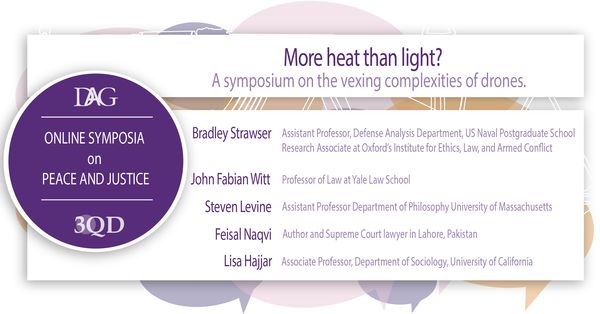
The Quarterly DAG-3QD Peace and Justice Symposium: Drones
Dear Reader,
We are very pleased to collaborate with the Amsterdam-based Dialogue Advisory Group (DAG) to bring to you quarterly online symposia on topics of international peace and justice. This is the third in this series of symposia; the first two can be seen here and here.
DAG is an organization which discreetly assists government, inter-government and other actors to confidentially manage national and international mediation efforts. Among their publicly known activities is DAG’s involvement in verifying the ETA ceasefire in Basque Country and the decommissioning of the weapons of INLA, a dissident Republican armed group in Northern Ireland.
DAG is directed by Ram Manikkalingam who also teaches politics at the University of Amsterdam. He advised the previous President of Sri Lanka during the peace process with the Tamil Tigers and prior to that advised the Rockefeller Foundation’s program in international peace and security.
In the DAG-3QD Peace and Justice Symposia internationally recognized figures will debate challenges in conflict resolution and human rights. One (or more) author(s) will present a thesis in the form of a short essay and then the others will present critiques of that point of view. Finally, the initial author(s) will also have an opportunity to present a rebuttal to the critiques.
The topic this time is the use of unmanned aerial vehicles, or drones, in situations of war and conflict.
The distinguished participants in this symposium:
- Bradley Jay Strawser is an assistant professor in the Defense Analysis Department at the US Naval Postgraduate School in Monterey, California, and a research associate at Oxford’s Institute for Ethics, Law, and Armed Conflict (ELAC) in Oxford, UK. He has written frequently about drones for the press, including for The Guardian and the New York Times. He also has a book forthcoming from Oxford University Press entitled Killing By Remote Control: The Ethics of an Unmanned Military. It is an edited volume on the ethical questions surrounding the employment of UAVs.
- John Fabian Witt is a professor of law at Yale Law School and the author of Lincoln’s Code: The Laws of War in American History (Free Press / Simon & Schuster, 2012).
- Steven Levine is an assistant professor of philosophy at the University of Massachussettes, Boston.
- Feisal H. Naqvi is a partner at the law firm Bhandari, Naqvi & Riaz and an advocate of the Supreme Court of Pakistan, as well as a columnist for The Express Tribune.
- Lisa Hajjar is an associate professor of sociology at the University of California at Santa Barbara. Her research and writing focus on the laws of war and conflict, human rights and torture. She is the author of Torture: A Sociology of Violence and Human Rights.
I would like to thank the participants as well as Ram Manikkalingam, Fleur Ravensbergen, Michelle Gehrig, and the indefatigable Amanda Beugeling of the Dialogue Advisory Group for working closely with me in organizing these symposia. The logo for the symposia has also been designed by Amanda Beugeling.
We look forward to your comments and feedback.
Yours,
S. Abbas Raza
NOTE: DAG and 3QD wish to acknowledge the generous contribution of the Nederlandse Organisatie voor Wetenschappelijk Onderzoek (NWO, the Dutch Organisation for Scientific Research) toward these symposia, as well as the support of our readers.
THE SYMPOSIUM
[Click the links below to read the essays.]
- More Heat Than Light: The Vexing Complexities of the Drone Debate by Bradley Jay Strawser
- On Adopting a Posture of Moral Neutrality by John Fabian Witt
- Drones Threaten Democratic Decision-Making by Steven Levine
- Even War Has Limits by Feisal H. Naqvi
- Is Targeted Killing War? by Lisa Hajjar
- Reply to Critics: No Easy Answers by Bradley Jay Strawser
***********************
***********
******
*
Please leave comments about any of the essays in the symposium in the comments area of this post. Thank you.
Posted by S. Abbas Raza at 12:35 AM | Permalink


Comments
Thank you.
Posted by: Dredd | Feb 25, 2013 8:29:23 AM
Couple of preliminary comments...
**Matt Taibbi's remarks, reflecting on a recent op-ed in Dawn are worth a look.
Welcome to the honor of American citizenship. Should we replace E Pluribus Unum with We Don't Kill as Many Children as Measles?
http://qote.me/bwjYXI
**Drones are also an everyday part of life in Gaza. And last year's targeted assassination of a Hamas commander was enabled by the use of drone surveillance.
**And as I scanned the first rejoinder to Strawser's opening essay it struck me that drones are the new trebuchets.
Posted by: John Ballard | Feb 25, 2013 11:13:12 AM
Are drones not interesting to peace activists? Why is there not an argument against killing anyone where drone attacks are but another example of this human stupidity?
Posted by: Grant Loewen Loewen | Feb 25, 2013 11:20:24 AM
Kudos to 3quarks for offering a balanced look at this issue.
Strawser's approach in particular highlights the complexity of the policy and ethical issues while concurrently avoiding the usual, tiring, partisan vitriol.
Posted by: Chris | Feb 25, 2013 11:34:43 AM
It's encouraging that the Obama Administration has subjected itself to the "imminence" test for each individual targeted. As Strawser notes, that test is the crux of the matter and is where the grey area is most apparent. It is therefore critical that each strike is subject to this kind of rigorous assessment and a proper process must be in place to conduct such an assessment.
Perhaps a less scrupulous administration might have argued that the declaration of war against terrorism met the requirements of Article 51 of the UN Charter in the classic sense and each action since then, including each drone strike, was simply a continuation of the state's right to self-defense under the Article 51.
Posted by: Sarah R. | Feb 25, 2013 1:24:19 PM
Deployment of drones is spreading, surveillance of civilian population is among others. But, currently, the primary use is as a weapon of war. Drones cost less and protect the operators of remote control system.
As to the operators and deaths of innocent civilians resulting from drone attacks, describing a drone attack that targeted a militant commander in Gaza, Peter Beaumont wrote in The Observer:
"What did bother me about that drone strike three years ago – about all drone strikes that cause civilian injuries and death – was the knowledge that, unlike a jet pilot or artilleryman firing a shell on to co-ordinates where he cannot see who is nearby, this aircraft's remote pilot must have been able to see the children who would be injured."
http://www.guardian.co.uk/commentisfree/2012/aug/19/peter-beaumont-drone-warfare-debate
Posted by: waqnis | Feb 25, 2013 2:25:12 PM
Rather than simply reacting to some small aspect of this complex topic as is so often seen, Strawser takes a step back and unpacks the morality of the subject.
His primary question, "Should those presently being attacked by drones be confronted at all?" is on the mark and often seems to be overlooked by many that participate in this debate.
With my thinking inspired by this central question, I wonder how the current opponents to drone warfare would feel if this was 1994 and drones were being used against Hutu Interhamwe militias to halt the Rwandan genocide.
Posted by: NFre | Feb 25, 2013 2:45:13 PM
Nfre -
Yes, something to think about.
We often zero in on a certain aspect that strikes a chord. This particular topic is one where an emotional position is hard to avoid.
Posted by: waqnis | Feb 25, 2013 3:56:13 PM
Golly, drones are wonderful, aren't they? Obama would never kill innocent civilians or children.
http://www.youtube.com/watch?v=msHJLwYWX30
Posted by: Louise Gordon | Feb 25, 2013 7:05:54 PM
I gathered together some responses to the release of the DOJ White Paper on Targeted Killing (although as the Israelis remind us, the use of drones is smaller in scope than the notion of 'targeted killing' as such ) and John Steele made them available at the Legal Ethics Forum: http://www.legalethicsforum.com/blog/2013/02/patrick-odonnells-resource-list-the-us-department-of-justice-white-paper-on-the-targeted-killing-of-.html
Interested readers should also consult Nils Melzer's Targeted Killings in International Law (Oxford University Press, 2008), and the volume edited by Claire Finkelstein, Jens David Ohlin, and Andrew Altman, Targeted Killings: Law and Morality in an Asymmetrical World (Oxford University Press, 2012).
Posted by: Patrick S. O'Donnell | Feb 26, 2013 1:25:50 AM
Whenever somebody agrees with the use of drones, they use weasel phrases like 'morally complex issue', 'balanced look', etc. A much more direct way of approaching this topic is to ask a simple question: if the situation were reversed, would those who agree with the use of drones and their consequences on the civilian population still defend it? If extremists existed in their midst (and they do, I actually can think of a couple of them in Miami who have committed what is clearly terrorist attacks against a foreign nation and are being protected by the US judicial system) would they support a drone attack on them on US soil by a foreign nation? Somehow I suspect that all the 'moral complexity' of the issue would suddenly disappear and give way to derision and outrage at the suggestion.
Posted by: Pepito | Feb 26, 2013 7:48:51 AM
Pepito -
Ultimately, we face the question "does the end justifies the means". No simple answer.
As to the anti-Castro former Cubans in Miami, the US has a history of supporting thugs in various countries. Adherence to the policy "My enemy's enemy is my friend" results in strange and abhorrent alliances.
Posted by: waqnis | Feb 26, 2013 10:46:14 AM
Proposed legislation:
http://www.chicagotribune.com/news/local/breaking/chi-state-lawmaker-proposes-law-to-regulate-drones-20130224,0,2501215.story
Posted by: Louise Gordon | Feb 26, 2013 6:00:19 PM
@Pepito - it seems like the word 'drone' can be excised from your comment without altering its sense.
Posted by: prasad | Feb 27, 2013 8:55:20 AM
"Adherence to the policy "My enemy's enemy is my friend" results in strange and abhorrent alliances."
Which is what you can also say about some of your perceived enemies. I don't see how this justifies us performing actions that we claim are barbaric and 'evil' when others do them.
"Ultimately, we face the question "does the end justifies the means". No simple answer."
I posit that the answer has a tendency to become very simple when the means might result in your own obliteration. See?
"Pepito - it seems like the word 'drone' can be excised from your comment without altering its sense."
Perhaps, but so what? My argument is not against drones per se (although I suspect that their use renders obsolete traditional military virtues bandied about like 'bravery') but against the kind of military intervention that always results in innocent deaths. It's easy to theorize about weapon accuracy and adopt a concerned tone while discussing ways of minimizing "collateral damage" when you are not in the receiving end of this violence.
Posted by: Pepito | Feb 27, 2013 12:22:43 PM
Post a comment