
by James McGirk
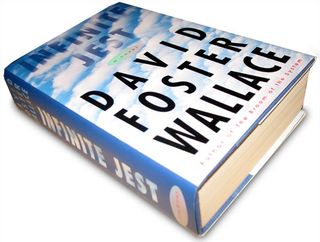
Fiction, on a crass, fundamental level, isn’t much more than a container for a story. Most stories have already been told (by William Shakespeare—or at least it feels that way), so the challenge of writing fiction is to find a new way to contain a story. This experimental impulse is tempered by a reader’s ability to decode what is going on. As readers have grown more accustomed to following hyperlinks and leaping about the Internet, their ability to understand information out of sequence has changed too.
Consider three popular, experimental novels and the technology of the era: David Foster Wallace’s (1996) Infinite Jest was written at the dawn of the Internet Age. The Internet was in an ugly growth spurt then. Amateurs created most online content. Big chunks of the Internet blossomed and died seemingly overnight. It was common to see gaping holes where content was no longer compatible. Following hyperlinks from page to page felt jarring (particularly given how slow most connections were). Wallace wanted to compress information in the Infinite Jest but he didn’t want to disrupt his timeline. So he chose endnotes to digress with—a fairly conventional device, although one not often used for fiction. He even said (to The New Yorker): “I pray they are nothing like hypertext.”
Endnotes are hypertext, however. They just happen to predate the Internet and, since they are numbered, romp alongside the text in a linear fashion (and nestle at the end of chapters, where they won’t distract readers). That’s not the case for the digressions in Dave Eggers’ A Heart Breaking Work of Staggering Genius (2000). Eggers digresses like Wallace does, but his digressions actually separate from the text, sometimes even forming self-contained documents.
It makes sense that Eggers was a magazine editor before he wrote the book. There’s almost a house style to A Heart Breaking Work. His asides could have been “front of the book” articles, accompanying and amplifying the main feature: Eggers’ story about raising his younger brother. The genius of A Heart Breaking Work is the way that Eggers bound it all together. Without that ever-so slightly smarmy voice, his story would have been unintelligible.
Ten years later, attitudes toward the virtual had changed considerably: Facebook, which didn’t exist when Eggers’ wrote A Heartbreaking Work, reached half a billion users, almost double the population of the United States. Office workers could no longer plead computer illiteracy. Jennifer Egan dropped an entire PowerPoint presentation into her (2010) A Visit from the Goon Squad. Her readers understood what it was, and what it meant, and what’s more Egan got the weird, confined, timeless, disassociated feeling that a PowerPoint presentation imposes on its audience, and she tweezed it out, and used that feeling to amplify the other loosely connected stories in her novel.
This is a reductive way of looking at three important novels; but fiction has changed as technology has penetrated the lives of its readers. Of course, readers, writers and editors are not the only stakeholders in the writing business. Logistics quietly informs what we read. There is a vast industrial apparatus supporting the contemporary novel, and, like writers and readers, it too has evolved as technology has spread.
Literary historian Pascale Casanova described the global marketplace for literature as “the world republic of letters.” Writers are everywhere, but their influence is unevenly distributed. During secondary school, the entire Anglophone world is made to suffer through Shakespeare. Young wannabes flood the outer boroughs of New York City hoping to join the ranks of the “Jonathans” [Lethem, Franzen, Safran Foer…]. Through military power, proximity to printer’s presses and pure accident, cities like Paris, London and New York wield enormous literary influence relative to their size. But the contours of cultural power are changing. Silicon Valley is beginning to surpass the old capitals of literary clout.
This clout is increasingly concentrated in what futurist Bruce Sterling calls the “five stacks.” Apple, Google, Facebook, Amazon and Microsoft are gobbling up the Internet like marauding PacMen and rebuilding it in their images. Apple designs, builds and sells computers and their operating systems, for example; Microsoft does the same with office productivity software and PCs; Facebook does it with social networks; Google for navigating the Internet and advertising; Amazon for selling and shipping items. These companies are vertically integrating, in other words, they are trying to control every aspect of their category, making it as user-friendly and predictable as possible, and walling it off from potential competitors. They do this by meticulously analyzing their users’ behavior and adapting to it. This customer-first mentality is downright corrosive to literature.
Behind the scenes, the great software companies constantly tweak things. They look at what people click on, what they share, how long they spend on pages, and what they search for. The Internet is becoming more intuitive. This is great for shopping but it is killing content. There is a reason why the Daily Mail has become the most popular news website. By the numbers, all people want from the Internet are cheap kicks. The Mail provides them: see the pneumatic sexpots climbing their sidebars, the chilling crimes, zoo babies and kittens, and all those other pretty, petty, treats.
Scientists at John Hopkins University have extrapolated that the Universe, on average, is pale beige in color (“Cosmic Latte”) and smells of burnt sugar. The Internet is a painless, more convenient reflection of the real world. If it were averaged out, rather than be the color of foam bleeding off of a nice latte, it would have the golden sheen of corn syrup: it’s tooth-rot, in other words, and most of what we read, really, most of what we experience now, for better or worse seems to reflect the sinister glow of the ultra-tweaked Internet.
Agents and publishers are reluctant to buy a novel with a narrator whose opinions or actions might revolt or frighten their readers. The sleek charm that held A Heartbreaking Work of Staggering Genius together is all but mandated now. Combine that with a tendency to skate through torrents of information and write about that, rather than trying to animate text with experience, and you get David Mitchell’s (2004) Cloud Atlas.
Cloud Atlas is the Daily Mail of great novels. Here is a novel made up of nested stories, populated by characters whose actions and personalities ripple across space and time. The book is beautifully written; its structure is beyond elegant. The research he’s done is staggering. Yet there is something so cartoonish about it: it is a literary pyrotechnic display, there is not a dram of unpleasant truth. It is as if he, David Mitchell, stopped short of surrendering himself to the evil orbiting in his themes. His reader never gets uncomfortable. It’s all surface.
Not all fiction is shot through with Silicon Valley’s neon-piped charm. Denis Cooper’s Marbled Swarm challenges the way words work and snaps together at the end with a jolt of recognition that condemns the reader as much as it does the story’s murderous protagonist. Helen DeWitt’s Lightning Rods conceives of a plausible device for relieving sexual tension at the office, then follows the inventor as he builds and arduously succeeds at selling the thing; exposing, damning and even celebrating the late capitalist system in a slim little story.
The best books provide an experience of virtual reality more profound than seducing the reader. When it is good, fiction is sneaky; it slithers into the mind and quietly lifts its blinders. But to deliver its payload, writing must use technology rather surrender to its robotic sentiments.