
February 18, 2013
River of Faith
By Namit Arora
A new documentary film about the Kumbh Mela 2013, Prayag, Allahabad. 56 minutes.
The Kumbh Mela is an ancient pilgrimage festival that happens once every three years, rotating across four locations in India. The largest of these riverside fairs happens every 12 years in Allahabad at the confluence of two rivers, Ganga and Yamuna. On its opening day in January 2013, I was among its estimated ten million visitors. During the 6-8 weeks it lasts, tens of millions come to bathe in these rivers — as a meritorious act to cleanse body and soul — making it the largest gathering of humanity on the planet. On the festival's most auspicious day in 2013, an estimated thirty million pilgrims came. The Kumbh Mela is also a meeting place for ascetics, sadhus, sants, gurus, yogis, sannyasis, bairagis, virakts, fakes, misfits, and crooks of various sects of Hinduism, who camp out in tents on the riverbank, lecture and debate, smoke ganja and drink milky-syrupy chai, and are visited by pilgrims seeking spiritual renewal. The sprawling floodplain resounds with devotional movie songs and bhajans, some strikingly melodious and familiar to me from childhood.
The Mahabharata mentions Prayag as a site of pilgrimage, but the first historical record occurs in the account of seventh century CE Chinese traveler Xuanzang, who wrote about Prayag and its ageless, month-long festival at the confluence of two rivers. As the eleventh century traveler Al-Beruni noted, "pilgrimages are not obligatory to the Hindus but facultative and meritorious." Indeed the idea of pilgrimage is commonplace in human cultures. Rivers, lakes, streams, springs, wells and other bodies of water too have been revered around the world. The writer Hilaire Belloc saw pilgrimage as "a nobler kind of travel ... an expedition to some venerated place to which a vivid memory of sacred things experienced, or a long and wonderful history of human experience in divine matters, or a personal attraction affecting the soul impels one. ... a pilgrimage may be made to the tomb of Descartes, in Paris, or it may be a little walk uphill to a neighbouring and beloved grave, or a modern travel, even in luxury, on the impulse to see something that greatly calls one."
This documentary film looks at the Kumbh Mela from many angles, focusing on one of its key pillars: the militant-monastic orders called akharas, whose members, including the naked ash-smeared Naga ascetics, see themselves as part of an ancient lineage of defenders and propagators of Sanātana Dharma. There are seven major and many minor akharas, some over a thousand years old, predating Islam in South Asia. Highly political and hierarchical organizations, the akharas compete for numbers and prestige, and have often in the past fought deadly battles with each other over matters of money and power — the akharas are hardly the happy family that their media-savvy spokesmen claim they are. Some are more liberal than others. Many akharas, I learned, choose their leaders through internal elections every third year at the Kumbh Mela, though I'm not sure when this custom began. Who are their members, how do they live, what do they believe? Such questions may have only partial answers but above all in this short documentary, I've tried to demystify the event, its history, and its participants.
_____________________________________
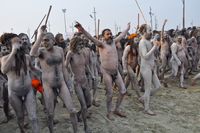
Click on the thumbnail to the right for pictures from my visit in 2013. I also have a more moody, music-infused video (part1, part2) and pictures from my 2001 visit to the Maha Kumbh Mela in Allahabad.
References (in no particular order):
- William R. Pinch, "Warrior Ascetics and Indian Empires", Cambridge University Press, 2006.
- Kama Maclean, "Pilgrimage and Power: The Kumbh Mela in Allahabad, 1765-1954", OUP, 2008.
- Diana L. Eck, "India: A Sacred Geography", Harmony, 2012.
- Joseph S. Alter, "The Wrestler’s Body: Identity and Ideology in North India", UC California Press, 1992.
- David E. Ludden, Editor, "Contesting the Nation: Religion, Community, and the Politics of Democracy in India. Chapter titled "Soldier Monks and Militant Sadhus" by William R. Pinch. University of Pennsylvania Press, 1996.
- Mark Tully, "No Full Stops in India", Penguin, 1991.
- Samuel Beal, Translator, 1906, "Si Yu Ki: Buddhist Records of the Western World, by Hiuen Tsiang [Xuanzang] (629 CE)."
- Editors of Hinduism Today, "What Is Hinduism?", Himalayan Academy Publications, 2007.
- Dhirendra K Jha, "Naga Sadhus on Hire", Open Magazine, 2 February 2013.
- "Kumbh Mela." Encyclopædia Britannica. Ultimate Reference Suite. Chicago: Encyclopædia Britannica, 2013.
________________________________
More writing by Namit Arora?
________________________________
Posted by Namit Arora at 12:30 AM | Permalink


Comments
Thank you, Namit, for this amazing documentary. You made sense of a chaotic, overwhelming, and often, alienating event.
Posted by: Arun Mukherjee | Feb 18, 2013 11:50:22 AM
This is great, Namit...In many ways I would say this is better than being there!
Posted by: Naveen Das | Feb 18, 2013 12:01:06 PM
This film and i have a date tonight! Thank you Namit -- and congratulations.
Posted by: Elatia Harris | Feb 18, 2013 1:27:07 PM
"As the eleventh century traveler Al-Beruni noted, "pilgrimages are not obligatory to the Hindus but facultative and meritorious." Indeed the idea of pilgrimage is commonplace in human cultures. Rivers, lakes, streams, springs, wells and other bodies of water too have been revered around the world."
Indeed, it is only modern holiness that causes people who bathe in the rivers to glow in the dark.
Posted by: Dredd | Feb 18, 2013 5:26:56 PM
Do the people behave better after they've been in the river?
Posted by: Louise Gordon | Feb 18, 2013 7:22:34 PM
Namit, thanks for a truly awesome video ! This is the best documentary on Kumbh Mela that I have come across ! It is highly interesting that Naga Sadhus belong to particular Akharas and that each Akhara is defined by so much structure and hierarchy. The financial as well as political aspect of this is stunning. From an Indian standpoint it is our belief that Sadhus are on a different plane of spiritual existence. Yet your documentary is an eye opener on some aspects of their shrewd practicality and worldliness. In your video some of the "Naga Babas" are carrying cell phones and even have Facebook accounts ! I was also surprised to note that instead of "equality" there was actually so much caste discrimination among the Naga Sadhu sect. Another interesting observation is the process of "initiation" of a Sadhu into the Naga sect. There are many traditional customs in India that truly merit scientific research and this form of mild neuronal injury is surely one of them ! How long do you think the Naga Sadhus live? Have they ever given up Sainthood and gone back to their families? Many such questions come to mind. In summary I would like to say that while you have done a wonderful job of demystifying the Naga Sadhus yet the "intrigue" of Kumbh Mela with its vast sea of humanity remains intact in your video. An amazing documentary !
Posted by: Shreyasi | Feb 19, 2013 12:30:09 AM
Thank you for this fascinating glimpse of humanity, Namit!
Simply superb reporting.
The event seems remarkably well-organized.
Posted by: VirtualMachine | Feb 20, 2013 2:42:44 AM
Thanks for your comments. As it turns out, the Jaipur Literature Festival last month had a session on the Kumbh Mela. Its video is online now and I think it makes a good companion video to this film. It features Sir James Mallinson in conversation with Diana Eck and Purushottam Agrawal.
http://www.youtube.com/watch?v=C3ViyroDTP0
Posted by: Namit | Feb 20, 2013 3:28:55 AM
Having grown up in New Delhi, I learnt very quickly to stay away from organized crowds, especially those gathered under the auspices of religion. Most of the time, devout folks in large numbers are peaceful and kind. Sometimes however, danger lurks just one panicky moment away in such humongous gatherings of hopeful and pious human beings. While I have attended very large open air political meetings in India without incident, I have stayed away from pilgrimages. But I am glad that there are intrepid souls like Namit who choose to go and record the sights and sounds that I can enjoy from a safe distance. :-)
I first came across the venerated naked sadhus in the holy city of Haridwar in north India when I was about seven or eight years old. My mother briefly explained to me their philosophy of renunciation of and indifference to worldly possessions and vanities. More than their unselfconscious ash covered nakedness, what I found fascinating was that one of them was wearing glasses!
Posted by: Ruchira | Feb 21, 2013 4:20:20 PM
The Sadhus need to renounce the idea of renunciation. Even that is a kind of attachment and ego.
Posted by: Georg | Feb 21, 2013 6:56:23 PM
Great Work!! You've done an amazing job here.
I'd also like to congratulate you on your restraint, and just letting the people speak for themselves (and they love to talk, don't they?), though I cracked up when I read your captions at the Agni Akhara. :)
Since most members of the Akharas probably don't understand that divinity can't counter the serious threat of water-borne diseases, I'm surprised that the Akharas --with all the power they hold in society, and specially in the areas surrounding the rivers -- don't do all they can to ban pollution in these rivers.
Anyway, I'm already looking forward to 2025.
Posted by: Manav | Feb 21, 2013 7:45:58 PM
Post a comment