February 11, 2013
Never on a Saturday
by Akim Reinhardt
Earlier this week, the United States Post Office announced that come
August, it would be suspending regular home delivery service of the
mails on Saturdays, except for package service. The USPS is In financial straits, and the budget-cutting move will save about $2 Billion in its
first year, putting a dent in the $16 Billion it lost just in
2012.
The Post Office has come under financial pressure from a number
of sources over the past decade. Of course the internet has usurped
traffic. And there’s also lost market share to private carriers like
Federal Express and United Parcel Service, which cut into the lucrative
package an overnight delivery markets, while leaving the USPS with an
unenviable monopoly in the money-losing but vitally important national
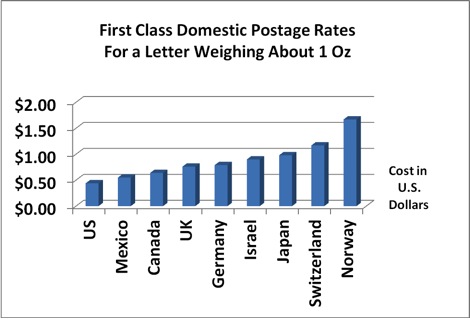
letter-and-stamp service. Despite regularly increasing rates over the
last decade, the United States still offers one of the cheapest such
services in the world, with a flat fee of 46 cents to send a 1
oz. envelope 1st class anywhere in the United States.
For less
than half a dollar, you can send a birthday card from Maine to Hawai’i,
and be confident that it will arrive in 2-3 days. Pretty impressive.
Especially when compared to other nations, almost all of which charge
more for an ounce of domestic mail, even though most of them are quite a
bit smaller in size. The chart below compares rates from 2011.
Another financial constraint comes from the fact that, other than some small subsidies for overseas U.S. electoral ballots, the USPS is a government agency that pays its own way, operating without any taxpayer dollars for about thirty years now..
However, the biggest factor in its recent financial free fall is undoubtedly the Postal Accountability and Enhancement Act of 2006 (PAEA), which Republicans pushed through Congress and President George W. Bush signed into law. The PAEA required the Post Office fully fund its pension healthcare costs through the year 2081.
Yes, you read that right. 2081. And it was given only 10 years to find the money to fund 75 years worth of retirement healthcare benefits.
To clarify just how odious this regulation is, think about it like this. In the next three years, the Post Office must finish finding the money to fully fund not only all of its current retirees and current works,Needless to say, no other federal, state, or government agency, much less any private company, has such a mandate, and the USPS is now bleeding money down the drain like it was shivved in a prison shower stall; which, metaphorically speaking, it was. Cloaked in the mantle of fiscal responsibility, the real impetus for the PAEA was an attack on the postal workers’ union, and a nod to the USPS’s private competitors.
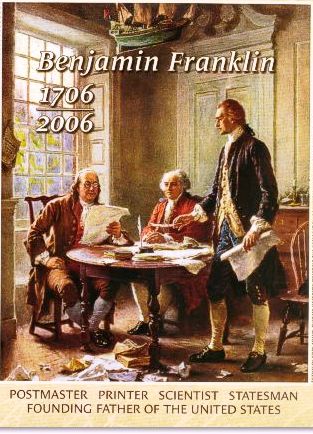
Created by the second Continental Congress in 1775, almost a year to the day before the signing of the Declaration of Independence, the new United States Post Office was originally deemed so important to the fledgling nation that none other than Benjamin Franklin was appointed the first Post Master General. When the national government was re-ordered under the Constitution in 1789, one of the first things the new document did was empower Congress to establish a new federal post office (Art. I, Sect. 8, Clause 7).
Before the explosion of federal bureaucracy after WWII and the estabsliment of a permanently massive military during the Cold War, the U.S. Post Office had typically been largest employer within the federal government. During parts of the 19th century, up to half of all federal employees worked for the Post Office. But beyond its importance to commerce and the economy, the United States Post Office has also long played a role in the nation’s cultural life.
In many small towns throughout rural America, such as the North Carolina hamlet my father grew up in, it was not uncommon for the only structures on Main Street to be the local church and the local post office. No wonder then that American culture abounds with references to the post office, ranging from the trope of carriers being plagued by overprotective dogs, to the office’s unofficial but iconic pledge that:
Neither snow nor rain nor heat nor gloom of night stays these couriers from the swift completion of their appointed rounds.
The phrase, engraved at the James A. Farley Post Office building at 8th Avenue and 33rd Street in New York City, is a translation of Herodotus describing the Persian postal carriers from 2,500 years ago.
Today,
however, it seems the post-office faces stiff pressure from the culture
of neo-conservative ideology, which fetishizes a vague and even
ironically cultish definition of freedom, dogmatically insisting that
only private interests can produce public good. It is a philosophy that claims the public good cannot
be achieved by the public itself through its constitutional mechanisms. Rather, it
champions private business as the premier mechanism of national
salvation, demonizing our democratic government as necessarily
inefficient and even corrupt. According to this ideology, the
constitutional organ of the people is actually the enemy of the people’s
happiness and success.
Pardon me if I say that, though no doubt most of its adherents are
well meaning, I personally find this extremist ideology to be less than
patriotic. While I have no illusions about government being "the
solution to all of our problems," I resent the idea that government
itself is to be resented. And I have had my fill of the logical fallacy
that zealous alliegance to the constitution is defined by attacking the
government that the constitution created.
Nevertheless, this is not the first time that the Post Office has been
caught in the crossfire of a grand struggle for the soul of the
nation's poltical culture. A couple of years ago, while I was conducting research for my (hopefully) upcoming book on the decline of American communities, I
came across some scholarly work that revealed cultural tensions in
early America, which also came to focus on the United States Post
Office. Indeed, there is a historical precedent for postal
operations being attacked by well-meaning Americans who took great
umbrage with some aspect of its workings. Some of the parallels are
striking. Some of them are ironic.
Much like today, some
Americans during the early 19th century believed that the new federal
government, though very small its presence, was exerting an undue and
detrimental influence on society. However, it was hardly a quest for
individualism that a vocal minority of citizens sought to safeguard.
To
the contrary, agitated citizens worried that the new nation was
descending into the abyss of sin, and they wished to enforce a strict moral code on all. And the best way to save U.S. from going down
the Devil’s path, they reasoned, would be to mandate observance of the
4th Commandment: Remember the Sabbath and keep it Holy. In fact, the
sentiment was so strong and pervasive, that it soon grew into a national
movement known as Sabbatarianism.
So what was the hot button
issue offending so many Americans that it erupted into a popular cry for
pious Sunday devotions? Was it drunkenness? Gambling? Sexual
promiscuity? Some potpourri of Deadly Sins? Not quite.
It was the mail.

Many
Americans took grave offense to Sunday mail service. Determined to make
America a Godlier place, Sabbatarians would spend decades waging an
intense political battle to ban mail service on Sundays.
In early
America there were no mailmen yet to bring letters and packages
directly to your door. That service would first appear in cities, though
free home delivery in rural areas would not begin until 1896. Instead,
Americans went to the post office and collected their mail whenever
postal couriers delivered it to the local postmaster, which was
irregularly. In a nation of small rural communities, a good number of
which were fairly isolated, and before railroads or even steam ships,
mail did not arrive everyday in most places. Rather, the nation’s 2,300+
local postmasters generally received the mail whenever it might arrive,
and then opened their post office after they were done sorting. That
might happen any day of the week. But never on a Sunday.
In most
towns, people were expected to spend Sunday attending church services,
observing the Sabbath, and refraining from secular work. Failure to keep
Sunday holy might not only trouble an individual’s conscience, but also
subject them to public censure from fellow community members.
Consequently, most postmasters did not tend to the mails on Sunday. But
then again, some did.
While the practice was not common, some
postmasters would sort mail if a delivery arrived on Sunday, perhaps
even handing out letters and packages to folks who showed up at the
office after church. And this, as it turned out, troubled not only stern
church leaders but also Uncle Sam, though for an entirely different
reason.
As the nation’s communications infrastructure, U.S. mail
was absolutely vital to commerce. But if a businessman in one community
could get Sunday mail while a competing businessman in another community
had to wait for Monday, it might create an unfair advantage, allowing
the early bird to get the worm.
So Congress passed a bill
formalizing federal mail delivery schedules for the first time in 1810.
The new law required local postmasters to receive the mail, sort it, and
open their office to the public on any day a shipment arrived. Whereas
local postmasters previously operated around the irregularities of mail delivery, personal discretion, and local community standards, Congress
now required regular services be offered on any relevant day, even a
Sunday.
The new law was an affront to many Christians who held
Sunday as a holy day of worship. Sabbatarians saw Sunday mail activity
as a disrespectful violation of their cherished community rules. For
example, in many towns across Connecticut at this time, commercial
vehicles were actually barred from the streets on Sundays; federal mail
coaches were the single exception, and that was only because the
Constitution does not allow local or state governments to regulate
interstate commerce. As the historian Richard John pointed out, “in
hundreds of communities this made [mail] the only local institution
impervious to local control.”[1]
Reaction was quick, widespread, and

multi-denominational. Presbyterians, Methodists, Lutherans, Baptists,
Congregationalists (formerly Puritans), and Episcopalians (formerly
Anglicans) all voiced their opposition to the new law, which they viewed
as indecent. Increasingly incensed by this assault on their values,
Sabbatarians demanded that the 1810 bill be repealed.
Furthermore,
critics now called for a ban on all labor by any postal employee during
the Christian Sabbath. That would mean Sunday suspension of not just
distributing the mail to customers, but also delivery to and sorting at
post offices. If Sabbatarians had their way, the entire postal system
would shutdown one day a week, prolonging an already frustratingly slow
process.
At first, given the importance of mail service, the
government resisted these calls. But Sabbatarians mobilized. By 1814,
thousands of petitions had poured into Congress. With the War of 1812
raging, however, a weekly suspension of mail service would hamper
military officers in the field. The rigors of wartime initially
prevented the issue from gaining any political traction, though it
returned with renewed vigor though during the 1820s.
As
industrialization and urbanization began to reshape the nation,
Sabbatarians complained of ever more commercial activity of all sorts
occurring on the Sabbath. Sunday mail service was becoming a bigger
issue. It had come to symbolize the nation’s growing pains.
Sabbatarian
organizations sprouted up not just in small towns, but also in cities
like Pittsburgh and New York. However, the surging protest movement also
faced new resistance from businessmen. By 1829, new anti-Sabbatarian
groups were organizing to maintain Sunday mail. The fight dragged on for
decades.
While Sabbatarians did not succeed in getting the
1810 law repealed, other developments eventually came to their aid.
During the 1830s-40s, new railroads proved to be a faster but more
expensive method of delivering mail, which led to concerns about
spiraling costs. Then came the invention of the telegraph. The emails of
their day, telegraphs provided near instant communication for the first
time, lessening the commercial need for seven-day mail service.
Amid
these changes, a succession of Postmasters General during the mid-19th
century were able to cut expenditures by limiting certain aspects of
national mail transportation on Sundays, which appealed to Sabbatarian
ideals. At the same time, fewer and fewer business owners were upset by
the cuts in service because faster trains, instantaneous telegraphs, and
later telephones, eventually made the issue moot. As Sunday mail
delivery by rail became less frequent, more local post offices were able
to remain closed on Sundays.
Congress finally put its stamp of
approval on the Sunday mail ban in 1912. More than a century after the

original 1810 law had sparked outrage across America, a new law finally
put an end to all Sunday mail service. This time, it had been lobbied
for by both, a new generation of Christian Sabbatarians and local postal
clerks eager for a day off.
And that is why American mailboxes are always empty on Sunday. But as to why they’ll soon be barren on Saturdays as well?
Sadly, it seems we still live in a world rife with sin.
[1] This quote, and much of the information on Sabbatarianism and the post office, comes from: Richard R. John, “Taking Sabbatarianism Seriously: The Postal System, the Sabbath, and the Transformation of American Political Culture,” Journal of the Early Republic 10:4 (Winter, 1990): 517-567.
--
Akim Reinhardt's website is ThePublicProfessor.com
Posted by Akim Reinhardt at 12:05 AM | Permalink


Comments
"Yes, you read that right. 2081. And it was given only 10 years to find the money to fund 75 years worth of retirement healthcare benefits."
You omit to mention that the post office has run up huge liabilities by NOT pre funding employee retirement benefits in the past. People reading your article are likely to come away with the impression that the USPS was in the pink of health prior to 2006. No private company could have ever gotten away with the kind of unfunded liabilities that the USPS was running up prior to 2006.
I agree that the 2006 law passed by Congress does not set a realistic (or even meaningful) schedule to make up the shortfall. But it is hard
to shed a tear for the Postal unions when you realize that they were running up huge costs on the taxpayer's account prior to 2006.
I found the rest of the article interesting. But your characterization of USPS finances is highly misleading.
Posted by: Sundar | Feb 11, 2013 9:58:30 AM
P.S. This is the most misleading statement in the whole article:
" the USPS is a government agency that pays its own way, operating without any taxpayer dollars for about thirty years now.."
This statement is WRONG. It does not take into account the IOUs that the USPS was happily writing to its employees. In the form of unfunded retirement benefits. Again, no private company could ever get away with this.
These IOUs are ultimately to be paid by the taxpayer.
I find it very distressing that someone as thoughtful as Prof. Reinhardt would write a long article on the basis of patently wrong information.
Posted by: Sundar | Feb 11, 2013 10:04:40 AM
Hmmm... my first comment has disappeared... Anyway, here is what I said:
The article strongly implies that the the problem was caused by the 2006 law. This is false. The USPS has irresponsibly run up huge liabilities (on the taxpayer's account) prior to 2006. Now schedule set out in the 2006 law is unrealistic. And so the law doesn't really help. But the law is by no means the main issue. All it does is shine a bright light on the USPS's unfunded debts.
The rest of the article is interesting. But surely Prof. Reinhardt can make his larger points without implying that the USPS was in the pink of financial health until 2006?
Posted by: Sundar | Feb 11, 2013 10:18:07 AM
For those interested, here is the Dec 2012 GAO report on the USPS's unfunded liabilities.
http://gao.gov/assets/660/650511.pdf
Summary:
* $48 Billion unfunded liability
* PAEA specifies 44 year funding schedule (I don't know where Akim gets a 10 year schedule)
* These numbers do not include workers not yet hired (again, I don't understand why Akim thinks the law includes future workers)
The point is not to defend the 2006 PAEA law, but to point out that the USPS's problems are unrelated (and predate the law)
Posted by: Sundar | Feb 11, 2013 10:55:06 AM
Sundar:
First, let me say I had nothing to do with any erased comments. I don't have editorial privileges in that regard, and I have no knowledge of, much less a role in, the removal of any prior comments.
Beyond that, thank you for engaging the discussion. I'll admit that I might have done a better job of emphasizing the extent to which the post-office's pre-PAEA financial woes stem from the fact that it really has had to "pay its own way" for the last thirty years or so as a government agency that does not subsist on tax revenues, while simultaneously competing with private, for-profit corporations (UPS, FedEx, et al) that siphon off the most lucrative part of its business. I did mention this, but I should have emphasized it more to clarify the larger picture.
As for private corporations supposedly having tougher restrictions on funding their pensions, I might point out that many a corporation has defaulted on its pension programs over the years, sometimes leaving retired and soon-to-be retired workers in the lurch. In fact, American Airlines is about to engage in the largest pension default in U.S. history, specifically because it underfunded the programs. This potentially affects 130k workers. <http://www.reuters.com/article/2012/02/08/us-column-miller-idUSTRE81718S20120208>.
To the contrast, the United States has never defaulted on any civil or military pensions to any of its workers so far as I know. In other words, it has a much better track record on funding and paying out pensions than the private sector does.
However, I do agree with you that there aren't real concerns to address. But based on your comments, I think you also agree with me that PAEA is a needlessly draconian measure that creates as many problems as it solves. I also think it's the main reason the USPS is ending Saturday mail service come August.
As to my sources for the article, all of them are linked and labeled (labels appear if you hang your cursor over the link).
Again, thanks for engaging and contributing to a better understanding of the issues.
Posted by: Akim Reinhardt | Feb 11, 2013 12:35:38 PM
Thanks Akim.
Yes, the PAEA is a messy piece of legislation that ties the hands of the USPS in many ways. It does not help.
However, I find your comment about public vs private pension performance revealing. What you consider a failure, is normal healthy market behavior. Surely, you don't want AA to continue to bleed money with an implicit taxpayer guarantee? Thats what the USPS is doing. Thats also why I consider the bank bailouts 0f 2008/2009 (both Bush and Obama) to be outrageous. The people who lent money to the banks were made whole by the US taxpayer.... Nice deal for them.
Yes AA workers are affected by the AA bankruptcy. But lots of people have bad things happen to them. Thats life. Why should the USPS employees be shielded from this risk when AA employees are not?
You can try and make a case that the USPS has some semi-mystical communitarian mission that entitles their unions to special treatment. And that insulates them from business risks. Its not clear to me why I shouldn't have the same privileges.
Also, why is losing healthcare benefits such a bad thing? The rest of us plebs manage with Obamacare. Why is Obamacare not good enough for the USPS?
Posted by: Sundar | Feb 11, 2013 1:23:17 PM
Akim,
I don't want to be argumentative, but I really have a problem with the following comment:
" I'll admit that I might have done a better job of emphasizing the extent to which the post-office's pre-PAEA financial woes stem from the fact that it really has had to "pay its own way" for the last thirty years or so as a government agency that does not subsist on tax revenues, while simultaneously competing with private, for-profit corporations (UPS, FedEx, et al) that siphon off the most lucrative part of its business. "
The USPS was paying employees with taxpayer IOUs for their future retirement benefits. A private company would love to be able to do that. Its as if I borrow money from the bank and spend it, but Akim Reinhardt gets to repay the money. So the USPS was not "paying its own way". Not even close.
This rather simple point is not grasped by many people. The unions understand it only too well, and pretend not to grasp it.
Posted by: Sundar | Feb 11, 2013 1:44:42 PM
One interesting point raised by this discussion is the one about how fundamental the Founders thought the post office was. But why did they think so? Not to deliver junk mail or whatever crap you bought on eBay (although they did figure they'd make some money off of it). They wanted to ensure the swift delivery of information, which they considered the lifeblood of democracy.
Today, that lifeblood is carried not by snail mail but by the Internet. Why is there no outcry for a public Federal Internet? They should be out there laying fiber as "Postal Roads" so that the People can continue to communicate effectively.
Posted by: X | Feb 11, 2013 8:41:29 PM
X, that's a good point. communication has moved far beyond what it was in the 18th century. the postal mandate seems an anachronism compared with other, far more important, means of exchanging info today.
Posted by: Chris | Feb 11, 2013 11:42:42 PM
Sundar:
Sorry for the delay in commenting. Yesterday was a bear at work. And don't worry about being argumentative. We obviously have different philosophies about this. It's good that we can exchange ideas and opinions.
I think there are important differences between non-profit government agencies and for profit corporations that are relevant here, and that it's generally wrong to treat either like the other; to demand that a government agency act like a corporation or visa versa.
For example, the USPS is backed by the full faith and credit of the federal government, while corporations like AA most certainly are not. And the feds have never defaulted on a pension plan, while many a private corporation has. So while there were legitimate concerns surrounding the financial situation at the USPS, I don't believe they warranted the panic measure of the PAEA.
Furthermore, I think that "panic" itself was largely an excuse for Conservative Republicans to launch a political attack on the USPS because of A) its large unionized workforce (now shrinking) and B) its competition with private carriers.
And in any event, most of the USPS's financial problems pre-PAEA stem from the federal government's decision to largely stop funding the post-office for the first time in its history. Which, when you think about it, is quite amazing. One of the federal government's largest and most important agencies hasn't received very much federal funding for operations for thirty years now.
Posted by: Akim Reinhardt | Feb 12, 2013 1:45:00 PM
"One of the federal government's largest and most important agencies hasn't received very much federal funding for operations for thirty years now."
Akim, I hope to convince you that this statement of yours is wrong.
The USPS has been writing IOUs (retirement benefits) to their employees for thirty or more years. These IOUs are taxpayer backed. The USPS itself has no ability to make good on these.
These IOUs have significant financial value. It is as if I hire a bunch of people and pay a large part of their compensation in the form of IOUs written against Akim Reinhardt. So even though Akim has not had to pay out any cash, he is on the hook for these payments.
I hope we can agree on this simple point. It does not depend on our "differing philosophies". It is basic logic.
Posted by: Sundar | Feb 13, 2013 8:24:17 AM
This agency of the federal government has been unable to meet its full financial obligations in cash since the federal government stopped funding it sufficiently. So in order to keep operating without sufficient federal funding, this federal agency has written IOUs that are backed by the full faith and credit of the federal government.
We agree that's a problem. We might disagree on the solution. Mine is in line with a friend from Minneapolis. While visiting for the first time, I commented to him that I found the city to be very clean and well run, more so than most major American cities. He responded:
"Yeah, we like our services and don't mind paying taxes for them."
Along those lines, I like having an efficient national postal service. I like Saturday delivery. I like sending a letter across the country in 2-3 days for less than the price of . . . well, just about anything else I can think of. And I wouldn't mind paying some taxes for that.
But we don't. So the cost of that service, which used to be covered in part by tax allocations, is now covered in part by increased rates and Federal IOUs. And unhappy with that, we're blaming the post office for muddling through the untenable situation Congress put it in 30 years ago, and demanding it layoff workers and cut services.
Posted by: Akim Reinhardt | Feb 14, 2013 12:05:42 AM
"Yeah, we like our services and don't mind paying taxes for them."
The idea that Minnesota has better services because of their tax rates is a strange idea.
Do you think San Fran does not tax enough?
*idle speculation on*
If I had to simplify and pick one reason for Minnesota's cleanliness, I'd pick their Scandinavian origin population and culture.
*idle speculation off*
Posted by: Sundar | Feb 14, 2013 8:57:58 AM
The larger point of my article, and of the comment I refer to, and that you even acknowledge when you talk about "Scandavian origin," is that cultural attitudes play a large role in defining policy.
Of course high taxes aren't the only causal factor in good services. You need many other things, such as a healthy tax base, a well run and efficient government, and smart policy, to name just a few. But if the attitude from the start is that government should be run like a private sector business, then you're less likely to have great government service. Instead, you'll have an emphasis on parceling government services out to the private sector.
We can argue about which approach is better, but certainly some services the private sector will never take up because, while they're very important to society, they're a money loser. National mail service (minus rush and package delivery) is one of them. The rates a company like UPS would have to charge to ship letters across the nation would be prohibitively expensive and fundamentally alter the nature of postal service in this country.
If we want to maintain one of the world's best postal systems (I'm defining best as an intersection of Quality of Service and Price), then we have to fund it. But we don't, and it's deteriorating; the loss of 1/6 of the delivery dates cannot be defined as anything other than a deterioration in service.
Thanks for engaging Sundar. Soceity needs more honest back forth. I've said all I have to say for no on the subject, and will give you the last word.
Posted by: Akim Reinhardt | Feb 14, 2013 11:10:41 AM
Post a comment