
by Scott F. Aikin and Robert B. Talisse
It’s not whether you win or lose, but how you play the game.
It’s not getting what you want, it’s wanting what you get.
Being good is its own reward.
Let’s first note an important terminological point about the paradoxical tradition. Paradox is a Greek word that, in its classical usage, that meant something counter intuitive, something surprising. Para, meaning alongside or against, and doxa, belief. So a paradox is something that runs against what we normally believe. In short, those who belong to the paradoxical tradition say surprising things. Now, the paradox is most clearly in view for us, as we endorse sentiments like It’s not whether you win or lose, it’s how you play the game, but we nevertheless cheer for winners, and nobody makes it to any Halls of Fame simply for being a good sport. The same goes for all the familiar old saws – we think they are right, but nevertheless don’t live in accord with them. The paradoxical tradition is one of consistently living in accord with sentiments like these.
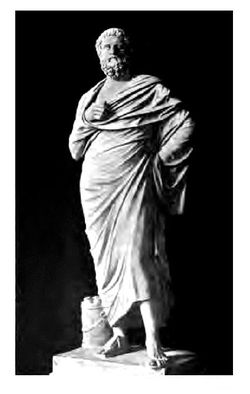
Socrates was one of the first great paradoxicalists, and one of the most famous. One particular paradox he announces after the Athenians sentence him to death for impiety and corrupting the young. He says he does not believe “a good man can be harmed in life or in death” (Apology 41d). And so we have the first of the ancient paradoxes of the good life, call it:
The paradox of invulnerability: Insofar as you are virtuous, you cannot be truly harmed.
Now what makes this view paradoxical is that Socrates says this in the face of a jury who’ve sentenced him to death. Having to drink hemlock and suffer its effects. That sounds like a harm. Dying? It certainly seems worse than living on and being Socrates. How else might someone consider it a punishment?
The paradoxical perspective on this is that these slings and arrows of outrageous fortune would be harms only if they harmed our souls. A death sentence is a harm only if it makes you willing to grovel, lie and cheat to avoid it. Poverty and suffering are harms only if it makes you a horrible person, violent, or selfish. Illness is a harm only if it makes you resentful and empty.
The world can destroy us, but if we live well, it cannot destroy the good in us. The world can take the light of goodness inside you only if you let it. Our job is to tend and care for that light of decency and goodness inside us. Virtue ensures it’s not snuffed out.
The second paradox concerns virtue—what it must be, if we are made invulnerable with its possession. In order to be invulnerable, we must be able to distinguish what matters from what doesn’t. We must tell what’s worth being upset about from what’s not. Virtue, then, must have at its core knowledge of what differentiates what matters and what doesn’t. And so the second paradox:
The Paradox of Cognitivity: Virtue is knowledge of what matters and what doesn’t
Consider: money, possessions, social status. Consider the confusions that abound when we take the accumulation of these things to be our main purpose. When make a buck, or be top dog, or have more stuff is our objective, consider how we distort ourselves. Consider the harm we do to ourselves. The inheritors of the Paradoxical tradition, the stoics, refined this thought. Epictetus, our most complete expositor of Stoic ethics, reasons: Only the things relevant to the care of our souls are what matter, only the cultivation of our own goodness.
Care for the soul, given the kinds of knowledge necessary, comes in three forms. There are then, three areas of moral and cognitive development:
1. The perfection of judgment – become an excellent critical thinker
2. The perfection of motives – become dutiful and exemplify only goodness
3. The perfection of emotions – be calm
With regard to judgment, we are often led astray by the fact that we judge things incorrectly. This happens for a variety of reasons. Socrates’ method was supposed to help along one line, as he thought that the clarification of our concepts will yield better judgment – and so he devoted much of his time to asking questions of the nature of Justice, Piety, Courage, and so on. Alternately, the stoics held that we may confuse what things are. We must see the objects of our judgment in the proper light. Marcus Aurelius gives us the exercise of proper description:
Upon seeing roasted meats and delicacies set upon a table, realize: this is a dead fish, a pig’s dead body. The fancy wine? Rotten grape juice. The elegant purple robes? Sheep wool dyed with shellfish blood. Making love? Some friction and then a mess. Meditations 6:13
With our motives, we must be able to see ourselves from a bird’s eye view. We must be able to see ourselves and our relationships not from the perspective of being in the midst of a petty squabble or a hard-fought competition. We must be able to see each other for what we are—beings with the light of virtue inside. And so with enemies, we must be able to see them as human beings. Those who disappoint us are nevertheless our brothers, sisters, parents, and children. The best way to tend our inner light is to live in the service of others.
To feel affection for people, even when they err, is good for us. You can do it if you recognize that they are human, too. They act out of ignorance, or against their will. Soon enough, you’ll both be dead. And above all, they haven’t really hurt you. So treat them decently. Meditations 7:22.
The world’s already a hard enough place. Our job is to not contribute to the hardships in it, but rather to help others and allow them a measure of dignity.
Finally, and most famously, is the stoic perfection of emotion. Here, the stoic exercises are designed to help us remember what distinguishes what matters from what doesn’t, and to react appropriately. And so we have Epictetus:
In the case of everything attractive or useful or that you are fond of, remember to say just what sort of thing it is, beginning with the little things. If you are fond of a jug, say “I am fond of a jug!” For when it is broken, you will not be upset. If you kiss your child or wife, say you are kissing a mortal human being. For when it dies, you will not be upset. Encheiridion 3
It’s here that we see what’s alien, almost inhuman about the paradoxical tradition in ethics. It seems that in order to make ourselves invulnerable, we must shed all the things that make us human. The well-being of a son or daughter, the flourishing of a marriage, the pleasure of friendship. That naturally makes us happy. And so, too, do children’s hardship, the failure of a marriage, and loss of friends make us unhappy. To become invulnerable to these losses, it seems we must forgo the benefits, too.
The stoic, in maintaining his own inner light, in tending his personal virtue, seems to lose a profound virtue, too. Let us call this the damage problem. Stoicism is ruinous of the goods we naturally take as comprising the good life. It’s a kind of scorched earth policy with life, in order to achieve invulnerability.
The worry about stoicism, again, is it’s morally ruinous, that it makes us so detached and shut off, nobody ever gets in. But that it needn’t be so. We are finite creatures, we live and love. But we die and grow old, we move away and we change our minds. Loving with open eyes about what we are doesn’t diminish that love at all. In fact, it adds to the poignancy of our moments together.