
| ABOUT US | ARCHIVES | LINKS | RSS FEED | MONDAYS | |

3quarksdaily

An Eclectic Digest of Science, Art and Literature

« THE MAKING OF THE IDEA OF RACE | Main | The Brooklyn College BDS debacle highlights the perils of pro-Israeli overkill »

February 17, 2013

A Theory of Theory of Mind

Michael Bérubé reviews Getting Inside Your Head: What Cognitive Science Can Tell Us about Popular Culture by Lisa Zunshine, in American Scientist:
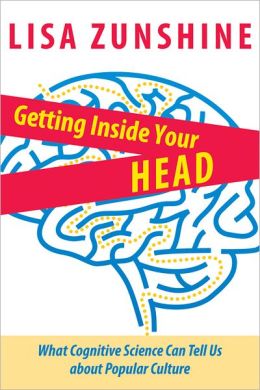
9781421406169_p0_v1_s260x420Lisa Zunshine has a theory—a theory about theory of mind. It goes something like this (and in order to paraphrase it, I have to exemplify it, by getting inside her head as best I can): Our brains evolved in such a way as to render us all eager but flawed mind readers. Whenever we see each other, we try to figure out what other people are thinking; it is a necessary skill in a deeply social species—or, rather, we are a deeply social species precisely because we have this skill. We try to read each other by look, posture, expression, gesture. And, to make things more complicated (and/or fun), we know this about each other, so we also try deliberately to produce certain readings in others by feigning certain looks, postures, expressions and gestures. All the world’s a stage—and the world we have created includes millions of actual stages, where actors embody the principle that all the world’s a (self-reflexive) stage.

Zunshine’s earlier book, Why We Read Fiction, argued that we read fiction in order to give our restless brains a good workout: In novels and short stories, we are given up-close and intensely personal representations of how characters succeed or fail at reading each other’s motives and desires. For extra added cognitive benefit, we watch characters succeed or fail at reading other characters’ attempts to read other characters’ motives and desires. According to Zunshine, the mental exercise involved in reading fiction serves an evolutionary purpose, deploying our theory of mind so as to flex and build the cognitive muscles that will help us navigate a bewilderingly complex world of subtle social cues. Drawing widely and judiciously on recent research in neuroscience, Getting Inside Your Head expands this theory to cover all of human culture, from novels to films, plays, musicals, paintings and reality shows.

More here.

Posted by S. Abbas Raza at 09:27 AM | Permalink

Comments

Beyond Berube's criticisms of the single mindedness of Zunshine's approach, as an anthropologist it strikes me as the projection of a particularly "Western" theory of mind onto all of humanity: culture dressed up as science. Compare Zunshine's ideas with the way Orokaivans in Papua New Guinea think about these things (From Ira Bashow's _The Meaning of Whitemen_)

"For Orokaiva, the 'person' (embo) is divided into two parts, the jo and the hamo. Literally, jo refers to anything's ' inside' or ‘interior' The word jo can be used to designate the inside of a house (bande jo), the interior of the forest (ariri jo), or the inside of a string bag or suitcase (ebi jo, sutkeisi jo). When describing the jo belonging to a person, people gesture toward the inside of the chest or trunk of the body. People speak of the jo as a real location within the body, identifying it with the guts or the inner organs, especially the liver. But idiomatically, the jo of the person is like the English "heart" as a seat of emotion: it refers not to the physical entity that can be revealed by the surgeon's knife, but rather to an intensely personal, inner locus of motivation and feelings. In Orokaiva, the jo specifically connotes volition intention, and will. Newborn infants are thought not to have a jo, since they do not yet have intentions that can be revealed. From the age when the child can move around on its own and express wishes that are more than physiological, it is assumed to have a jo of its own. It is the jo that explains why a person chooses one course of action over another; it is the state of a person's jo that determines how he or she will respond to a request The Orokaiva jo is autonomous, beyond the control of others, invisible to them, and unknowable by them. As Andre Iteanu has observed, the notion of jo "implies above all that something is concealed, and that what is concealed cannot accurately be described or accounted for….[I]t’s very nature is to be hidden" (lteanu 1990, 41). It is axiomatic that one cannot know the true will or intentions found in another's jo. As the common saying puts it: 'We do not know [what will happen); it is up to his[, her, or their] jo.' The Orokaiva jo is volatile, unpredictable, and inconstant, with no definite roots in the past. It is identified with the future, as the cause that generates future events and action. Indeed, the future itself is called jo: Ille future (iji jo-ta) is the as yet unrevealed, hidden 'inside' of time. When people talk about the jo of a person, the only states they attribute to it are simple positive or negative dispositions like ‘good’/'bad,' 'cool'/’hot’ ‘joyous'/'troubled,' or 'buoyant' {favorably disposed and receptive)/'hanl' (displeased or angry). The jo is never spoken of as having internal differentiation or structure."

Posted by: Daniel Rosenblatt | Feb 17, 2013 10:22:14 AM

Her name is a joke of some kind, right? I mean, come on, devoting her life to shedding zome light on - what? - her zelf, I guess.

Posted by: oldman | Feb 17, 2013 10:48:35 AM

Hey - if she lived forever - she would be eternal Zunshine.

Posted by: Steve | Feb 17, 2013 1:15:38 PM

This is taking TOM a bit too far...

Posted by: Félix E. F. Larocca, MD | Feb 17, 2013 1:49:21 PM

I like Ernst Mayr's notion better.

He thinks that human intelligence is a fatal mutation.

Posted by: Dredd | Feb 17, 2013 2:18:30 PM

Part 'art of the bleedin' obvious' while failing to explain why a sense of humour, the appreciation of beauty in a sunset. . . and obviously written by someone who's never owned a dog.

Posted by: Nigel Foster | Feb 17, 2013 6:49:47 PM

"Ahem, cough, cough, my theory, and it is exclusively mine, is that a Brontosaurus is narrow at one end, becomes wide in the middle, and narrows again at the other." Ann Elk

Posted by: Erich | Feb 17, 2013 9:26:30 PM

Erich: Excellent! I haven't thought of that in a good long while!

Posted by: Sarah Doyle | Feb 19, 2013 2:26:50 PM

Post a comment


Subscribe to this blog's feed  

PayAnywhere with iphone credit card swiper

Android Tablet

Bluetooth Headset

2013 New Style Dresses

Compare Car Rental Prices

DHgate.com Wholesale

3QD on Facebook

3QD on Kindle

3QD by Daily Email

Receive all blogposts at the same time every day.

Enter your Email:


Preview 3QD Email

3QD on Twitter

Miscellany

Lijit Search

AddThis Social Bookmark Button

Add to Google

Recent Comments

Rashid on Aftermath: Pakistan Elections 2013

Yoann on The Bystander Effect in Medical Care. Why Do I Have So Many Doctors Not Taking Care of Me?

Dave Ranning on Aftermath: Pakistan Elections 2013

sadhana on Aftermath: Pakistan Elections 2013

Carol Westbrook on The Bystander Effect in Medical Care. Why Do I Have So Many Doctors Not Taking Care of Me?

Ken Bryant on Aftermath: Pakistan Elections 2013

Umer Vakil on POETRY IN TRANSLATION: CORDOBA

Kabir on Aftermath: Pakistan Elections 2013

Nina on White Indians

Nina on White Indians

Dave Ranning on If Only We Had A Leader Like Chavez, Who Solved Real Problems -- Instead Of Debating Fake Ones Like The Deficit

Mohammed Hassanali on Aftermath: Pakistan Elections 2013

musafir on Aftermath: Pakistan Elections 2013

Maniza on Aftermath: Pakistan Elections 2013

Ellen Perry on The Bystander Effect in Medical Care. Why Do I Have So Many Doctors Not Taking Care of Me?

waqnis on The Bystander Effect in Medical Care. Why Do I Have So Many Doctors Not Taking Care of Me?

Norman Costa on The Bystander Effect in Medical Care. Why Do I Have So Many Doctors Not Taking Care of Me?

Hannah Carlton on POETRY IN TRANSLATION: CORDOBA

Joe on Digging Up Bones or, The Labyrinths beneath Our Feet

JonJ on The Beautiful German Language

cpfaff on Passionate About The Actor's Art: an interview with Michael Howard

Sumiran on Sunday Poem

Ethan on Getting Smarter

Pacificklaus on NORTH KOREA’S NERVE WAR

Félix E. F. Larocca, MD on POETRY IN TRANSLATION: CORDOBA

Acclaim For 3QD


"I couldn't tear myself away from 3 Quarks Daily, to the point of neglecting my work. Congratulations on this superb site."—Steven Pinker, Johnstone Professor of Psychology, Harvard University.

"I have placed 3 Quarks Daily at the head of my list of web bookmarks."—Richard Dawkins, Charles Simonyi Professor of the Public Understanding of Science at Oxford University.

"Just wanted you to know I’m one of many who reads and enjoys 3 Quarks....almost daily."—David Byrne, musician, former lead-singer of the Talking Heads, artist, intellectual.

Read more here.

The 3QD Prizes

Subscribe to this blog's feed