
by James McGirk
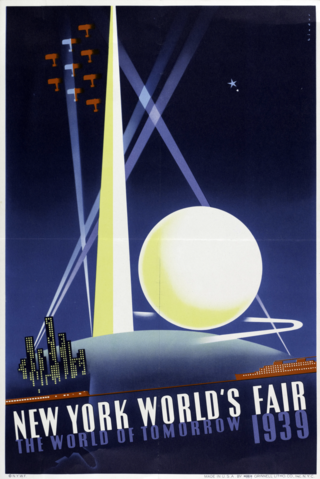
It seemed natural our future would come to look like this too. Rocketships and sleek shapes seized our imaginations and seeped into our culture. The centerpiece of the 1939 World’s Fair was the Trylon and Perisphere, a 600-foot tall spire that stood beside an enormous sphere while klieg lights roamed the sky. Architects added ringed spines to radio towers, engineers built trains that looked like gleaming bullets; cars became swoopy and streamlined and eventually grew fins. Anything futuristic was swaddled with chrome and extraneous antennae. By day the movie theatres, airports, motels and diners lining the brand new superhighways looked like docking spacecraft, by night their neon blazed until it blotted out the stars.
Literature absorbed and was mutated by this great swell of imagination. The slender prose of Hemingway and F. Scott Fitzgerald was replaced with huge tomes and colossal egos who tried to devour all of postwar America and regurgitate it into a single tome. This was the era of Norman Mailer, of Saul Bellow and William Burroughs and John Updike and Joseph Heller and Thomas Pynchon and Alan Ginsberg. Their work was as larded with glittering things—with extraneous information, details about objects and history and revolution—as the glorious motels and gleaming theatres had been a generation before.
Science fiction writers took even bigger mouthfuls than their highbrow cousins. Writers like Arthur C. Clarke and Isaac Asimov wrote space operas that stretched across entire galaxies and sprawled across two, three, even four books at a time.
By the 1970s, the electroplated luster of the future was flaking off. We knew our resources were finite and the glories of technology wouldn’t save us from losing wars or being scorched by an atomic bomb. Architects and industrial designers began to favor forms that were more functional than fanciful. Motel owners figured guests would feel more reassured by a national franchise than an unidentified flying object hovering over their beds. Literary fiction became grittier and more introspective. It pared down until individual sentences were pulling stories along: Raymond Carver, Martin Amis, Barry Hannah. American techno-culture seemed tasteless and plastic. Writers like Toni Morrison, V.S. Naipaul, Salman Rushdie and Mario Vargas Losa brought stories from other cultures to readers, and to many of us, these neglected voices were as rich and strange as Marco Polo’s Travels.
Science fiction sought out the underworld. A movement of writers called “Cyberpunk” plundered from hard-boiled detective fiction. William Gibson, who coined the word “cyberspace” in his 1983 novel Neuromancer, published one of the first Cyberpunk stories in 1981, when he wrote the “Gernsback Continuum.” It’s a marvelous illustration how technology, imagination and fiction are warped by one another. Gibson called them semiotic ghosts.
The “Gernsback Continuum” is told from a photographer’s point of view. The unnamed narrator is a mercenary of a sort, a little jaded, a good photographer but not the best of them, an updated version of the grizzled private investigators you might encounter in a Dashiell Hammet or a Raymond Chandler story. He takes on an assignment from a femme fatale, who asks him to photograph the crumbling vestiges of America’s “raygun Gothic” culture. Gradually, he succumbs to the illusion. Gibson’s nameless narrator begins seeing fragments of a past that never was: Flying wedges pester him in the desert. Lonely highways bloat into 80-lane super-freeways. He takes a diet pill, crashes, and wakes to find a titanic city floating above him and… Them: a couple, a male and a female, Aryan supermen both, a pair of inhabitants of the future that wasn’t. He overhears the male lecturing the female and “his words were as bright and hollow as the pitch in some Chamber of Commerce brochure, and I knew that he believed them absolutely.” The female listens politely to her male and then reminds him to take his food pill.
Gibson was thumbing his nose at classic science fiction. Seen beside modern technology, the twelve-engined flying wings and silver gyrocopters were preposterous—“it had all the sinister fruitiness of Hitler Youth propaganda” drawls the narrator—and the perfect pair was every bit as empowered and boring as the Rocket Age heroes Gibson’s everyman photographer was replacing. But as much as Gibson may be sneering at Gernsback’s classic aesthetic, he acknowledges that it’s a continuum, a seamless shift from one thing to another; that his photographer couldn’t exist without the glorious blondes who came before him. And in the same manner, contemporary writing grew from soil rich in the residue of its clanking, exuberant, Diesel Age predecessors.
The Internet is a mirror of the Universe, albeit an imperfect one. It’s a richer, happier, more transparent reflection of the real world. And though there is a background noise of snickering and threats and occasional yuckiness, those can’t hurt you (in the U.S.A.). The Internet is all about treats: factoids, pneumatic sexpots prancing at your command, mewling kittens, pithy sayings, and other pretty, shiny, glossy things, all available at your fingertips, all delivered from a deliciously designed device through convenient app.
If the mechanical dreams of the Diesel Age were exuberant and colossal, those of the Internet Age are effervescent and charming. I remember the feeling of logging into the Internet for the first time, of making a million weird discoveries as I traversed space and time from behind a monochrome display. It felt glowy and golden. The way swiping an iPhone does the first time you try. The chirping, friendly infrastructure of the Internet has been scorched into our brains. Our literature has been extruded through its cheerful strictures. As mundane as our glowing Apples may seem to us now, they have changed the way we think and the way we write.
Literature will slide back on the continuum. The next wave of novels will slough the Internet. They will be dark, bitter and angry: like biting down on a hunk of coal. But a trace of the Internet’s tinsel will remain.