
January 26, 2013
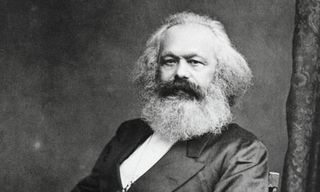
Why the Ideas of Karl Marx are More Relevant than Ever in the 21st century
Bhaskar Sunkara in The Guardian:
Capital used to sell us visions of tomorrow. At the 1939 World's Fair in New York, corporations showcased new technologies: nylon, air conditioning, fluorescent lamps, the ever-impressive View-Master. But more than just products, an ideal of middle-class leisure and abundance was offered to those weary from economic depression and the prospect of European war.
The Futurama ride even took attendees through miniature versions of transformed landscapes, depicting new highways and development projects: the world of the future. It was a visceral attempt to renew faith in capitalism.
In the wake of the second world war, some of this vision became a reality. Capitalism thrived and, though uneven, progress was made by American workers. With pressure from below, the state was wielded by reformers, not smashed, and class compromise, not just class struggle, fostered economic growth and shared prosperity previously unimaginable.
Exploitation and oppression didn't go away, but the system seemed not only powerful and dynamic, but reconcilable with democratic ideals. The progress, however, was fleeting. Social democracy faced the structural crisis in the 1970s that Michal Kalecki, author of The Political Aspects of Full Employment, predicted decades earlier. High employment rates and welfare state protections didn't buy off workers, it encouraged militant wage demands. Capitalists kept up when times were good, but with stagflation ā the intersection of poor growth and rising inflation ā and the Opec embargo, a crisis of profitability ensued.
An emergent neoliberalism did curb inflation and restore profits, but only through a vicious offensive against the working class.
Posted by Robin Varghese at 01:49 PM | Permalink


Comments
Every time a Marxist wants to criticize neoliberalism my first thought is, 'what's his take on China or India or Brazil.'
The author offers nothing in his article. Instead he does say the usual stuff: "For many in my generation, the ideological underpinnings of capitalism have been undermined" or ", real wages have stagnated, debt soared, and the prospects for a new generation, still wedded to a vision of the old social-democratic compact, are bleak." He does make an appearance in the comments section to say:
"Most Marxists, including myself, wouldn't deny the productive power of capitalism, even today in places like China and India, its dynamic and has lifted millions out of poverty, and somewhat fittingly, creating a larger working class that challenges it's power, as well as the productive forces for us to build something different and more democratic."
I don't know how satisfying this statement is, but I do know damn well the issue deserves to be taken on in the article itself. I would like to see more western marxists acknowledge that their nominally internationalist/cosmopolitan view seems to have acquired a curious [*] nativism these days. I'd like even more to see honest talk about the third world impact of globalization, instead of just convenient exploitation shopping (Foxconn etc).
[*] Curious I say, because it's not mere patriotism. We're talking generic first world nativism and solidarity (grounded in what exactly? Race? Religion?). A Briton who's merely patriotic has no humanitarian reasons to bemoan the migration of certain jobs from the US to China. Far from it. Nor does the Guardian (a UK paper) have an obvious reason that's morally sound to want such a perspective to be heard and become more successful.
Posted by: prasad | Jan 26, 2013 5:00:49 PM
Prasad, what if the writer is not aware of some (or most) of the implications of what he is saying. After all, we are human. If we always knew what we are upto, why would anything ever go badly wrong?
Posted by: omar | Jan 26, 2013 10:12:00 PM
Omar, no-one has a worldview whose underpinnings are perfectly transparent to him, I guess that's what discussion is for. But he's not a clueless stumbler onto the scene either; more like a rising star, and lots of extremely smart people write in his magazine.
Anyway the above is not new or innovative - it's one of the most obvious weapons in the arsenal of someone who boosts the globalized, neoliberal way. I'm guessing Bhaskar Sunkara has read the argument more than a few times, if only because he's capable of making pro forma noises about the phenomena he's challenging having "lifted millions out of poverty." (Also because his parents are immigrants, so probably he's done the occasional India pilgrimage in his childhood.)
Plus the people at the Jacobin are nothing if not a theory-loving bunch, so it's especially infuriating to see talk about "challenging" something that's "lifted millions out of poverty" without ever articulating an internally consistent basis on which to do so. He's supposedly "raising fundamental questions that had been off the table since the collapse of the Soviet Union." That's charming, but I think would-be Marx revivalists need a "China answer" now even more than they need a post-Berlin-wall strategy, and for the most part even the problem goes unacknowledged. If so, they need shoving whenever they assume the moral high-ground.
Posted by: prasad | Jan 27, 2013 3:33:09 AM
Prasad, I was thinking more of why someone like this would miss the nativist implications.
It was just a passing thought. I would have to read much more and think much more to make an intelligent comment on this topic, so I wont.
Posted by: omar | Jan 27, 2013 10:46:53 AM
Post a comment