
January 22, 2013
The Ho-Humdrum
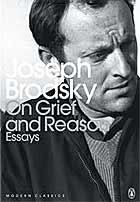
In Outlook, an excerpt from Joseph Brodsky's In Praise of Boredom:
But should you fail to keep your kingdom And, like your father before you come Where though accuses and feeling mocks, Believe your pain...- W.H. Auden, Alonso to Ferdinand
Known under several aliases—anguish, ennui, tedium, doldrums, humdrum, the blahs, apathy, listlessness, stolidity, lethargy, languor, accidie, etc—boredom is a complex phenomenon and by and large a product of repetition. It would seem, then, that the best remedy against it would be constant inventiveness and originality. That is what you, young and newfangled, would hope for. Alas, life won’t supply you with that option, for life’s main medium is precisely repetition.
One may argue, of course, that repeated attempts at originality and inventiveness are the vehicle of progress and—in the same breath—civilisation. As benefits of hindsight go, however, this one is not the most valuable. For should we divide the history of our species by scientific discoveries, not to mention ethical concepts, the result will not be in our favour. We will get, technically speaking, centuries of boredom. The very notion of originality or innovation spells out the monotony of standard reality, of life, whose main medium—nay, idiom—is tedium.
In that, it—life—differs from art, whose worst enemy, as you probably know, is cliche. Small wonder, then, that art, too, fails to instruct you as to how to handle boredom. There are few novels about this subject; paintings are still fewer; and as for music, it is largely non-semantic. On the whole, art treats boredom in a self-defensive, satirical fashion. The only way art can become a solace from boredom, the existential equivalent of cliche, is if you yourselves become artists. Given your number, though, this prospect is as unappetising as it is unlikely.
But even should you march out of this commencement in full force to typewriters, easels and Steinway grands, you won’t shield yourselves from boredom entirely. If repetitiveness is boredom’s mother, you, young and newfangled, will be quickly smothered by lack of recognition and low pay, both chronic in the world of art. In these respects, writing, painting, composing music are plain inferior to working for a law firm, a bank, or even a lab.
Herein, of course, lies art’s saving grace. Not being lucrative, it falls victim to demography rather reluctantly. For if, as we’ve said, repetition is boredom’s mother, demography (which is to play in your lives a far greater role than any discipline you’ve mastered here) is its other parent.
Posted by Robin Varghese at 06:27 PM | Permalink


Comments
Outlook is an interesting magazine, but it seems a bit bipolar. On the one hand, some articles are really good. On the other hand, other articles are really poorly argued.
Take this one by Swapan Dasgupta:
http://www.outlookindia.com/article.aspx?283592
Thoroughly 'confused'/'confusing' fellow. The whole premise of nation states being based on the rule of law is more or less based on the Westphalian nation-state model. Notwithstanding what Swapan Dasgupta says below, Indian nationhood is not necessarily based on 'universalist, secular AND republican' ideals. 'Universalism' is not at all mentioned in the Indian constitution. What is this cosmopolitan modernity this guy is talking about? Bringing in universalism is an absolute strawman argument. Also, why is this a 'left-liberal elite's' view of the 'idea of India'? There are plenty of people who are very much right of center and absolutely are on board with the Westphalian model of nation-statehood. Needless to say, one absolutely does not need to subscribe to this supposed Nehruvian consensus.
It sounds like this guy has deliberately kept himself unaware of libertarianism, Republicanism, Chicago School Economics, et cetera, et cetera, because those schools of thought would have offered at least some way of 'reviewing' the world in different ways that would have argued against the position that Swapan D. is taking.
These intellectual positions are very weird intellectual positions.
I think his problem is that he is trying to somehow 'intellectualize' the BJP's political positions, i.e., trying to make those political positions intellectually robust. He is failing miserably there. The reason he is failing is something I have spent some time thinking about. The major reason is this : Indian political parties are not based on political beliefs, i.e., are not organized along lines of political ideology. This makes it difficult to anyone to accept all of their political opinions. In America, it is a cafeteria style choice. Pick what political party you want. Depending on whether you are more a fan of right wing economics or left wing economics, you can pick and choose your political party. In India, this is impossible. You have to somehow be willing to believe the ridiculous things that Sharad Pawar might say if you are with Congress(I) or the ridiculous things that V.P. Singh might say/have said if you are with the Janata Dal. But rationalizing these ideas in the context of your actual deeply held political beliefs might be impossible.
Anyway, I don't understand how this guy has a serious readership.
Posted by: Anand Manikutty | Jan 22, 2013 9:54:42 PM
Post a comment