by Sue Hubbard
 How do we remember? Before the invention of the camera most people never possessed a likeness of themselves or those they loved – a lock of hair, a letter, were the heart’s most treasured possessions, the artefacts that conjured the past. Photography democratised the ownership of images. A portrait need no longer be in watercolour or oils, it could be an informal snap taken on a box Brownie: a casual moment sealed in the proverbial amber of memory. With the technological advances of the 20thand 21st centuries, with film, video and digital technology and the predominance of surveillance equipment it might, theoretically, be possible to record a whole life from the moment of birth till the second of death. It was only a decade or so ago that the French Postmodernist social theorist Jean Baudrillard argued that the images which assault us – on our TVs, in film and advertising – are not copies of the real, but become truth in their own right: the hyperral. Where Plato had spoken of two kinds of image-making: the first a faithful reproduction of reality, the second intentionally distorted in order to make a copy appear correct to viewers (such as a in a painting) Baudrillard saw four: the basic reflection of reality; the perversion of reality; the pretence of reality, and the simulacrum, which “bears no relation to any reality whatsoever”. Baudrillard's simulacra were, basically, perceived as negative, but another modern French philosopher, Gilles Deleuze, has described simulacra as the vehicle by which accepted ideals or a “privileged position” can be “challenged and overturned”. Reality has become a complex issue.
 Jonas Mekas was 90 on Christmas Eve, which means that the film-maker, artist and poet, often referred to as the godfather of avant garde cinema, has lived through a lot of history. Born in Lithuania he spent part of the war in a forced labour camp, then after the hostilities ended, another four years in various displaced person’s camps such as Flensburg, Hamburg, Wiesbaden, Kassel – first in the British Zone, then in the American. With nothing much to do and a lot of time he read, he wrote and went to the movies, which were shown free in the camps by the Americans. So began his long relationship with film. Later, when he commuted to the French Zone to study at the University of Mainz, he met André Gide who told him to “work only for yourself,” and watched a lot of French cinema. After arriving in America he bought his first Bolex camera in 1950, which he used to film everyday scenes in Williamsburg, Brooklyn, and the Lithuanian immigrants who lived there. Describing himself and his brother as “two shabby, naïve Lithuanian boys, just out of forced labour camp”, it was not until some 10 years later that he decided to assemble the footage into a film.
 His has been a radical vision. He has said he wanted “to celebrate the small forms of cinema, the lyrical forms, the poem, the watercolour, etude, sketch, portrait, arabesque, bagatelle and little 8mm songs. I am standing”, he went on, “in the middle of the information highway and laughing, because a butterfly on a little flower somewhere just fluttered its wings, and I know that the whole course of history will drastically change because of that flutter. A super-8 camera just made a little soft buzz somewhere on New York’s Lower East Side and the world will never be the same”. In his ‘first draft’ of the Brooklyn material, Diaries, Notes and Sketches (Walden), he was already employing his signature documentary style: using intersecting time-planes, and linking memories associated with the loss of his home, alongside current footage of NYC, making associations between images that he overlaid with a palimpsest of poetic observations and direct emotional commentary. His fist script, written in 1949, entitled Lost Lost Lost Lost (as opposed to 3 Losts in the title of the 1979 remake) was an angry piece that drew attention to the fact that Estonia, Latvia and Lithuania had, after the war, been sacrificed by the West to the Soviet Union. Captured simply and directly, all the footage was taken with just one or two flood lamps with no attempt to be ‘artistic’.
 As a published poet he has brought a particular sensibility to his films; a sense of loss and homelessness experienced when driving through snowy city streets or Central Park or, as in his more recent 365 Day Project, 2007, a lament to a Brooklyn tree felled by a storm. Such points of view have become his hallmark. His poetry is written in Lithuanian – for he believes that one can only write poetry in the language in which one grew up – so that his films have become a more expansive and direct ‘Esperanto’ expression than his writing. Very quickly after arriving in America he became a key player in the bohemian arts community of his adopted city, alongside those who would become his friends and collaborators, including Andy Warhol, John Lennon, Allen Ginsberg and film-makers Kenneth Anger and Maya Deren.
His diary format is more than simply an art form. Not only does it unite art and life but life becomes art and not just reportage though a process of recording, selection, editing and framing. His work constantly asks ‘what do we remember?’, ‘what do we forget?’ Returning to the displaced persons’camp, he discovers the factory he worked in is still there – but like our memories – it has been transformed. The mundane and everyday become art by virtue of their preservation and framing. It is as if he has redrawn Descartes principal about perception to become: I record, therefore, I am, as if it is the very act of witnessing and remembering that makes us human. To record becomes not only a facet of memory and history, but a process of metamorphosis and transformation.
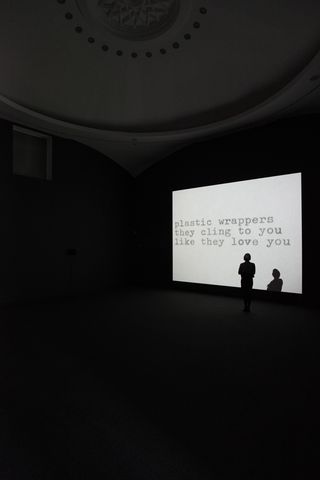 Mekas’s work at the Serpentine represents a broad range of his activities. It covers his passion for film, his relationship with artists and cinematographers, his involvement as co-founder of Film Culturemagazine in 1955, and his commitment to avant-garde and underground film, as well as his activities as a writer, with his manifesto-style texts and collections of poems. As early as 1968 he had radical ideas about screening films in places other than cinemas, where viewers could decide how long they wanted to watch a particular film, making it an interactive, democratic affair between viewer and film-maker. “We cannot,” he has said, “judge the length of a film today at all […] because we go by imposed length conventions, we are conditioned to lengths…we walk into a theatre, and we are supposed to sit for an hour and a half […]we still insist on a ‘one sitting’ movie”.
In this sense Mekas is a true postmodern. He understands, exactly, the fragmented, impressionistic, and conditional nature of the world in which we live. In Birth of a Nation, 1997/2007,which documents portraits of friends and acquaintances – both famous and less well known – to his 365 Day Project, 2007, he shows us that art is less about ‘a subject’than about ‘a sensibility’ and a way of seeing the world. The everyday, the ordinary become art through a process of framing and selection. Time and history do the rest.
List of Images:
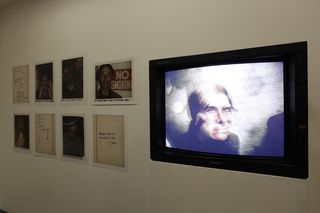
MG_3195
DUMPLING PARTY 2012
Mixed media
Dimensions variable
Installation view, Jonas Mekas
Serpentine Gallery, London
(5 December 2012 – 27 January 2013)
© 2012 Jerry Hardman-Jones
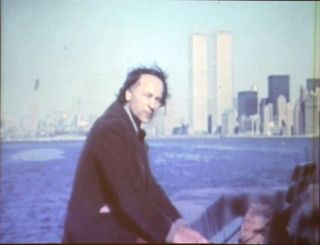
MG_3266
WTC HAIKUS2010
16mm film transferred to video
14min 4sec
Installation view, Jonas Mekas
Serpentine Gallery, London
(5 December 2012 – 27 January 2013)
© 2012 Jerry Hardman-Jones
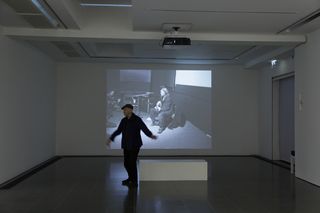
MG_2883
THE FIRST FORTY 2006
16mm film transferred to video, video
Each film 5-12 min long
Installation view, Jonas Mekas
Serpentine Gallery, London
(5 December 2012 – 27 January 2013)
© 2012 Jerry Hardman-Jones_
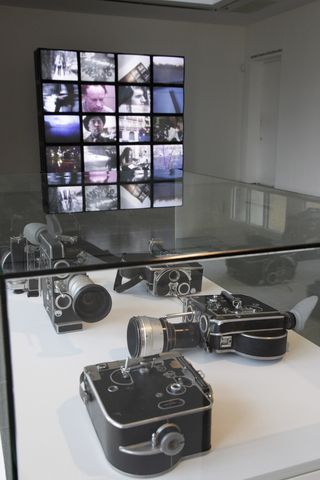
MG_2993
LAVENDER PIECE 2012
16mm film transferred to video, various dates
Each film 5-15min long
Bolex cameras owned by Mekas
Installation view, Jonas Mekas
Serpentine Gallery, London
(5 December 2012 – 27 January 2013)
© 2012 Jerry Hardman-Jones
MG_3095
Outtakes from the Life of a Happy Man 2012
16mm film transferred to video
68min
Installation view, Jonas Mekas
Serpentine Gallery, London
(5 December 2012 – 27 January 2013)
© 2012 Jerry Hardman-Jones
www.serpentinegallery.org
Text: © Sue Hubbard
www.suehubbard.com
Her new novel GIRL IN WHITE can be ordered from:
www.inpressbooks.co.uk/girl-in-white/
“A literary tour de force; you are the less for not reading it.”: Fay Weldon
