
January 14, 2013
Eating God (随 筆)
by Leanne Ogasawara
Talking about sacred music the other day, the Rabbi quite unexpectedly said, the name Bethlehem means the "house of bread," or "the house of lambs for sacrifice." Just think about *that* for a minute.
Sacrifice. Whether understood in the traditional ritual do ut des terms familiar throughout much of Asia; or in the liturgical terms of the Eucharist; or even in the grisly terms of ancient Mediterranean polytheism--I wonder whether these acts haven't served to help to lead us away from the dangers of self-deification (even if it leads to other perils).
Binding the individual in communion with others, ancestors, and gods: this call to transcendence was certainly what was behind Guru Dreyfus and Kelly's book, All Shining Things. For as Heidegger famously said, "Only a god can save us."
Life is more sterile now, anyway.
My own interest in this topic goes back to Carthage. Always and forever dreaming of time-travel, ancient Carthage was for a long-time my top choice destination. Hannibal-obsessed, I thought Carthage would be an interesting place to see. That is, until a friend re-minded me that the Phoenician custom of child sacrifice was practiced notoriously in Carthage. (I only have one son, after all!)
Stanford University professor and archaeologist extraordinaire Patrick Hunt is also pretty obsessed with Carthage. He is yet another great man in a long line of great men in search of Hannibal's route across the Alps.(That is John Hoyte crossing on elephant in the picture below). In Hunt's Carthage lectures he talks about the Carthiginian god Ba'al Hammon. This Baal was the same Baal known in the Bible as Ba‘al Zəbûb. Translated as "Lord of the Flies," Hunt says this word is a visual image depicting the innumerable flies attracted to the massive amount of offerings of raw meat that were sacrificed to the statues of Ba'al in Can'an. It was all so long ago, and yet no matter what sources you read, whether Biblical or Roman historical-- it seems conclusive that the Canaanite religions centered around sacrifice --sometimes human. And this was notoriously so at Carthage.

Ba'al, or Ba‘al Zəbûb, was the Beelzebub of the Bible. And, it was to the custom of child sacrifice about which Abraham was to manifest the big break.
That was the context.
Abraham was prepared to do what others had done before him. Sacrifice his son. In Carthage, especially child sacrifice was practiced on a large scale-- and they were mainly boys' bones found in the urns, I believe. But, as Abraham steps up an raises the knife, God stops him. Knowing that Abraham fears God, God thereby allows a ram to be sacrificed instead. This was a fundamental moment for all three Abrahamic religions--still celebrated every year in the Feast of the Sacrifice of Eid al-Adha, for example.
One of my very favorite philosopers Kierkegaard had a life-long fascination with this story. Like a lot of people, I think he found it absolutely outrageous. Indeed, not long before Kierkegaard, Kant had came right out and said that Abraham should have stood up to this so-called voice of God--for in its pure irrationality, how could it truly be God?
The Maverick philosopher lays out Kant's argument below:
1. It is certain that one ought not kill one's innocent son.
2. It is not certain that a seemingly divine command to kill one's innocent son is truly a divine command.
Therefore
3. One ought to trust one's moral sense and not the putative divine revelation.
Therefore
4. ". . . if it [a scriptural text] contains statements that contradict practical reason, it must be interpreted in the interests of practical reason." (65)
Kierkegaard begins here as well, and I guess he would even get as far as Kant's #2. However, Kierkegaard goes on to draw a very different conclusion than Kant; for he posits that above human reason, there is an even higher realm-- which he calls that of Faith. And through what is a "leap of faith," the rational is subsumed into something which stands outside of reality and is beyond logic and reason. It is in this way, according to Kierkegaard, that the Knight of Faith overcomes death.
Kierkegaard, being a Lutheran philosopher, would naturally make this move to retain faith vis-a-vis sacrifice (ie, a passionate commitment that one would die for). I mean, with Kierkegaard's existentialist Christianity, one cannot really help but appreciate this move full circle from human beings sacrificing to God to God sacrificing for human beings (whom he created out of love and a longing to be known--says yet another of the Abrahamic religious traditions).
"This is my body which is for you. Do this in remembrance of me." (Corithinians)
In the places I have lived--far, far beyond the reaches of the Abrahamic traditions-- sacrifice (in the form of offerings and festivals) and communion (in the form of communitarian values) is a part of life. In Japan, Hong Kong, Bali... just to name of few, people regularly make offerings and participate in communal festivals, and I think it is safe to say that there too, this comes from a similar belief that in the pouring of self (ie sacrifice) there comes an increased Being.
Dreyfus calls this a transcendent experience. But it is also a "binding" experience. Jane Harrison, in her book Themis, would say that, "the communal feast, the renewal of group unity, and the definition of the individual reborn as part of the social group is a symbolic feast; for Communion will always be both feast and sacrifice."
I really liked this recent essay by Mark Morford in which he sees variations of extremism in terms of dis-connection. I too think the extremism seen in the US points to a communal coming apart; or as Morford says "Extremism implies disconnection. And more extreme = more disconnection."
He goes on though:
But the good news is, it also begets the opposite: more compassion, education, distinction, discretion, patience, quiet, inner focus also equal calm, stability, peace. Does it make sense? The old gurus only smile at your panicked expression: Why are you so freaked out by stillness?
Why indeed? Except of course, that I am not sure that extremism and dis-connection can, in fact, lead to more compassion, patience, inner focus, etc... But, it would be nice to think so, though.
++
Thanks to Jeff Richey for being part of the conversation.
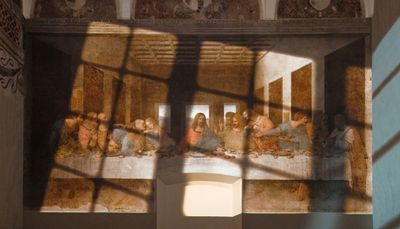
Topic image is a still from Peter Greenaway's Leonardo's Last Supper
随筆= Zuihitsu
Babette's Feast below.
Posted by Leanne Ogasawara at 12:20 AM | Permalink


Comments
People understand sacrifice of life given the right cultural context. Someone I knew once told me Stravinsky's Rite of Spring was too wild and barbaric for him, involving a human sacrifice in fertility rites, yet he got very upset when I reminded him that he didn't see it that way every week at church when he took communion.
Obligatory xkcd link: http://xkcd.com/1152/
Posted by: Al Wheeler | Jan 14, 2013 7:15:38 AM
I was listening to a Johnny Cash version of an old song, Redemption, talking about "the blood that came down" when Jesus was crucified. I don't know enough about theology to seriously discuss the implications, but wasn't that the sacrifice God made to man, an exchange of blood for....something, maybe sin? It would be interesting to see the early interpretations of this event and whether it was considered a sacrifice. Speaking as a Buddhist scholar, occasional Kant dabbler, Kierkegaard dis-truster (sorry!), and outsider to Christian studies, "the sacrifice of the only-begotten Son" (if memory serves) seems like a meta version of earlier sacrificial practice.
Posted by: Chelsea | Jan 14, 2013 10:23:59 AM
Here's food for thought. What evidence, actual evidence, is there to collaborate the theory that Hannibal invaded Roman Italy from the north and fought for decades against Roman armies? Besides of course Roman and Greek historians' accounts. Well, it is the discovery in the late 19th century of a single coin from Carthage near Capua. There is no other actual evidence -- bones, carvings, nothing. Think about that one.
Also, I recall, years ago in Hong Kong, while giving a lecture on Vietnam in passing, noting one of the "stranger" [to me, clearly] religions of the Vietnamese was the Cao Dai religion centered in Tay Ninh with its pantheon of saints stretching from Buddha to Victor Hugo. An alert young Japanese student asked if I knew of any major religion in the world today that practiced widespread cannibalism. I told her I could think of none. She suggested Christianity. She asked, "Is it not true that every Sunday as part of their religious ceremonies the Christians eat the body of the only child of their God and drink his blood?" Well, gulp, I thought, yes indeed they do. End of my lecture on the strangeness of the Cao Dai faith.
Posted by: cesar de ocampo | Jan 14, 2013 1:49:03 PM
Chelsea:
“Oh God said to Abraham, "Kill me a son"...
Well Abe says, "Where do you want this killin' done?"
God says, "Out on Highway 61."
There is a great book on the Jewish roots of Eucharist, whih doesn’t talk about the earlier pagan rites but discusses the Eucharist just in terms of the cultural context of that time—highly recommend it to you!
http://www.amazon.com/Jesus-Jewish-Roots-Eucharist-Unlocking/dp/0385531842
PS: I couldn't locate the citation but I am almost positive that Tom Sheehan (Stanford University Heideggerean and Roman Catholic) says that the blood atonement interpretation of the awakening (aka Resurrection) is a modern fundamentalist interpretation not found in the Gospels... this is way outside my own area so take with grain of salt and proceed with great caution :)
Posted by: Leanne Ogasawara | Jan 14, 2013 2:29:48 PM
Was thinking of sacrifice just yesterday, so this essay (or are we supposed to call it a posting?)seemed particularly relevant. I'm reading E.O. Wilson's "The Social Conquest of Earth." Wilson talks about "creation myths" which he says are the essential bonds that held a tribe together, provided identity, vouchsafed law, encouraged valor and sacrifice and offered meaning to cycles of life and death. No tribe could survive without a creation story." I think you can still believe that to be true today, even if you are not a believer. It creates a lot of cognitive dissonance though.
Posted by: Jake | Jan 14, 2013 3:11:54 PM
Cesar, it is such a romance, isn't it? Patrick Hunt, who goes on expeditions there most summers, says, "how could all those elephants and Hannibal's army not have left any trace of their passing? It is a mystery and yet--as you said, we do have that one coin....
Alpine Elephant is such a charming story--have you read it?? http://www.amazon.com/Alpine-Elephant-In-Hannibals-Tracks/dp/B001V9QRJW
I also was fascinated by the Cao Dai temple outside Saigon..
Posted by: Leanne Ogasawara | Jan 14, 2013 10:09:26 PM
Wonderful journey into timeless themes -- history, faith and food. One of my favorite reflections is Kierkegaard's "Pinch of Spice." Here is God the Cook.
Oh, the Governance of the world is an immense housekeeping and a grandiose painting.
And yes, sacrifice is essential to the recipe. Not all sacrifices are voluntary. And sadly, many are never known or remembered. But all are part of the future, however it unfolds. Kierkegaard's Journals are a cookbook for living.
http://kierkegaarden.wordpress.com/a-little-spice/
Posted by: John Ballard | Jan 15, 2013 8:02:23 AM
Leanne, I thought your piece on sacrifice was really interesting. A couple of things that are well off to the side of your points but that came to mind as I read: One, as a (qualified) Carthage fan, do you know that a highly respectable historical linguist, Theo Vennemann, has argued on the basis of extensive linguistic and cultural evidence that Carthage colonized northwestern Europe at some point before the Roman Empire, and that the Germanic languages very clearly bear the mark of the influence of the Phoenician language as a result? Among his sub-arguments is that the Norse/Germanic god Baldur is actually a version of Baal — and he can show versions of the name Baal in Semitic languages that could easily have morphed into Baldur.
The other thing is that in a paper a few years ago I made a not-very-formal suggestion that the text of the Catholic mass itself, contrary to the Church's modern understanding, may show a do-ut-des structure, specifically in the Credo section. My argument was that "credo" in Latin originally meant "to entrust something to somebody," or even "to lend," as well as "to believe" — belief in something being a kind of tentative entrusting — and that in the Credo we see a long series of "credo in..." clauses, asserting a series of acts of belief or entrusting, culminating in the final "ET EXSPECTO...," which spells out what one expects / looks forward to in return for the loan of one's trust/belief — namely resurrection and eternal life, a pretty nifty payoff. I don't know whether any historian of Christianity would buy this, but I managed to convince myself, at least for the length of that paper.
Posted by: Zhao Mingcheng | Jan 15, 2013 10:20:01 AM
Message to Master Zhao and Monsieur Ballard:
Ah... we Carthage fans. I think as a group it could be said, we love the underdog? My tea teacher once said to me that she hated Hollywood movies since they rarely understand that people are more interesting in the failures. She thought Napoleon was infinitely more interesting in his failings than in his successes....
I know a preacher who is crazy about French philosophy and he emailed to say, “don’t forget about Girard!”
I think this concept of “belief as a trusting” is interesting. In fact, reading your comment and thinking about it, I wondered whether it wasn’t to this “tentative trusting” (vis-a-vis the expectations) that Kierkegaard wasn’t concerned with? I am thinking of his move to see belief as a “stand.” (ie belief=trusting enough to act). It is this intensely personal “gut check” on the level of the individual. And I just feel compelled to say we have to remove all the contemporary psychological baggage around this word, individual, since in the end all he was saying is that it is stand “to act.” ( 知行合一)
In Kierkegaard, at least, I think it is a “leap” that goes much beyond the tentative. That is my real thought about this. And, this maybe even spports your argument since it could have very well been this “mass mentality at Mass” that he was counter-balancing or moving away from?
But this is also a move away from ritual. For sacrifice/ritual imply communion/community with others.... ie, 人間→ 人と人との間柄、倫理→行為的連関
As a lover of Watsuji, how could I resist this:
"Totality is said to be established in the negation of the individual, but it cannot come out of the negation of a single individual alone. Individuals are many, and by casting off their individuality, those many individuals become one, and thereby a totality is established as a communal existence. However, in no totality whatsoever can we say that individuality is completely extinguished. So soon as the negated individual becomes an individual once more by negating totality, the movement of negation repeats anew. Totality subsists only in this movement." (WTZ 10:27)
More on Girard later...
JB, I loved the Kierkegaardian--thanks so much!!!
Posted by: Leanne Ogasawara | Jan 15, 2013 1:07:43 PM
The story about Abraham and Isaac can get one twisted in knots theologically. It makes more sense humanistically...i.e. why did the author write this story-- what was its polemical purpose? The Israelites were in contact with neighbors who sometimes conducted human sacrifice as part of propitiatory fertility rites, to keep the gods blessing them with children, flocks and herds, and crops. The Israelites distinguished themselves from their neighbors with circumcision, kosher food laws, etc, and a refusal to go along with the barbarism of child sacrifice. So Abe/Isaac is an etiological story to tell later Israelites when the transition from child to animal sacrifice occurred, and to provide a justification for acting as their putative founder did, rather than as their neighbors do.
Posted by: Brian | Jan 16, 2013 2:28:38 PM
It does make more sense humanistically--just as you said, Brian.
A friend reminds me of an apparent existence of a narrative tradition in which Abraham DOES sacrifice Isaac –
http://www.js.emory.edu/BLUMENTHAL/Levenson.html
But that said, I really do agree with you... It is a dramatic way of saying--we are different. Indeed, the ba'al lovers were disparaged by Hebrews, Romans and on and on....
Thanks so much for your comment!
Posted by: Leanne Ogasawara | Jan 16, 2013 3:59:09 PM
A lot of Genesis was from a redactor stitching together earlier Elohist and Jahwist versions, and some think the E source had Isaac being killed, while J had him spared. By the time redaction occurred, they went with the J version, and the article you reference bears out the signs of why this was: 1) they had child sacrifice; 2) they made various substitutions for it; 3) they denied the first phase had ever occurred among themselves. So, the final Tanakh redaction followed that, as well as the rabbinical midrash.
Thanks for the fascinating essay.
Posted by: Brian | Jan 16, 2013 5:53:32 PM
Post a comment