
December 09, 2012
Why the Anti-Mursi Protesters Are Right
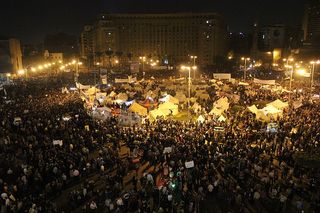
Ahmad Shokr in MERIP (image from Wikimedia commons):
The draft constitution does not reflect a democratic consensus, as many in the opposition have argued that it should. It reflects an emerging relationship between the Muslim Brothers and existing state institutions, like the army, along with a great deal of appeasement of the salafis, whom the Brothers have embraced as junior partners. The rush to a referendum suggests a deep anxiety among the state elites about continuing instability and a desire to seize the opportunity to cement a new political framework as quickly as possible. More worrisome than the text itself is the vision these leaders have for which voices count and which alliances matter in the new Egypt. Should this vision go unchallenged, the losers would be all those who have been calling for more pluralistic and inclusive system.
In his December 6 post, Jason Brownlee writes, “It is important that the ideological debate between liberalism and Islamism not be seen as a battle between democracy and authoritarianism.” Perhaps recent events in Egypt call for a rethinking of these terms. True, liberalism and democracy are not automatic counterparts, no more than Islamism and authoritarianism are. But the battle in Egypt is indeed one between a democracy that reflects the country’s political diversity and a remodeled authoritarianism, led by the Muslim Brothers and their allies, that seeks to circumscribe it.
Posted by Robin Varghese at 01:03 PM | Permalink


Comments
This is pure nonsense. This is a battle between secular and religious groups.
We have a democratically elected president, a constitution created by a democratically elected body that is being submitted to the populous for a democratic vote of approval.
If the Muslim Brotherhood had lost the election and was now in the streets, no one would be concerned that the constitution failed to have a "democratic consensus" that included their religious tests.
This is actually a danger of our fascination with democracy in the west. For democracy to work there needs to be sufficient consensus that losers are willing to accept their opponents being in power. And the winners are willing to accept that their opponents may return to power. When that fails, as it did in the United States before the Civil War, democracy is no longer a solution.
Posted by: Ross Williams | Dec 9, 2012 2:01:58 PM
I think not, Ross. The current struggle in Egypt is for democracy, not secularism. Granted there is a strong relationship between islamism and undemocratic governance, the struggle is primarily FOR democracy rather than AGAINST Islamism. After all, Egypt under Mubarak has for the past 3 decades been a largely secular state, so it is hard to see how secularism itself could be the driving motivator for the opposition.
Posted by: Max | Dec 9, 2012 5:31:02 PM
Post a comment