
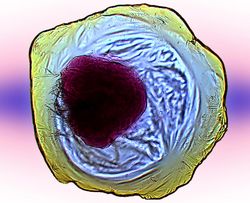
December 14, 2012
Was life inevitable?
From PhysOrg:
A new synthesis by two Santa Fe Institute researchers offers a coherent picture of how metabolism, and thus all life, arose. The study, published December 12, 2012, in the journal Physical Biology, offers new insights into how the complex chemistry of metabolism cobbled itself together, the likelihood of life emerging and evolving as it did on Earth, and the chances of finding life elsewhere. "We're trying to bring knowledge across disciplines into a unified whole that fits the essentials of metabolism development," says co-author Eric Smith, a Santa Fe Institute External Professor.
Creating life from scratch requires two abilities: fixing carbon and making more of yourself. The first, essentially hitching carbon atoms together to make living matter, is a remarkably difficult feat. Carbon dioxide (CO2), of which Earth has plenty, is a stable molecule; the bonds are tough to break, and a chemical system can only turn carbon into biologically useful compounds by way of some wildly unstable in-between stages. As hard as it is to do, fixing carbon is necessary for life. A carbon molecule's ability to bond stably with up to four atoms makes it phenomenally versatile, and its abundance makes it suitable as a backbone for trillions of compounds. Once an organized chemical system can harness and manipulate carbon, it can expand and innovate in countless ways. In other words, carbon fixation is the centerpiece of metabolism – the basic process by which cells take in chemicals from their environments and build them into products they need to live. It's also the link between the geochemistry of Earth and the biochemistry of life.
More here.
Posted by Azra Raza at 07:38 AM | Permalink


Comments
Of relevance to the subject are Harold Morowitz papers and ideas.
http://www.santafe.edu/media/workingpapers/06-08-029.pdf
Posted by: Félix E. F. Larocca, MD | Dec 14, 2012 8:26:00 AM
"Creating life from scratch requires two abilities: fixing carbon and making more of yourself. The first, essentially hitching carbon atoms together to make living matter, is a remarkably difficult feat."
The ~10.21 billion years of abiotic evolution that produced carbon in stars is a remarkably difficult feat as well.
That carbon evolved in a ~10.21 billion year process compared to all life evolving in a comparatively small ~3.54 billion years is rarely addressed.
Likewise, the indication of abiotic intelligence preceding biotic intelligence is rarely addressed.
Posted by: Dredd | Dec 14, 2012 12:58:42 PM
Great link Felix.
Posted by: Dredd | Dec 14, 2012 1:06:10 PM
"Was life inevitable?"
One does not need chemistry or biology to answer this. Based on the principal of causality (determinism), anything that has happened was inevitable.
The more interesting question is could life (or for that matter any future event) have been predicted. To do so would require perfect knowledge, but if one had that, what would be left to predict?
Posted by: Raza Husain | Dec 14, 2012 1:21:50 PM
Post a comment