| ABOUT US | ARCHIVES | LINKS | RSS FEED | MONDAYS | |

3quarksdaily

An Eclectic Digest of Science, Art and Literature

« Looking for America | Main | Wiping away tears, Obama mourns children killed in school shooting »

December 15, 2012

Twelve facts about guns and mass shootings in the United States

Ezra Klein in The Washington Post:
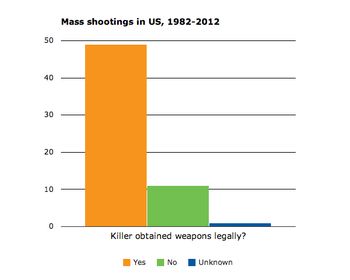
Mass-shooting-legallyIf roads were collapsing all across the United States, killing dozens of drivers, we would surely see that as a moment to talk about what we could do to keep roads from collapsing. If terrorists were detonating bombs in port after port, you can be sure Congress would be working to upgrade the nation’s security measures. If a plague was ripping through communities, public-health officials would be working feverishly to contain it. Only with gun violence do we respond to repeated tragedies by saying that mourning is acceptable but discussing how to prevent more tragedies is not. “Too soon,” howl supporters of loose gun laws. But as others have observed, talking about how to stop mass shootings in the aftermath of a string of mass shootings isn’t “too soon.” It’s much too late. What follows here isn’t a policy agenda. It’s simply a set of facts — many of which complicate a search for easy answers — that should inform the discussion that we desperately need to have.

1. Shooting sprees are not rare in the United States. 

Mother Jones has tracked and mapped every shooting spree in the last three decades. “Since 1982, there have been at least 61 mass murders carried out with firearms across the country, with the killings unfolding in 30 states from Massachusetts to Hawaii,” they found. And in most cases, the killers had obtained their weapons legally:

2. Eleven of the 20 worst mass shootings in the last 50 years took place in the United States.

Time has the full list here. In second place is Finland, with two entries.

More here.

Posted by Azra Raza at 06:55 AM | Permalink

Comments

And out will come the predictably ignorant and childish slogan of "guns don't kill, people do!" or "an armed citizenry is better able to take down these guys" (yeah, because that's exactly how all these mass shootings end..... right?..) Take a look at the stats, people.

How can a nation be collectively SO childish that a popular and smart president can't push through common-sense initiatives, seen to work worldwide, to protect its own citizens? Fuck the NRA. Are Americans that piss-weak? (oh, yeah, that's right, they don't even believe in universal, affordable healthcare) Weird....

Posted by: MattInOz | Dec 15, 2012 8:10:54 AM

There seems to be a correlation between berserker shootings and psychotropic drugs:

http://psychrights.org/index.htm

Posted by: Louise Gordon | Dec 15, 2012 9:55:19 AM

I am curious to know what you guys think of Mark Ames analysis about a lot of this stuff (He wrote 'Going Postal')
This type of public violence in america seems to come in waves for a decade or two at a time, but for whatever reason it has really picked up steam since the Reagan Revolution (also known as the moment the middle class started circling the drain). This kind of thing was unheard of in the 50's, 60's etc, despite the US having plenty of small arms back then. I'll try to find a link to one of his pieces that somehow connects those two things, as I lack the skill and memory of the argument to relate it all here.

Oh, and this shit is really fucking depressing and pointless and senseless and awful. I almost threw my hunting rifles in the pacific ocean yesterday.

Posted by: DrunktankDan | Dec 15, 2012 3:39:23 PM

Australia, with a population of only 20 million, had 5 gun massacres between 1984 and 1996. (not just one as reported in Time) The worst was the Port Arthur massacre of 1996 with 35 dead and 21 injured. Public outrage prompted the then conservative government to legislate strict gun controls, which at the time were unpopular with their own political base.

Since the institution of gun control there have been no more massacres.

Posted by: nickm | Dec 15, 2012 5:58:14 PM

http://ssristories.com/index.php

Posted by: Louise Gordon | Dec 15, 2012 8:28:01 PM


KNIVES AND GUNS WHEN I WAS A KID

A kid from the city, I spent a few weeks every summer on a farm. There was the dairy farm of my maternal grandparents. Many of my aunts, uncles, cousins, and their friends and in-laws lived on working farms. It would be a mistake to romanticize farm life. There was plenty of mental illness, family strife, and dysfunction to go around. It was getting more difficult to support a family without one household member having a non-farm job.

Yet, I had fun with my cousins and favorite aunts and uncles, and got to drive a tractor when I was thirteen. My cousins were driving Massey-Ferguson tractors and pulling a hay baler at 8 years old.

Every farm boy carried a good pocket knife with a blade that was kept very sharp by the grind wheel in the tool shed. That knife went everywhere the kid went, including school. A sharp pocket knife was pure utility for opening a box, cutting a line, sharpening a pencil, and shaving a clarinet reed during band practice. It was as ubiquitous as today's cell phone, without the social networking.

I envied my cousins. I always wanted a good pocket knife. I didn't know what I would do with one at home in the Bronx, NY. Also, I knew I couldn't take to school.

Every farm boy had a rifle at home. It may have been shared by the entire family, or dads and sons each had their own. No one had a gun rack on the rear window inside the cab of the pickup truck. But, it was likely there was a rifle under or behind the seat. Every boy, even if he wasn't living on a working farm, could shoot. He was taught by his father with healthy doses of gun safety and respect for a dangerous weapon. Getting a certificate in gun safety from a certified NRA instructor was customary though redundant.

My uncle Carl had a .22 rifle on his tractor. If a crow came within sight while he was driving, it was toast. Uncle Stie was legendary at being able to shoot a bat hanging on the ceiling of his barn with his .22. He did this at dark with my cousin or me illuminating the tiny target with a flashlight.

Others had rifles or shotguns suitable for large game. Some liked the military rifles like the M-1 Garand, the 1903 Springfield, the German Mauser, or the British Lee-Enfield. The Lee-Enfield is still my personal favorite though it's been decades since I had one.

Back home in the city, a few friends aspired to be great white hunters or just wanted to do target shooting. Attending an NRA class on gun safety was a legal requirement. There was no political connotation to 'NRA.' NRA meant gun safety, and there was a certain amount of satisfaction and even cache' to taking the class. It gave you a sense of righteous power when, upon being handed a rifle, you could hold up your palm to the face of the offerer and say, "I will not take that rifle from you until you hand it to me with an open bolt and an empty chamber."

What about knives and guns today? The only thing I can say is that my narrative stops, abruptly. In my personal view, it is not a preamble nor a segue to the present time. There are no parallels in the present urban and suburban society to my observations of nonchalant utility, dads and sons, .22s, farms, crows, bats, and gun safety pride. So I stop, abruptly.

Posted by: Norman Costa | Dec 16, 2012 1:54:23 PM

The most important point to make about gun violence is hidden in this story - most gun deaths *don't* happen in mass murders. These 60 massacres total about ~1000 (didn't count, just sampled and eyeballed. Basically I'm saying a yearly average of ~30 with some skew) deaths over thirty years. By contrast, the US witnesses ~15k homicides a year, two thirds of which use guns. Even in a year with unusually many massacres (say a hundred victims) these represent under a percent of gun deaths.

So all this talk about gun control and assault weapon bans and mental health and background checks occurs in a context that has essentially nothing to do with the reality of gun deaths in the US. Only incoherence can result from a conversation that only confronts (in a manner of speaking; the aftermath of a mass shooting tends not to produce good analysis anyway) statistically insignificant events that live far out in the tail.

Posted by: prasad | Dec 16, 2012 2:03:51 PM

Prasad, the issue is not that massacres are a small percentage of homicides and therefore statistically insignificant and therefore not worthy of conversation. It is because that it is rare and the manner in which it takes place that shocks everyone to think about gun control that would reduce homicides as well. Let us hope massacres don't become so common that it becomes part of homicide statistics and we become blind to it too.

Posted by: Raza Husain | Dec 16, 2012 4:25:29 PM

Raza,

1) Focusing on these events distracts in terms of relevant causes. For example, everyone starts yakking about things like mental health, or bullying, or loners, or Aspergers. But these matters have nothing to do with drug violence, or gang violence, or armed crimes, or even crimes of passion, any one of which simply dwarfs these numerically negligible but newsworthy crimes. You might as well be doing gun policy by examining the killing patterns of serial killers, or by watching Criminal Minds. You can rinse and repeat with respect to type / legality of weapons used or use of armor, where too these events are quite atypical.

2) I don't think such situations actually change minds. Fundamentally these are times when people want to mourn and rubberneck. They don't want to do wonkery. You can always say that such events lead one to say "boo gun violence." But not even gun nuts disagree with *that.* The question is what to do, and what's the cost, and whether it's popular and whether it's legal and so on. And when the gun control talk is done always and only in the shadow of such events, the responses too are pro-forma, solid and respectable. You accuse your opponent of politicizing a tragedy with partisan politics. You say something about temporary security and essential liberties. And you say that guns don't kill, people do. And life goes on.

The basic issue is in fact the forgotten cost side of the ledger. If you only ever see it as thirty deaths a year that furnish therapeutic sadness and popcorn, then gun control matters they way controlling deaths by snakebite (look up the numbers) matters, which is to say not. Democrats can keep doing their annual or bi-annual gun control dance after these stochastic events, and the public support for gun control will continue to remain unaffected over any timescales longer than the media cycle, including those relevant to passing laws or elections or legal decisions.

Posted by: prasad | Dec 16, 2012 5:59:51 PM

Prasad, I think you are missing the point about human nature. True, far more people die of gun violence in situations that are not so-called "senseless" massacres as also do in car accidents, snake bites and from the flu than did in Newton, Aurora or Columbine. But people don't take note and a public conversation about guns doesn't take place because the deaths of a roomful of 6 and 7 year olds, carefree late night movie goers or people going to a temple on a Sunday morning in seemingly "motiveless" acts are generally more shocking than people caught in the cross fire of other human emotions like greed, jealousy or revenge.

So, what is wrong with starting the conversation about guns under these circumstances when our emotions are raw and when callous politicians can't hide behind the cover of the 2nd Amendment? After all, no tyrants were killed in Friday's rampage in Sandy Hook and no proud American's home / castle was invaded. Also, even though the public is outraged by the deaths of "innocents," I doubt that the serious gun control advocates are going to make their point based solely on these high profile mass murders. They surely know the statistics that you quote. If these horrendous events open the doors to a discussion about the rampant proliferation of high power fire arms in the hands of private citizens, I think we should kick that open instead of saying "this is not the time to talk about gun control when we are feeling emotionally wrought." Why in the world not? I keep hearing experts on TV advising schools on how they can make their schools more secure and train teachers to act like professional First Responders in an emergency like this. That is the wrong discussion. Schools should not have to become like fortified bunkers. It is time to talk about what to do about domestic terrorism and the use of military style weapons to settle private disputes and make society pay for an individual's lonely rage.

Posted by: Ruchira | Dec 16, 2012 7:19:09 PM

Ruchira, I've nothing conceptual against deploying such incidents for various rhetorical purposes. To the contrary - at least then the month long circus is in service of something instead of being pure rubbish. Where I'm coming from is probably a more cynical place than that: a tragic collection of deaths from time to time is enough to provoke sadness and catharsis and titillation. It isn't enough to provoke anything more. Things would be different if high profile shootings killed a thousand or two- one WTC was enough to bring about a variety of changes for better or worse (mostly for worse).
I suspect the "incident" based response is incapable of producing more than rage and sadness, both temporary. Actually, if that's how it has to be done, it would work better to have a two day blitz when someone died accidentally in a shooting, say once a fortnight, producing a constant and low grade discontentment with status quo. Not a big weepie that leaves you feeling fine after it's done. The stories should be individually irritating, not devastating. That's my read of the psychology of these events over the past five or six years at any rate.

Posted by: prasad | Dec 17, 2012 11:12:38 AM

Post a comment


Subscribe to this blog's feed  

PayAnywhere with iphone credit card swiper

Android Tablet

Bluetooth Headset

2013 New Style Dresses

Compare Car Rental Prices

DHgate.com Wholesale

3QD on Facebook

3QD on Kindle

3QD by Daily Email

Receive all blogposts at the same time every day.

Enter your Email:


Preview 3QD Email

3QD on Twitter

Miscellany

Lijit Search

AddThis Social Bookmark Button

Add to Google

Recent Comments

Dredd on Race Is Not Biology

Dredd on Race Is Not Biology

allsmiles on A Mother, a Son and a Wife

sverson on Race Is Not Biology

carlos on Daniel Dennett's seven tools for thinking

araldo on Race Is Not Biology

jo smith on Daniel Dennett's seven tools for thinking

Louise Gordon on Why race as a biological construct matters

Louise Gordon on Race Is Not Biology

Dave on Race Is Not Biology

Bill on Daniel Dennett's seven tools for thinking

Boursin on Why Rational People Buy Into Conspiracy Theories

Usha Alexander on Race Is Not Biology

Abbas Raza on Daniel Dennett's seven tools for thinking

X on Race Is Not Biology

Usha Alexander on Race Is Not Biology

jo smith on Mohsin Hamid: 'Islam is not a monolith'

araldo on Mohsin Hamid: 'Islam is not a monolith'

Dr. X, Ph.D. on Race Is Not Biology

jo smith on Physicists Create Quantum Link Between Photons That Don't Exist at the Same Time

jo smith on Mohsin Hamid: 'Islam is not a monolith'

omar on Why race as a biological construct matters

Dr. Smith on Race Is Not Biology

Sundar on Daniel Dennett's seven tools for thinking

Sundar on Daniel Dennett's seven tools for thinking

Acclaim For 3QD


"I couldn't tear myself away from 3 Quarks Daily, to the point of neglecting my work. Congratulations on this superb site."—Steven Pinker, Johnstone Professor of Psychology, Harvard University.

"I have placed 3 Quarks Daily at the head of my list of web bookmarks."—Richard Dawkins, Charles Simonyi Professor of the Public Understanding of Science at Oxford University.

"Just wanted you to know I’m one of many who reads and enjoys 3 Quarks....almost daily."—David Byrne, musician, former lead-singer of the Talking Heads, artist, intellectual.

Read more here.

The 3QD Prizes

Subscribe to this blog's feed