
This week the chairman of Bangladesh’s International Crimes Tribunal resigned. We explain the background to his action, our role in the story, and what it all means for his country’s search for justice.
From The Economist:
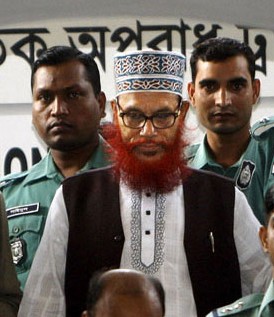
In 2010 Bangladesh established a tribunal to try those accused of war crimes. It is called the International Crimes Tribunal, though it is not an international court in the sense of being founded on international law. Rather it is a national court, based on a Bangladeshi statute passed in 1973 and amended in 2009 and 2012. It was very late to begin the search for justice, for the accused as well as for victims. But war crimes are subject to no statute of limitation.
The main perpetrators are not in the dock, since they are either dead or living in Pakistan. But some suspects are still leading prominent lives in Bangladesh. Ten people have been arrested and charged with offences ranging from individual acts of rape and murder to the ordering of mass executions. This week the first case—that of Delwar Hossain Sayeedi (pictured above), a member of parliament in 1996-2008 and a leader of Jamaat—seemed to be moving towards its fatal conclusion. His conviction, and presumed death sentence, was widely expected in mid-December.
At the last moment, however, the presiding judge, Mohammed Nizamul Huq, resigned as chairman of the tribunal, following questions put to him by The Economist and the publication in Bangladesh of private e-mails which cast doubt upon his role and upon the court proceedings.
More here.