From The Atlantic Monthly:
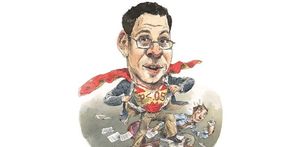 Simonsohn does not look like a vigilante—or, for that matter, like a business-school professor: at 37, in his jeans, T-shirt, and Keen-style water sandals, he might be mistaken for a grad student. And yet he is anything but laid-back. He is, on the contrary, seized by the conviction that science is beset by sloppy statistical maneuvering and, in some cases, outright fraud. He has therefore been moonlighting as a fraud-buster, developing techniques to help detect doctored data in other people’s research. Already, in the space of less than a year, he has blown up two colleagues’ careers. (In a third instance, he feels sure fraud occurred, but he hasn’t yet nailed down the case.) In so doing, he hopes to keep social psychology from falling into disrepute. Simonsohn initially targeted not flagrant dishonesty, but loose methodology. In a paper called “False-Positive Psychology,” published in the prestigious journal Psychological Science, he and two colleagues—Leif Nelson, a professor at the University of California at Berkeley, and Wharton’s Joseph Simmons—showed that psychologists could all but guarantee an interesting research finding if they were creative enough with their statistics and procedures. The three social psychologists set up a test experiment, then played by current academic methodologies and widely permissible statistical rules. By going on what amounted to a fishing expedition (that is, by recording many, many variables but reporting only the results that came out to their liking); by failing to establish in advance the number of human subjects in an experiment; and by analyzing the data as they went, so they could end the experiment when the results suited them, they produced a howler of a result, a truly absurd finding. They then ran a series of computer simulations using other experimental data to show that these methods could increase the odds of a false-positive result—a statistical fluke, basically—to nearly two-thirds.
Just as Simonsohn was thinking about how to follow up on the paper, he came across an article that seemed too good to be true. In it, Lawrence Sanna, a professor who’d recently moved from the University of North Carolina to the University of Michigan, claimed to have found that people with a physically high vantage point—a concert stage instead of an orchestra pit—feel and act more “pro-socially.” (He measured sociability partly by, of all things, someone’s willingness to force fellow research subjects to consume painfully spicy hot sauce.) The size of the effect Sanna reported was “out-of-this-world strong, gravity strong—just super-strong,” Simonsohn told me over Chinese food (heavy on the hot sauce) at a restaurant around the corner from his office. As he read the paper, something else struck him, too: the data didn’t seem to vary as widely as you’d expect real-world results to. Imagine a study that calculated male height: if the average man were 5-foot‑10, you wouldn’t expect that in every group of male subjects, the average man would always be precisely 5-foot-10. Yet this was exactly the sort of unlikely pattern Simonsohn detected in Sanna’s data.
More here.
