
by Mara Jebsen
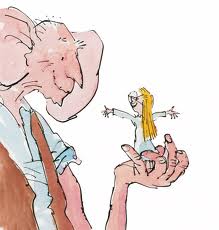
'No thank you' Sophie said, backing away.—Roald Dahl
Readers of contemporary fiction might do well, from time to time, to dip back through the bookshelves of their childhoods to see what un-boring and un-foolish stuff is patiently waiting there. In my own shelves, there's magic, magic and grimness. Also, adventure. And beneath the magic and the adventure, a dark sort of wisdom that lurks enticingly. It is something like the sea–a blue and salt at the edge of consciousness that pulls–as if all children had the weak, seducible souls of sailors.
One such wisdom: the love between a very young person and a very old person is strange, unsentimental, prickly thing. In the old “Charlie and The Chocolate Factory” film, funny-faced Charlie and his sweet grandpa make a poignant pair, but Roald Dahl really explored this dynamic to its most comic and satisfying effect in the Big Friendly Giant. In it, a little bespectacled orphan, Sophie, and a giant hundreds of years old and dozens of feet tall befriend one another. “You mean you don't even know how old you are?” Sophie asks, early in the story. “No giant is knowing that,'the BFG said. 'All I is knowing about myself is that I is very old, very very old and crumply. Perhaps as old as the earth.”
Orphan and giant are two of the loneliest souls, each at the far reaches of life, and of no real use to anyone (though the giant, like Dahl, has elected to amuse himself by blowing dreams through a trumpet into the minds of sleeping children.) Otherwise, each is living a life simply awash in unkindnesses. The girl marks time in a cruel orphanage; the giant bears daily punishment as the 'runt' of a group of human-eating giants who crunch bones and slobber and tease (and seem like mythologized versions of bullies in a boys' boarding school.) Sophie and the giant bark at one another, arguing over proper English, eating filthsome snozzcumbers, and drinking delicious frobscottle that makes them fart until they float.
But when they are not doing that, they are hiding, terrorized, from twin threats–the supernatural forces of the horrible Fleshlumpeating Giants, and the mean-minded ideas of the “human beans.” There is, on the blue-rocked, yellow-skyed plain of Giant country, a great deal of musing going on about what these 'human beans' are about, and when giant and orphan undertake an adventure to save the “beans” from “Meatdripper” and Childchewer,” there's more than a touch of reluctance about the whole project.
It is this grim, humourous, and possibly Nordic sensibility that marks a book I read for the first time recently:”Summer Book,” by Tove Jansson. I don't know much about Jansson, except for that she's responsible for the Moomin series. In “Summer Book”, on an island in the gulf of Finland, a little girl and her grandmother spend a lot of time together. That sounds boring and sweet, but it isn't. It was Jansson's book that got me thinking about wisdom in a way I hadn't before, which is to say from the standpoint of a conversation between a person who hasn't had enough life yet, and one who's nearly had too much.
This grandmother, when she isn't smoking, dropping her teeth, or having a tantrum, is revealing an almost otherworldly understanding about fear and sweetness and God and awfulness. In one of my favorite chapters, “Berenice,” the granddaughter has company. Jannsen writes: “One summer Sophia had a guest of her own–her first friend to come and visit. It was a fairly new friend, a little girl whose hair she admired.” While Sophia, throughout the book, is subject to strange bouts of terror and anxiety that are simultaneously funny and moving, Berenice is so stunned by island life that she cannot function. Sophia tries to make her dive, even pushes her in the water, but finds that the girl's hair can't take saltwater. So she looks terrible. “And it was her hair I liked” says Sophia, gloomily.
But the important bit comes at the end of the chapter, which the grandmother, feeling ill, tries to distract the paralyzed Berenice. Janssen is very spare: “Draw something awful,” Grandmother said, for she was really tired now.” “Draw the awfullest thing you can think of, and take as much time as you possibly can.” When the girl makes a furious bat-armed creature with a black hole for a face, the Grandmother finds it so “awful and expressive” that she's “filled with admiration.”
Together, Sophia and her grandmother are differently flummoxed by awfulness and also by God–and they shout and argue over whether God made “A great big Hell!” as Sophia claims, or whether “life as it is is difficult enough without having to be punished for it afterward.” And yet they never stop being quite funny, these shouting, contemptuous characters, who slam doors and tell one another they are “very busy.” They are like the giant and the orphan, separate from us all, seriously considering whether it is “horrible” that the giant Meatdripper is running off to Wales to eat children “tasting very whooshy of fish.”
“Horribleness” and “awfulness” might be a kind of quality, different from “evil” or “bad”, that children and older people have time to understand. Horribleness is funnier than evil, but no less horrible, or scary, for being funny. And so, I'd say again that the love between a very old person and a very young person is a strange, revelatory thing. They annoy one another. One is always too slow and the other is too fast. They don't care much for social graces. Each is closer to the Nothingness; its piercing terrors and beatific plenitudes, than most of us in the middle can fathom, with our ambitions and responsibilities, and our stupid sentimentalities.
How did they do it, Dahl and Janssen, writing out of the middle of thier lives into the far, funny reaches? With terrific grimness and a sensitivity bordering on the occult. Dahl knows this, too, and takes a forgivable pride in it. Like Dahl, the Big Friendly Giant is capable of hearing dreams whizz by with his ears. When Sophie asks if he can hear things she can't hear, he shouts triumphantly: “You is deaf as a dumpling compared with me!” He goes on:”You is hearing only thumping loud noises with those little earwigs of yours. But I am hearing all the secret whisperings of the world!”
And perhaps he is.