
December 08, 2012
Gangnam Nationalism: Why Psy’s Anti-American Rap Shouldn’t Surprise You
Max Fisher in the Washington Post's WorldViews blog [h/t: Linta Varghese]:
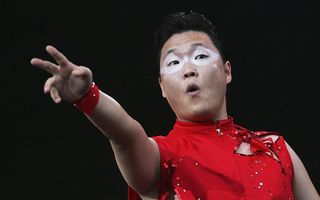
In 2002, Psy walked onto the stage at a massive performance meant to protest the large U.S. military presence in South Korea. He wore an outlandish, glittered red costume and gold face paint. As the crowd cheered him on, Psy lifted a large model of a U.S. tank and, to cheers and applause, smashed it against the stage.
Two years later, Psy joined several other performers in a concert, this one also protesting the United States and its military. He rapped a song titled “Dear American.” The song is not his – the original is by South Korean metal band N.EX.T – but here are the lyrics, in English and in Korean, in case any readers would like to suggest a better translation:
싸이 rap : 이라크 포로를 고문해 댄 씨발양년놈들과
고문 하라고 시킨 개 씨발 양년놈들에
딸래미 애미 며느리 애비 코쟁이 모두 죽여
아주 천천히 죽여 고통스럽게 죽여Kill those —— Yankees who have been torturing Iraqi captives
Kill those —— Yankees who ordered them to torture
Kill their daughters, mothers, daughters-in-law, and fathers
Kill them all slowly and painfullyAmericans don’t hear much about these anti-American protests in South Korea. It’s a strong American ally, after all; a liberal free market democracy; home to tens of thousands of American troops; and a partner, ever since so many Americans fought and died in the Korean War, in containing North Korea’s threat to the world. Shouldn’t they love us?
This is all true, but the Korean-American alliance can sometimes look a bit different from the other end of the Pacific. Some crucial events inform – though do not, on their own, fully explain – why Psy and other Korean performers would show such animosity toward the United States.
On June 13, 2002, one of the many U.S. military vehicles in South Korea struck and killed two 14-year-old girls walking along the side of a road outside Seoul. Because of the terms of the U.S.-South Korean treaty that allows for America’s military presence there, the incident was considered a “military operation” and thus outside of Korea’s jurisdiction. A U.S. court martial acquitted the driver and his commander.
Furious at the acquittal, Koreans protested for months, some seeing echoes of the foreign empires that had dominated their country for centuries. Universities became hotbeds of anti-American rage.
Posted by Robin Varghese at 09:27 AM | Permalink


Comments
It is true that anti-Yankee sentiment is all about us, but there is some here at home too.
This will accelerate exponentially as U.S. foreign police reaps what it has sown.
Posted by: Dredd | Dec 8, 2012 12:22:17 PM
I was pretty surprised to find out about all of the anti Americanism when one of my closest friends moved to Korea several years ago (right during the middle of the Sunshine Policy). I have family members who served in Korea and my knee jerk reaction was 'What ungrateful little shits!'
Of course as I learned more about the situation it made more sense.
It's also important to point out there is an almost professional class of protester out there (upper middle class students from the suburbs, sound familiar?) that make the american protester stereotype look reasonable, moderate, and well informed by comparison. My buddy was telling me about showing up to a protest (he was a punk rock badass in his youth, made it on the cover of the SF chronicle during the iraq war protests) and chatting it up with several people who had no idea why they were there or what they were doing until organizers handed out pamphlets with the slogans printed on them so that they knew what to say. His explanation was that it is kind of a new and social thing more than anything else still (kind of like a lot of berkeley kids in the 60's)
Posted by: DrunktankDan | Dec 8, 2012 5:35:54 PM
Anti-Americanism in South Korea is driven by elites and is not a mass movement, as it is in other countries. Many. of the most vociferous anti-Americans come from the upper classes and some even come from the yangbyan nobility, who resent the loss of their priviliges under the post war governments.
Posted by: Hektor Bim | Dec 8, 2012 8:37:06 PM
As an American expat living in SK, I'd make this analogy -- do South Koreans want unification with North Korea? Absolutely -- it's a national dream. But, if you could wave a magic wand and actually make it happen there'd be much less enthusiasm. The reality is that it would cost billions of dollars, and you'd have waves of hungry, illiterate North Koreans who would come south and need to be fed and housed (taxes) or willing to work for much lower wages (driving down salaries).
Similarly, are there Koreans who resent the tens of thousands of US troops here? Absolutely. The occasional tank accident/sexual assault/drunk GI burning down a restaurant doesn't help. But if Obama announced an immediate withdrawal of troops overnight? There'd be a national crisis.
Some South Koreans talk a big game about ousting the "Yankees," but if you offered to do exactly what some of these people want the country would freak out. The US spends billions here to defend against a North Korean threat (which might or might not actually be serious) and Koreans are not exactly excited to raise taxes to fill the gap.
As for PSY, I can't help but laugh at all of this. For the past months the Korean media has been fluffing him as "an international superstar."
There's egg on their face now, to say the least.
Posted by: wetcasements | Dec 10, 2012 12:47:00 AM
Post a comment