
by Rishidev Chaudhuri
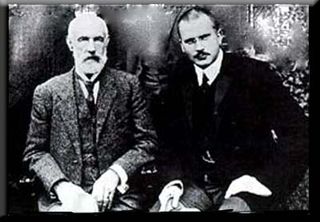
And yet there is much grandeur and richness in his world. Few thinkers have given such a central place to creativity and the imaginative life. And his pantheon of symbols, at their best, allow us a polytheism of the world and of the self, allowing us to honor ambiguity, allowing a personality to speak through a multitude of voices and in a multitude of ways, and permitting a playful approach to symbols that enriches the world. His is a worldview extraordinarily sympathetic to meaning-making and narrative-construction, to framing the world in terms of journey and discovery and the reenchantment of life, which is a useful contrast for us, who so often seem to oscillate between attempting to master a world of ever better understood and yet more indifferent matter and the paralysis that comes with the recognition of the contingency of meaning and of the opacity of the selves we cobble together. And Jungian thought has a friendliness and openness to chance and coincidence and the possibilities they allow, made palatable to the rational mind by telling us that it is simply the unconscious expressing itself; that when we flip over a tarot card or open the I Ching to plan for the future we are expanding the space of possibility and that what we find is not random but is allowing a space for the unconscious to speak. And in doing so it allows for the irrational and the differently rational to sweep through and enchant us in their passing.
Active Imagination is a Jungian practice that embodies this richness and openness to symbolic possibility. It's a form of imaginative storytelling used to enter into a dialogue with the unconscious. You center a session around an initial image or figure (often from a dream or myth) and then leave yourself open to how it evolves, and to the related images and figures that drift into consciousness. A session might start with you shutting your eyes (or not), and waiting for a mental image to appear. Perhaps you see yourself walking in a forest. And then you let it unfold, so that perhaps you follow a winding path between the trees, and in the distance you see a hunched figure, and you follow and you try to get closer but the figure keep shuffling away, and you see it turn off the path and enter a house, and you follow it into the house, and it turns out to be an old woman who has laid out a plate of bread and cheese for you. And you start to talk to her. And so on and so forth. It's a meditative process, one where you bracket out the discursive mind and try to simply let yourself be lead along by your imaginings. It's a bit like an interactive process of free association, but you don't just let yourself jump from subject to subject; for example, if you suddenly get distracted by what you plan to have for breakfast, you'd let that go and bring yourself back to the fantasy. As a practice it's actively creative and not just a “quiet-watching” meditative practice.
Another possible way of letting this process unfold is to find a figure or an object that has been in your mind (from a dream, from real life, from a painting, from a tarot card), and start a conversation with it. You say your piece, let the figure says its piece (which you imaginatively fill in without really thinking about it) and so on, back and forth. This can be done in writing (rather like automatic writing), or as an imagined mental conversation. It takes a few tries to get the hang of, but it's a fascinating process. And, of course, you can have dialogues between any number of symbols and figures.
A third approach, not quite Active Imagination but similar, is to consult some semi-random oracle for insight (like tarot cards, or the I Ching, or randomly open up a book at some page and treat what is on that page as guidance), and then try to implement that advice in your life. Again, the idea is that what you find is not random, but is read through your unconscious and semi-conscious preoccupations and needs, and that, at the very least, it will lead you in new and creative directions.
Active imagination is easily ported to other spheres and to artistic practice; for example, you could have these dialogues and tell these stories in paint. It seems to work especially well in movement, as in the odd but compelling body of practice called Authentic Movement, which is halfway between a detached movement meditation and a choreography exercise. In a typical setting, it's performed by a group of people who break up into two. Half the group sits in a circle around the other half and silently witnesses what they do, attempting to be present and non-judgmental. The other half sit, lie and stand inside the circle and then wait until they feel the need to move. And then they move, in the ways that seem natural, but trying to bracket out planning and scripts and just to follow urges, either physical or imaginative. It's a surprisingly productive way of tapping into creative movement possibilities. The initial fear, of course, is that you'll have no interesting ways to move (much like worrying that, if you do Active Imagination, you'll have nothing interesting to imagine), and this fear is enhanced by the presence of the audience. But wait through this fear and permit yourself to move in boring ways and then you start to move in interesting ways: you find interesting movement textures that seem natural; you find interesting imaginative journeys that you lead yourself on. Like Active Imagination, Authentic Movement aims to not be goal directed. I remember a series of sessions where I lay down and took a nap for a half hour or so. Afterwards, I felt like a fraud and in some ways I was, but this was irrelevant. In the following session, I remember waking and stumbling to my feet, my body feeling like that of a wobbly child, and I remember stepping and feeling my weight and relearning how to balance and to walk. It was a simple set of movements, but I find that I often think of that particular texture, both tentative and trusting, when I'm walking about the everyday world and it always subtly shifts the way I experience walking.
Of course it would be foolish for me to prescribe a general approach to these practices or a general way that we should understand the symbols and stories that emerge. At one point in my life, I believed that they represented deep universal truths and that I was excavating my true and authentic inner self. For the usual variety of reasons, I don't think this any more and I'm broadly suspicious of true and authentic selves, and of interiority and excavation as guiding metaphors. But a self that is not pre-given is a self that can be created, even if most of the productive forces are obscure and perhaps sinister, and I still find these practices very compelling in their creative potential and their playfulness. The symbols and archetypes and the movements and the stories all allow for a more expansive and creative self, and seem to open up new possibilities, and the meanings they allow are still valuable even if they are no longer unconditioned or universal. And still, sometimes, when I'm feeling romantic or naively optimistic, they allow me to think that maybe after all there is some transcendent self-discovery awaiting and maybe the universe is conspiring on our behalf and maybe we stumble upon that conspiracy in the midst of creative play.