
by Tom Jacobs
The underlying bureaucratic key is the ability to deal with boredom. To function effectively in an environment that precludes everything vital and human. To breathe, so to speak, without air. The key is the ability, whether innate or conditioned, to find the other side of the rote, the picayune, the meaningless, the repetitive, the pointlessly complex. To be, in a word, unborable. It is the key to modern life. If you are immune to boredom, there is literally nothing you cannot accomplish.”
~ David Foster Wallace
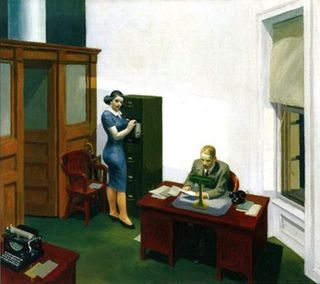
In one of the more amusing passages in David Foster Wallace’s The Pale King, a character mistakenly enters the wrong university classroom and finds himself developing an unexpected interest in accounting. The Jesuit accounting professor delivers remarkably fascinating reflections on the subject during his lectures, at one point making the following claim:
Enduring tedium over real time in a confined space is what real courage is… The truth is that the heroism of your childhood entertainments was not true valour. It was theatre. The grand gesture, the moment of choice, the mortal danger, the external foe, the climactic battle whose outcome resolves all – all designed to appear heroic, to excite and gratify an audience… Gentlemen, welcome to the world of reality – there is no audience. No one to applaud, to admire… actual heroism receives no ovation, entertains no one. No one queues up to see it. No one is interested.
The real heroes, it seems, are perhaps not those who make grand gestures or defeat foes but rather people like accountants: those who toil in obscurity and make the wheels of commerce and bureaucracy turn. Wallace called his last novel a “portrait of bureaucracy,” and the portrait offers is both horrifying and hopeful. His work explores this dialectic of ecstasy and crushing boredom, and the relation of freedom and rigid structure. Most intriguing is the way he understands the ecstasies and freedoms to be found even in the most boring and structured of scenarios—like working for the IRS.
The question of whether he is actually endorsing bureaucracy remains an open one, but more interesting to consider are the heroic pleasures he insists exist in the boredom of being a cog in a machine. At the very least it provides him an occasion to test out his unyielding belief that “Almost anything that you pay close, direct attention to becomes interesting.” All of this is well-known to anyone who reads or reads about Wallace, and it’s one of his major contributions to literary and to some degree even political discourse.
His last novel got me thinking about how other writers have grappled with life in a bureaucracy. One of Whitman’s greatest poems, for instance, is about the generally boring and unconscious experience of commuting. Granted, crossing Brooklyn Ferry is probably more interesting than taking the subway, but still—part of what makes that poem about the profoundly human dimensions of the daily commute so interesting is that it takes place in the context of going to or coming home from one’s job.
Much more recently, “The Office” and Office Space wrung a fair amount of humor out of the boredom and fellow-feeling of a bureaucratic life. Part of what’s funny and even tender and moving about these works is that everyone in a bureaucracy is constantly desperately seeking ways to retrieve some human element from the otherwise crushing banalities of the workplace. The fleeting and/or enduring romances, for instance, are compelling because they emerge in the context of the featureless terrains of corporate America.
When I worked as a temp at a huge accounting firm for a brief while in Chicago several years ago, I remember being shocked to discover that my boss—a partner in the firm with a magisterial view of the city stretching out below his window—spent a fair amount of time playing solitaire on his computer (which I could see reflected in the window whenever I poked my head into to tell him something or other. The fact that even the bureaucrats poach time back from the machine is still a surprising thing to consider.
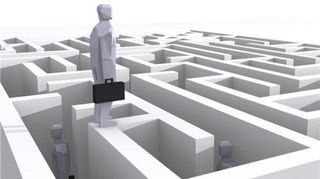
If to be unborable is the key to modern life, then there are many figures in literature that might help us think about living in a bureaucracy. Perhaps some of us have managed to escape the direct tentacles of the network of bureaucracies that surrounds us, but as Melville once said in a slightly different context, “who ain’t a slave?” We are all implicated in one way or another, whether we want to be or not. One question that underlies most of this discussion is about how we choose to inhabit this role, or perhaps, as Wallace would have it, what we choose to pay attention to. The deeper and perhaps more troubling question, though, is whether or not learning to find pleasure and interest in this role is to be complicit in some of the dehumanizing structures and forces that generate this very pleasure and interest. To be unbored is no doubt crucial to living a full and happy life, but is it, in short, a good thing?
I’m still not sure.