
| ABOUT US | ARCHIVES | LINKS | RSS FEED | MONDAYS | |

3quarksdaily

An Eclectic Digest of Science, Art and Literature

« Derrida: A Biography | Main | Infinite Proofs: The Effects of Mathematics on David Foster Wallace »

November 27, 2012

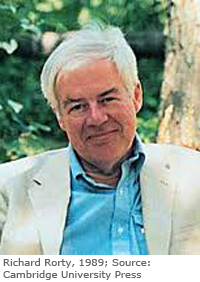
Rorty and the Democratic Power of the Novel

Voparil_200w

Christopher J. Voparil in Eurozine:

The context of Rorty's embrace of the novel within the development of his own thought is instructive for understanding his view of the distinctive power of this genre over others, including philosophy. As he fleshed out the political consequences of his sweeping philosophical critique in Philosophy and the Mirror of Nature, in the 1990s social and political concerns came to the forefront of his work in an unprecedented way. A central preoccupation of Rorty's was "how we treat people whom we think not worth understanding" – that is, those people whom "are not viewed as possible conversational partners". The thesis I will argue is that Rorty's turn to the novel is part of an effort to bring excluded voices into what he called in the final section of Mirror, the "conversation of mankind".

The primary thrust of Philosophy and the Mirror of Nature advocates a fundamental shift away from a conception of knowledge as accuracy of representation and towards an understanding of knowledge as conversation and social practice. The idea that conversation is "the ultimate context with which knowledge is to be understood" leads Rorty to a preoccupation with "conversation with strangers", understood as those who fall outside our "sense of community based on the imagined possibility of conversation". If, as Rorty claimed, "the community is the source of epistemic authority", and, building on Wilfrid Sellars, "we can only come under epistemic rules when we have entered the community where the game governed by these rules is played," then we attribute knowledge to beings "on the basis of their potential membership in this community". To illustrate this point, Rorty gives the example of how we are more likely to get sentimental about "babies and the more attractive sorts of animal" as having feelings than, say, "flounders and spiders". Likewise, we are more likely to care about koalas than pigs, he tells us, even though pigs rate higher on the intelligence scale, because "pigs don't writhe in quite the right humanoid way, and the pig's face is the wrong shape for the facial expressions which go with ordinary conversation".

Posted by Robin Varghese at 11:30 PM | Permalink

Comments

Post a comment


Subscribe to this blog's feed  

PayAnywhere with iphone credit card swiper

Android Tablet

Bluetooth Headset

2013 New Style Dresses

Compare Car Rental Prices

DHgate.com Wholesale

3QD on Facebook

3QD on Kindle

3QD by Daily Email

Receive all blogposts at the same time every day.

Enter your Email:


Preview 3QD Email

3QD on Twitter

Miscellany

Lijit Search

AddThis Social Bookmark Button

Add to Google

Recent Comments

j_93 on Gezi Park

j_93 on Syria: Inventing a Religious War

Norman Costa on The Insanity Virus

Dave Ranning on Political Ideology and the Avoidance of Dissonance-Arousing Situations

Sundar on Quest for 'Genius Babies'?

Sundar on Syria: Inventing a Religious War

gaddeswarup on What is ‘smart’ and how does it fit our consciousness?

gaddeswarup on What is ‘smart’ and how does it fit our consciousness?

musafir on Syria: Inventing a Religious War

Lusine on Syria: Inventing a Religious War

Brad Wilson on Gezi Park

Raza Husain on Syria: Inventing a Religious War

Brad Wilson on The Insanity Virus

billy on Syria: Inventing a Religious War

rafiq on The Insanity Virus

Ben Schwartz on Here He Goes Again: Sam Harris’s Falsehoods

JonJ on Moving books

musafir on My Father: A Veteran's Story – Part 2

omar on Quest for 'Genius Babies'?

Norman Costa on My Father: A Veteran's Story

j_93 on Syria: Inventing a Religious War

jo smith on Syria: Inventing a Religious War

Dredd on Political Ideology and the Avoidance of Dissonance-Arousing Situations

Dredd on Syria: Inventing a Religious War

R. Michael on Moving books

Acclaim For 3QD


"I couldn't tear myself away from 3 Quarks Daily, to the point of neglecting my work. Congratulations on this superb site."—Steven Pinker, Johnstone Professor of Psychology, Harvard University.

"I have placed 3 Quarks Daily at the head of my list of web bookmarks."—Richard Dawkins, Charles Simonyi Professor of the Public Understanding of Science at Oxford University.

"Just wanted you to know I’m one of many who reads and enjoys 3 Quarks....almost daily."—David Byrne, musician, former lead-singer of the Talking Heads, artist, intellectual.

Read more here.

The 3QD Prizes

Subscribe to this blog's feed