
| ABOUT US | ARCHIVES | LINKS | RSS FEED | MONDAYS | |

3quarksdaily

An Eclectic Digest of Science, Art and Literature

« from Herodotus to globalisation | Main | An important note to our readers »

November 16, 2012

Respect Gandhi If You Will, Don’t Sentimentalise Him

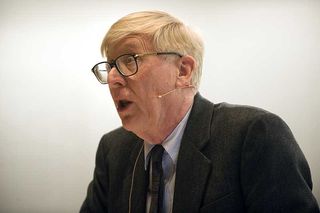
Perry_anderson_20121112

Praful Bidwai interviews Perry Anderson in Outlook:

You’ve explained that one of the reasons why, instead of writing simply about contemporary India, you start by looking at the struggle for independence, was your shock at the reception of Kathryn Tidrick’s work on Gandhi, so thoroughly blanketed by silence that most Indians are unaware of its existence. Tidrick concentrates on the relationship between Gandhi’s self-perception as a world-saviour— his religious beliefs— and his politics. She doesn’t really explore his role as a mass leader and tactician of the independence struggle. How far is your own account of Gandhi, which many in India would regard as a savage criticism, based on hers?

Tidrick’s biography of Gandhi is an extraordinarily careful, calm and courageous work. Not just I, but any serious student of this historical figure, would have more to learn about his outlook from her work than from any other extant study of him —the vast majority of Gandhiana being, to one degree or another, hagiographic.  The silence covering it in India is an intellectual scandal which reflects poorly on local opinion. The problem here is not, of course, confined to her work. More recently, the reception of Joseph Lelyveld’s much more superficial and not very political,  but extremely respectful,  book about Gandhi—it’s even entitled Great Soul—tells the same story. Because it dismantles some of the legends Gandhi propagated about his time in South Africa, we have his grandson complaining that it ‘belittles’ him. It’s only in this climate of deference that my treatment of Gandhi could be regarded as sacrilege. Actually, I single out not only his remarkable gifts as a leader, and his achievement in making Congress a mass party, but also his personal sincerity and selflessness—he did not want power for himself, as most politicians do. In his own way he was a great man. 

But that does not exempt him from criticism.  He was gripped by a set of regressive personal fixations and phobias, had a very limited intellectual formation, was impervious to rational argument, and entirely unaware of the  damage he was doing to the national movement by suffusing it with Hindu pietism as he reconceived it. He is to be respected, with all his blindness. But there is no need to sentimentalize him. The complete latitude he gave himself to declare as truth whatever he happened to say at any time, and then change it from one day to the next, still as the word of God shining through him, set a disastrous example for his followers and admirers.  Nowhere more so than in his inconsistencies on satyagraha itself. For when it suited him, he was perfectly willing to contemplate violence —not only to send Indian peasants to their death on the Somme in the service of their colonial masters, or applaud Indian bombers taking off to conquer Kashmir, but calmly to envisage communal slaughter—‘civil war’— in the subcontinent as preferable to expelling the British. As a historian, one has to take cool stock of all this, not skate over it as Gandhi’s apologists continually do.

Posted by Robin Varghese at 02:00 PM | Permalink

Comments

There has been critical evaluation of Gandhi in India, particularly in Hindi. The Marxists were the most critical. They spent much of their energy in deciding whether he was a reactionary or a revolutionary.

A more nuanced criticism is that of Dr. Ramvilas Sharma in his book Gandhi, Ambedkar Aur Lohia, in which he makes a very detailed analysis of Gandhi's thoughts, actions and political strategies. His verdict is that Gandhi was a proxy for the Indian capitalists like the Birlas and he played a very big role in keeping the Indian freedom movement from maturing into a full-fledged Marxist revolution. His calling off of the non-cooperation movement on flimsy grounds when it was poised for explosion into a communist revolution is a case in point. This was a tactic Gandhi used frequently - build up mass protest up to a level sufficient to frighten the British to get concessions from them, but not allow the mass protest to take a momentum of its own and sweep away the colonial-capitalistic regime, and all its divisive manipulations such as pitting one religious group against the other which ended in partition, and establish a communist revolutionary society in its place.

Gandhi's social background as bania (shopkeeper)helped him understand the capitalistic aspirations and to articulate them in Indian politics.

Indirectly, Dr. Sharma also holds Gandhi responsible for partition and the communal polarisation of Indian society, for had he not come in the way of the imminent Marxist revolution, the revolutionary forces unleashed would have swept away not only the British but also healed the communal divide fostered by the British and kept India as a single political unit.

Although Gandhi was dead against partition, he on his own could not prevent it. According to Dr. Sharma, only a communist, secular revolution could have done that.

At the same time, Dr. Sharma lauds many of his positive contributions - such as his criticisms of Western civilization, his support of Indian languages over English, his support for grouping India on linguistic regions, his empathy for the poor people,his bringing in women into the political arena and thus not only strengthening the freedom movement but also aiding the uplift of women, and his sincerity and incorruptibility.

Gandhi, like all great leaders was a complex personality and I agree that we need to understand him warts and all, instead of merely deifying him.

Posted by: Kabir | Apr 20, 2013 3:17:47 AM

And, I may add,one of the staunchest critics of Gandhi was Rabindranath Tagore himself.

Their disagreements were famous and are well documented. So it is not entirely true that Gandhi is idolised uncritically in India.

The leaders of the freedom movement were truly great people and of an intellectual calibre far above that of the world leaders of current times.

They agreed and disagreed but civily and intellectually. They were united in their common purpose of ending colonial exploitation and nation-building even while disagreeing on how exactly to go about it.

Tagore was a strong opponent of Gandhi's quaint ideas about village-based development, personal labour, and Gandhi's views on the utility of the arts.

Tagore a poet and an artist himself disagreed strongly with Gandhi on these points and put his views quite forcefully in his writings.

Posted by: Kabir | Apr 20, 2013 3:27:01 AM

Post a comment


Subscribe to this blog's feed  

PayAnywhere with iphone credit card swiper

Android Tablet

Bluetooth Headset

2013 New Style Dresses

Compare Car Rental Prices

DHgate.com Wholesale

3QD on Facebook

3QD on Kindle

3QD by Daily Email

Receive all blogposts at the same time every day.

Enter your Email:


Preview 3QD Email

3QD on Twitter

Miscellany

Lijit Search

AddThis Social Bookmark Button

Add to Google

Recent Comments

Louise Gordon on The need for critical science journalism

Stuart Mathieson on REFLECTIONS ON WOOLWICH

Kai Matthews on The Moral Status of Rocks

Norman Costa on Dear Guardian: You’ve Been Played

Dave Ranning on REFLECTIONS ON WOOLWICH

Joel Grant on Why Rational People Buy Into Conspiracy Theories

musafir on REFLECTIONS ON WOOLWICH

Norman Costa on Race Is Not Biology

Geoff on REFLECTIONS ON WOOLWICH

Kai Matthews on Why Rational People Buy Into Conspiracy Theories

fallensparks on REFLECTIONS ON WOOLWICH

jon s on Race Is Not Biology

musafir on REFLECTIONS ON WOOLWICH

musafir on Faith Healing

Dave Ranning on REFLECTIONS ON WOOLWICH

Geoff on REFLECTIONS ON WOOLWICH

Luke Lea on Race Is Not Biology

fallensparks on REFLECTIONS ON WOOLWICH

Luke Lea on Race Is Not Biology

jo smith on REFLECTIONS ON WOOLWICH

jo smith on Guy de Maupassant

Geoff on Jeremy Scahill & Noam Chomsky on Secret U.S. Dirty Wars From Yemen to Pakistan to Laos

Jim on Friday Poem

JF on REFLECTIONS ON WOOLWICH

Jesse on REFLECTIONS ON WOOLWICH

Acclaim For 3QD


"I couldn't tear myself away from 3 Quarks Daily, to the point of neglecting my work. Congratulations on this superb site."—Steven Pinker, Johnstone Professor of Psychology, Harvard University.

"I have placed 3 Quarks Daily at the head of my list of web bookmarks."—Richard Dawkins, Charles Simonyi Professor of the Public Understanding of Science at Oxford University.

"Just wanted you to know I’m one of many who reads and enjoys 3 Quarks....almost daily."—David Byrne, musician, former lead-singer of the Talking Heads, artist, intellectual.

Read more here.

The 3QD Prizes

Subscribe to this blog's feed