
| ABOUT US | ARCHIVES | LINKS | RSS FEED | MONDAYS | |

3quarksdaily

An Eclectic Digest of Science, Art and Literature

« Can a Jellyfish Unlock the Secret of Immortality? | Main | Thursday Poem »

November 29, 2012

Past 5,000 years prolific for changes to human genome

From Nature:

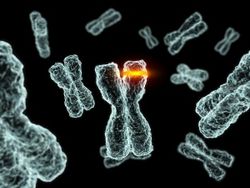
GenomeThe human genome has been busy over the past 5,000 years. Human populations have grown exponentially, and new genetic mutations arise with each generation. Humans now have a vast abundance of rare genetic variants in the protein-encoding sections of the genome1, 2. A study published today in Nature3 now helps to clarify when many of those rare variants arose. Researchers used deep sequencing to locate and date more than one million single-nucleotide variants — locations where a single letter of the DNA sequence is different from other individuals — in the genomes of 6,500 African and European Americans. Their findings confirm early work by Akey1 suggesting that the majority of variants, including potentially harmful ones, were picked up during the past 5,000–10,000 years. Researchers also saw the genetic stamp of the diverging migratory history of the two groups.

The large sample size — 4,298 North Americans of European descent and 2,217 African Americans — has enabled the researchers to mine down into the human genome, says study co-author Josh Akey, a genomics expert at the University of Washington in Seattle. He adds that the researchers now have “a way to look at recent human history in a way that we couldn’t before.” Akey and his colleagues were able to dig out genetic variants occurring in less than 0.1% of the sample population — a resolution that is a full order of magnitude finer than that achieved in previous studies, says Alon Keinan, a statistical geneticist at Cornell University in Ithaca, New York, who was not involved with the study. Of 1.15 million single-nucleotide variants found among more than 15,000 protein-encoding genes, 73% in arose the past 5,000 years, the researchers report. On average, 164,688 of the variants — roughly 14% — were potentially harmful, and of those, 86% arose in the past 5,000 years. “There’s so many of [variants] that exist that some of them have to contribute to disease,” says Akey

More here.

Posted by Azra Raza at 06:14 AM | Permalink

Comments

Post a comment


Subscribe to this blog's feed  

PayAnywhere with iphone credit card swiper

Android Tablet

Bluetooth Headset

2013 New Style Dresses

Compare Car Rental Prices

DHgate.com Wholesale

3QD on Facebook

3QD on Kindle

3QD by Daily Email

Receive all blogposts at the same time every day.

Enter your Email:


Preview 3QD Email

3QD on Twitter

Miscellany

Lijit Search

AddThis Social Bookmark Button

Add to Google

Recent Comments

omar on Race Is Not Biology

Dredd on Race Is Not Biology

Dredd on Race Is Not Biology

allsmiles on A Mother, a Son and a Wife

sverson on Race Is Not Biology

carlos on Daniel Dennett's seven tools for thinking

araldo on Race Is Not Biology

jo smith on Daniel Dennett's seven tools for thinking

Louise Gordon on Why race as a biological construct matters

Louise Gordon on Race Is Not Biology

Dave on Race Is Not Biology

Bill on Daniel Dennett's seven tools for thinking

Boursin on Why Rational People Buy Into Conspiracy Theories

Usha Alexander on Race Is Not Biology

Abbas Raza on Daniel Dennett's seven tools for thinking

X on Race Is Not Biology

Usha Alexander on Race Is Not Biology

jo smith on Mohsin Hamid: 'Islam is not a monolith'

araldo on Mohsin Hamid: 'Islam is not a monolith'

Dr. X, Ph.D. on Race Is Not Biology

jo smith on Physicists Create Quantum Link Between Photons That Don't Exist at the Same Time

jo smith on Mohsin Hamid: 'Islam is not a monolith'

omar on Why race as a biological construct matters

Dr. Smith on Race Is Not Biology

Sundar on Daniel Dennett's seven tools for thinking

Acclaim For 3QD


"I couldn't tear myself away from 3 Quarks Daily, to the point of neglecting my work. Congratulations on this superb site."—Steven Pinker, Johnstone Professor of Psychology, Harvard University.

"I have placed 3 Quarks Daily at the head of my list of web bookmarks."—Richard Dawkins, Charles Simonyi Professor of the Public Understanding of Science at Oxford University.

"Just wanted you to know I’m one of many who reads and enjoys 3 Quarks....almost daily."—David Byrne, musician, former lead-singer of the Talking Heads, artist, intellectual.

Read more here.

The 3QD Prizes

Subscribe to this blog's feed