
November 17, 2012
Katherine Boo's "Behind the Beautiful Forevers"
Katherine Boo's Behind the Beautiful Forevers won the National Book Award on Wednesday. Here's a review by Anis Shivani in the Huffington Post:
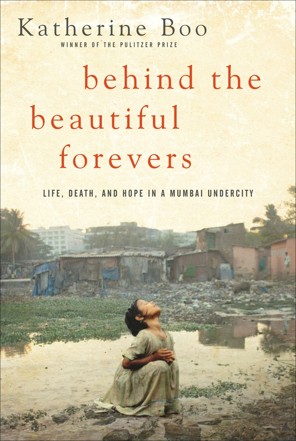
Katherine Boo's Behind the Beautiful Forevers: Life, Death, and Hope in a Mumbai Undercity (Random House, 2012), a gripping work of reportage based on the three years she spent in Bombay's Annawadi slum, is a truly deserving National Book Award finalist.
Earlier in the year when I read the book, I hoped it would be in line for the major awards. I was impressed with the way Boo keeps herself out of the narrative, giving us a no-holds-barred dramatization of life in the slums, without any element of romanticization or exoticization. Boo is a staff writer for the New Yorker, married to the Indian academic Sunil Khilnani, and has previously written about poor communities in the U.S. There isn't a single jarring note as she transitions to reporting about Annawadi.
Boo's is not the only recent book in this genre. While the dominant impression from neoliberal propagandists like Thomas Friedman is that of an aspiring hegemon with a thriving middle class of more than 300 million people, and growing more powerful by the day, more honest writers have been presenting a mixed picture of the winners and losers resulting from India's high-stakes economic liberalization, a regime the country has been doggedly pursuing since the early 1990s.
More here.
Posted by S. Abbas Raza at 01:53 PM | Permalink


Comments
Deeply flawed book. Boo has no interest in India's history. And she is economically illiterate (except for a crude anti market sentiment that is always in the background). Martha Nussbaum's review in the TLS goes into this in greater detail. My advice to Ms. Boo: Get an education before you begin writing.
"Perhaps most damaging of all, Boo’s narrative does not have a sense of history, and thus does not permit us even to ask what part of this misery might possibly be the effect of recent market liberalization and what part, by contrast, has been there for a very long time. But one has only to read Mistry’s novel, set at the height of socialist economic control, to discover that most of the miseries Boo identifies – ubiquitous corruption, government indifference to slum dwellers, periodic “clean-ups” razing slums, gross failures in education – were present in Mumbai slums thirty-five years ago under socialism – and in addition some horrors that were unique to Indira Gandhi’s dictatorial rule, such as the forced sterilization of the poor. By avoiding history, Boo allows readers to construe her book as an indictment of recent free-market policies (it is widely so construed, and at several points she herself suggests this interpretation). One might possibly conclude from what she presents that recent changes have not changed enough in the lives of the poorest. That is indeed a scandal, and bad enough. But one is given no reason to conclude that liberalization has created problems for the poor that did not exist previously under socialism. And though increased economic growth certainly does not solve all problems of justice, it is one good thing to which one should have no objection."
http://www.the-tls.co.uk/tls/public/article1144744.ece
Posted by: Sundar | Nov 18, 2012 11:31:15 AM
Post a comment