
| ABOUT US | ARCHIVES | LINKS | RSS FEED | MONDAYS | |

3quarksdaily

An Eclectic Digest of Science, Art and Literature

« Antifragile: How to Live in a World We Don't Understand | Main | Cézanne: A Life by Alex Danchev »

November 22, 2012

Giving thanks for Gauge Symmetry

Sean Carroll in Cosmic Variance:

This year we give thanks for an idea that is central to our modern understanding of the forces of nature: gauge symmetry. (We’ve previously given thanks for the Standard Model Lagrangian, Hubble’s Law, the Spin-Statistics Theorem, conservation of momentum, effective field theory, andthe error bar.)

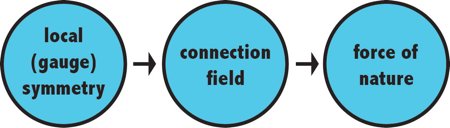
When you write a popular book, some of the biggest decisions you are faced with involve choosing which interesting but difficult concepts to tackle, and which to simply put aside. In The Particle at the End of the Universe, I faced this question when it came to the concept of gauge symmetries, and in particular their relationship to the forces of nature. It’s a simple relationship to summarize: the standard four “forces of nature” all arise directly from gauge symmetries. And the Higgs field is interesting because it serves to hide some of those symmetries from us. So in the end, recognizing that it’s a subtle topic and the discussion might prove unsatisfying, I bit the bullet and tried my best to explain why this kind of symmetry leads directly to what we think of as a force. Part of that involved explaining what a “connection” is in this context, which I’m not sure anyone has ever tried before in a popular book. And likely nobody ever will try again! (Corrections welcome in comments.)

Gauge
Physicists and mathematicians define a “symmetry” as “a transformation we can do to a system that leaves its essential features unchanged.” A circle has a lot of symmetry, as we can rotate it around the middle by any angle, and after the rotation it remains the same circle. We can also reflect it around an axis down the middle. A square, by contrast, has some symmetry, but less — we can reflect it around the middle, or rotate by some number of 90-degree angles, but if we rotated it by an angle that wasn’t a multiple of 90 degrees we wouldn’t get the same square back. A random scribble doesn’t have any symmetry at all; anything we do to it will change its appearance.
More here.

Posted by S. Abbas Raza at 04:43 PM | Permalink

Comments

Post a comment


Subscribe to this blog's feed  

PayAnywhere with iphone credit card swiper

Android Tablet

Bluetooth Headset

2013 New Style Dresses

Compare Car Rental Prices

DHgate.com Wholesale

3QD on Facebook

3QD on Kindle

3QD by Daily Email

Receive all blogposts at the same time every day.

Enter your Email:


Preview 3QD Email

3QD on Twitter

Miscellany

Lijit Search

AddThis Social Bookmark Button

Add to Google

Recent Comments

Mitt Romney's Dog on Why race as a biological construct matters

Elatia Harris on The Moral Status of Rocks

prasad on The Moral Status of Rocks

Raza Husain on The Moral Status of Rocks

Fred on Unknown Mathematician Proves Elusive Property of Prime Numbers

Joel Grant on Why Rational People Buy Into Conspiracy Theories

Tomboktu on Why is Europe so Messed Up? An Illuminating History

Joe on Why Rational People Buy Into Conspiracy Theories

Jalees Rehman on The Science Mystique

Dredd on The Moral Status of Rocks

sjg on Why Rational People Buy Into Conspiracy Theories

Dredd on Why Rational People Buy Into Conspiracy Theories

Louise Gordon on Why race as a biological construct matters

Louise Gordon on The stories of two Palestinian villages: From Al-Araqib to Susiya

musafir on a pretty funny book

freddie on The stories of two Palestinian villages: From Al-Araqib to Susiya

freddie on The stories of two Palestinian villages: From Al-Araqib to Susiya

Junaida on Tuesday Poem

rafiq on Tuesday Poem

Raza Husain on the culture animal

Nebor on Tuesday Poem

Eleutheria on I am dust and ashes and full of sin

carlos on I am dust and ashes and full of sin

Joe on the culture animal

Sundar on the culture animal

Acclaim For 3QD


"I couldn't tear myself away from 3 Quarks Daily, to the point of neglecting my work. Congratulations on this superb site."—Steven Pinker, Johnstone Professor of Psychology, Harvard University.

"I have placed 3 Quarks Daily at the head of my list of web bookmarks."—Richard Dawkins, Charles Simonyi Professor of the Public Understanding of Science at Oxford University.

"Just wanted you to know I’m one of many who reads and enjoys 3 Quarks....almost daily."—David Byrne, musician, former lead-singer of the Talking Heads, artist, intellectual.

Read more here.

The 3QD Prizes

Subscribe to this blog's feed