
by Akim Reinhardt
Instead, I first talk about Indigenous creation stories. For example, a Jicarilla Apache story says that in the beginning, all the world was covered with water. Everything lived underwater, including people, animals, trees, and rocks, all of which could talk. People and animals used eagle feathers as torches, and they all wanted more light, except for the night animals who preferred the darkness: the panther, bear, and owl. The two sides competed by playing the thimble and button game. The sharp-eyed quail and magpie helped people win five consecutive games until the sun finally rose to create the first day. People then peered through a hole to see another world above them: Earth. They climbed up to it.
Or there’s a story from the Modocs of California and Oregon, which says the leader of the Sky Spirits grew tired of his home in Above World. It was always cold, so he carved a hole in the sky and shoveled down snow and ice until it almost reached the Earth, thereby creating W’lamswash (Mt. Shasta). He stepped from a cloud onto the mountain. As he descended, trees grew where ever his finger touched the ground, and the snow melted in his footsteps, creating rivers. Long pieces from his walking stick became beavers, and smaller pieces became fish. He blew on leaves, turning them into birds, and the big end of his stick created the other animals, including the bears, who walked upright on two legs. Pleased with what he’d done, the leader of the Sky Spirits and his family lived atop the mountain. But after his 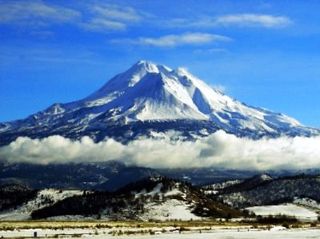
One reason I begin the semester with Indigenous creation stories instead of scientific evidence about the peopling of the Americas is that, like most people who teach American Indian history nowadays, I look for ways to emphasize Indians’ historical agency. Stressing agency, the centrality of people in manifesting their own history, is an important part of teaching any group’s history. However, for too long, American Indian history was taught (when it was taught at all) through a EuroAmerican lense. Instead of looking at what Indians did, historians used to focus on what was done to them. Indians, they told us, were victims of aggression and/or obstacles to progress. Native people were reduced to two-dimensional tropes, mere foils in the larger story about European empires and the rise of the United States.
Today, scholars take a different approach. They aim to study American Indian history on its own terms. It’s a history that predates European invasions by thousands of years. And after contact, Indian peoples did not just endure colonialism. They interacted with it, often on their own terms. They shaped it, sometimes they used it to their own advantage, and in many ways overcame it. Even as their political independence was overwhelmed by U.S. imperial expansion, and indeed some Indigenous nations were erased altogether, many more survive to the present day.
Historians now strive to make American Indians the subject of their own historical sentence, as it were, instead of the objects. Indigenous perspectives and Indian voices take center stage as victimology yields to a more complex and active story. For once we accept that Indigenous histories are worth studying on their own merits, just like any other people’s history, we must ask new and better questions about how Indian peoples experienced their histories and how they manifested them.
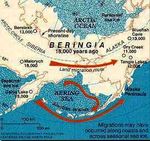
Stressing Indian agency in Indian history is something I try to do throughout the semester. And it begins on the first day. So instead of beginning with scientific theories on the peopling of the Americas, I start with the people themselves by introducing my students to Indigenous creation stories. The archaeologists and anthropologists can wait a day.
“Creation story” is a neutral term that scholars use to categorize the often ancient stories that all cultures use to explain things like how the world was made, where people come from, and classic tales of heroes, monsters, villains, and tricksters of yore who roamed the Earth, the heavens, and the worlds of the afterlife.
We use the neutral term “creation story” because many other terms are loaded. If you believe certain stories, or respect other people’s beliefs even when you don’t, then words like “religion,” “creed,” and “denomination” are typically used to categorize them. But if no one any longer believes a certain set of stories, or if people don’t particularly respect the religious properties of marginalized cultures, then they are often labeled as “mythology,” “superstition,” or “fables.”
As scholars, it is not our job to tell people what to believe. Rather, our goal is to help people build their knowledge base and develop their critical skills so that they might decide for themselves. We’re researchers and educators, not doctrinaire propagandists. So when you enter my class, it’s no concern of mine whether or not you believe this or that creation story, be it from sub-Saharan Africa, from China, from ancient Greece, from the Indigenous Americans, or from the Bible, Koran, Vedas, or Buddhavacana texts.
In that vein, the neutral term “creation story” indicates that whether or not I believe a particular story is irrelevant. We are here to learn and study these stories as part of a larger lesson, not to condemn or proselytize them. So I use that term then when referring to all such stories, whether they are believed by billions, hundreds, or no one at all anymore.
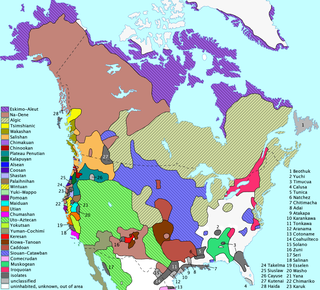
Like every other human society that has ever existed, the thousands of Indigenous American societies all have their own creation stories. Some are still believed, some are not. By learning and discussing some of those stories, students can gain insights into American Indian history. Before moving onto what scientists say about where people come from, students can learn something about how those people understood themselves, the world around them, and their place in it.
* * *
The United States, like most modern nations, has a number of such creation stories. And for the most part, we know they are fanciful and recognize that their true purpose is not to reveal accurate history but to impart national values.
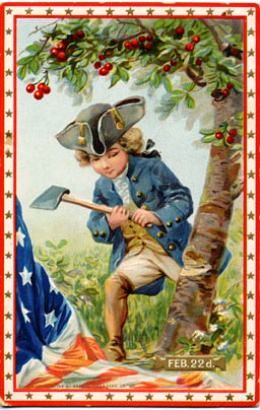
For example, when George Washington was a young boy, he chopped down his father’s cherry tree. When confronted, he confessed. Why? Because George Washington could not tell a lie.
Of course it’s bullshit. In fact, we even know who wrote it. Parson Mason Weems (1759-1825) fabricated the story as part of his book The Life of Washington (1800). But we continue to tell the story anyway, because it imparts a wonderful message: honesty is a virtue that children should emulate.
The story also serves another purpose though, one less noble. It has a second moral that is not about morality. It is about sanctifying the nation. The story glorifies Washington as a righteous person, thereby enshrining the revolutionary general and first president. After all, The Life of Washington was pure hagiography. As such, it fits with other creation stories that paint the father of the new nation as a superman. Don’t you know, he also once threw a silver dollar across the Potomac River.
The Potomac River is over a mile wide.
Such national, secular creation stories are designed to establish the nation as worthy of our devotion. And this time of year, Americans traditionally recite one of their most cherished secular creation stories.
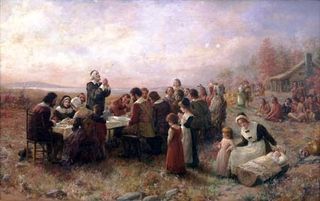
The king wanted people to sing god’s praises, as proscribed by his appointed priests, and to adorn their churches with shiny objects that glorified the king and god both. But the Puritans had no use for shiny trinkets or the king’s immodest glory. So the king persecuted the Puritans, and eventually they fled.
Desperate for religious freedom, the Puritans boarded a ship called the Mayflower and set sail westward across the ocean wide, in search of a new land where they could build a city upon a hill for all the world to see as a shining example of liberty. They finally came upon a new land, and first set foot on Plymouth Rock. There they began building their new home.
But the first winter was very hard. The Puritans were ill-prepared for life in this new world. Many of them died. They would not have made it at all if not for the generous and loving help of the nearby Indian people. The Wampanoags shared their food and got the Puritans through. The following spring, the Indians taught them how to farm in this new world. An Indian named Squanto brought them corn and showed them how to plant and raise it. Thanks to Squanto’s generosity, the Puritans were successful.
That autumn, the Puritans reaped a bountiful harvest, and they invited the Indians to celebrate with them. They held a large feast to show their gratitude to the Indian people who had welcomed the Puritans to the new world, who had shared with them when at their most desperate hour, and who had helped them establish their new home. The Puritans feasted and celebrated their friendship with the Indians who helped make it possible. It was the first Thanksgiving.
* *
Likewise, scholarship does not incline towards the veracity of most secular creation stories. Often based on actual history, they are usually mangled versions of the past. George Washington did not chop down that cherry tree or throw silver dollars across the Potomac. For the record, he didn’t even have wooden teeth. But studying secular creation stories can help us understand the societies that value them.
Grounded in actual history and eschewing the supernatural, the tale of the Puritans and the Wampanoag Indians is a modern, secular, national creation story. Unsurprisingly, it is plagued with falsehoods.
- The America-bound Puritans first went to Calivinst Holland for a number of years. They eventually left there, in part, because of an ethnocetnrist desire to preserve their British heritage.
- Most Puritans did not leave England. They stayed and partook in the English Civil War, which resulted in the decapitation King Charles II. Puritan Oliver Cromwell ruled the country from 1653-59.
- The Puritans abhorred religious freedom, setting up something closer to a theocracy in New England, and outlawing other religions.
- The Puritans abhorred egalitarianism, instead adhering to European norms of hereditary social stratification.
- The Puritans did not land on Plymouth Rock. They didn’t even land near Plymouth. They first set food on Cape Cod and only went to Plymouth several months later. Their records make no note of an auspicious rock, in Cape Cod, Plymouth, or anywhere else.
- Puritans were not the first Europeans to have contact with Indians of the north Atlantic. European contact dated all the way back to 15th century fishing vessels.
- The Wampanoag Indians, led by Massasoit (ca. 1581-1661) had already been ravaged by Euro/Afro/Asiatic diseases before the Puritans arrived. Weakened, they cautiously viewed the newcomers as possible allies against other Indigenous rivals.
- Squanto (ca. 1580-1622) was a real person. His real name was Tisquantum. He was from the Patuxet people, subsidiaries of the Wampanoag confederacy. When the Puritans first arrived, Tisquantum worked as a diplomatic go-between because he already spoke English. Tisquantum already spoke English because in 1614 he had been kidnaped by Englishman Thomas Hunt, who brought him and a number of other Indians to Spain, where he tried to sell them into slavery. Catholic friars freed Tisquantum, who then made his way to London and spent several years working for shipbuilder John Slany. Slany took him to Newfoundland and back to England again. In 1619, Tisquantum finally returned to New England to find most of his people dead from epidemic diseases.
- Any meal the Puritans might have shared with the Wampanoags was not the first American Thanksgiving. Based on European harvest-home feasts, not Indian rituals, earlier examples include: 1578, Martin Forshiber’s Thanksgiving feast after his third Atlantic crossing to Canada;1598, Don Juan de Onate’s Thanksgiving feast on the banks of the Rio Grande after crossing the Mexican desert and before beginning his terroristic campaign to subdue the Pueblos;1606, Samuel de Champlain’s harvest feast in Quebec; 1619, Thanksgiving feast at Berkeley Plantation on the Chesapeake, with the Virginia Company decreeing that day (December 4) an annual holiday.
- Indians did not stick dead fish in the ground when planting corn.
But if the popular story about Puritans and Wampanoags does not make for good, scholarly history, then what can we learn about the society that values it. What can we learn by studying it as a major American creation story?
Most Americans are fairly well versed in the story. To this day, it is still often taught to, and even reenacted this time of year by children in elementary school plays. This tells us that even if the story itself isn’t accepted as historically accurate, it continues to impart and reflect broader cultural values and beliefs.
With this story, Americans sanctify their nation. Through it, they tell themselves that the United States was founded upon liberty and friendship. The Puritans were seeking freedom. The Indians welcomed and helped them. Things might have gotten very messy later on, but it all began with the best of intentions on both sides. The English and the Indians were inspired by freedom, generosity, and mutual acceptance.
After all, that’s a lot more comforting than telling yourself it began in a firmament of religious zealotry, colonialism, slavery, and genocide.
But again, my job isn’t to tell you what to believe. It’s to share the knowledge and analytical tools I’ve acquired over the years.
On the first day, I talk about creation stories. On the second day I talk about scientific research.
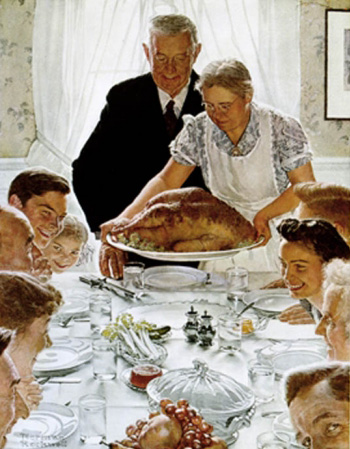
Happy Thanksgiving.
1The Apache and Modoc stories are adapted from Richard Erdoes and Alfonso Ortiz, eds., American Indian Myths and Legends (New York: Pantheon, 1984).
—
Akim Reinhardt blogs regularly at The Public Professor.