by Maniza Naqvi
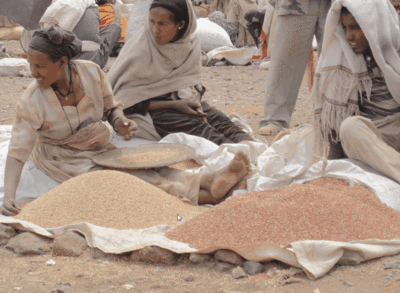
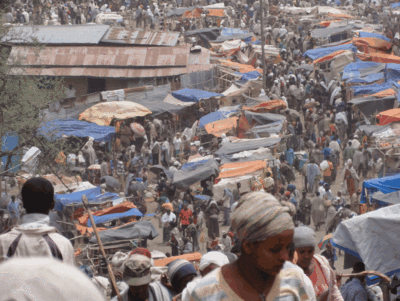 On a Saturday, in the crisp air and bright light of the highlands, hundreds of people, a flood of people —made their way to and from the market place, as has been done for centuries, carrying on their backs and shoulders, their precious babies and bundled loads of produce and goods. A miracle, this, how they had walked as far as forty kilometers up and down mountains for as long as five hours in one direction to reach the market with their livestock while carrying on their own backs and on the backs of their donkeys vessels of grains, honey, firewood, baskets, onions, potatoes, tomatoes, garlic, green chilies cauliflower, lettuce, live chickens, cabbage, Tef, Tej, sorghum, maize, wheat, rice, baskets and so on. In Lalibela, the sun drenched and bustling Saturday market right outside the walls of the dark, cool, quiet and largely empty inner sanctums of the stone churches reminded me of Jerusalem. The sacred it seems, all over the world must have a market. Or is it that commerce must have temples or that what is of value rings around itself the sacred?
 In the market there are lemons for sale. And the guide picks one up and takes aim saying that over here if someone throws a lemon at you it’s a declaration of love. I can’t think of something clever so I say, “I bet they say that to all the older women who come through here”. He laughs, rubbing the back of his graying head, “Yes! See that motel there? It belongs to former guides who were helped by a lady tourist who was very happy with their services.” I pick up a lemon and do a mock throw at a kid who has been trailing alongside giggling and testing one liners on me in German, Italian and French.
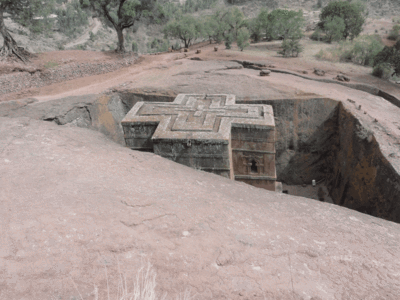
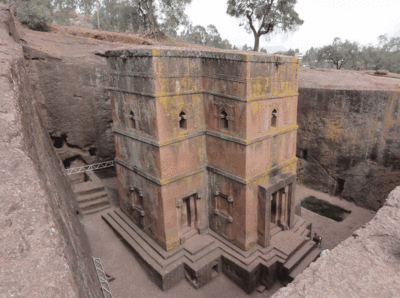 My guide points out things that must be noted by me, “King Lalibela had divine intervention on his side, look what he accomplished, look how he carved this wall, that pillar, this step, that window, that cross and that detail of a divine eye watching over us.” My guide talks of King Lalibela as though he constructed the churches all by himself, single handedly. I point this out. Well that’s the folklore he says. “If there is anything divine,” I say, “Then surely it is the labor of the people who made these churches, no?” The guide agrees. I continue on “The rest is a King’s ego. Perhaps if rulers had focused on works that fed people instead of works that only nourished their own need for immortality then the centuries to follow would have been of plentiful crops.
  Kings who build such things and the places like the Taj Mahal seem to condemn generations forward to misery. A King who made his people labor for 24 years on carving out these churches with their hands and tools made of stone must have done this at the cost of producing food and security. No wonder the neighboring warlords marched right into these valleys…everyone was busy cutting stone.” The guide leans against an embankment of stone watching me silently. I ask whether there are irrigation channels, water storage cisterns and wells in the area that date from the same time as the churches. “No”, replies the guide, “There was no need at that time because the land was plentiful with water and forests. Now the hills and valleys have neither and depend on the rain. The new road built in the valley recently destroyed the water sources. Besides, the King’s granaries were full. He provided his people food for work.”
 On the main street there are piles of stones on the road outside the churches—public works are underway for cobbled streets. The poorest are engaged as day laborers in exchange for food for work. Further down the cobbled walkway, a donkey named Celin Dion has been spotted. And at a hearing distance, regrettably not further away, breaking through the cacophony of the street, a group of American women shout out their appreciation about the strength of the neck and back muscles of the people carrying huge loads of woods. “You are so strong, Sir! Tell him, I’m a physiotherapist, I should know, tell him I said, he has amazing strength in his back!” Their guide obliges. This done they continue to celebrate themselves in happy high volume amazement as they discuss their morning jog through the town.
  Their voices rise above the quietness of everyone else around them as they incessantly and loudly unburden themselves about, how astonished they are at what they have discovered here and how remarkable, they are themselves. They sound like geese flying low. They chatter on about the details of their husbands' work—while the rest of us stuck in their wake wonder, how do they know the rest of us aren’t spies? Ah yes—because we are quiet and we look away from them— our looking away makes us irrelevant perhaps and perhaps it is further evidence that we don’t understand or speak English. A wife talks non-stop about her husband and his work and among other things he had said that most of the army recruits were in it for the “three hots and a cot”. I think to myself that it would make for a cute name for a motel.
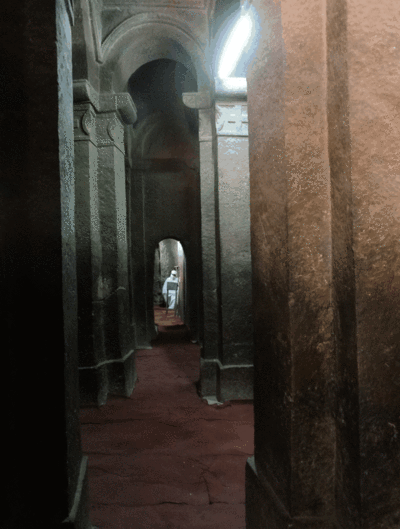 My guide points out the symbol of the eye. God's eye watching his creation, it is carved at the top of the stone pillars in one of the churches. I can't help but think of the surveillance cameras newly installed in the new offices in Addis, the drones that now fly over Ethiopia, and only yesterday yet another drone attack killed 30 people in Pakistan. It now seems to be almost a daily occurrence. It is now an ordinary and normal thing not something of wonder, this eye in the sky.
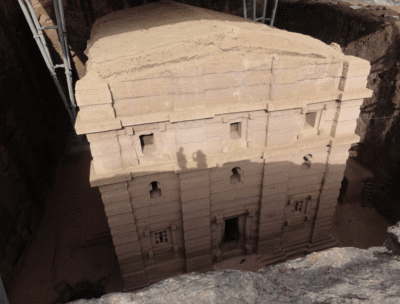
“There should be a movement called The Protection of Cultural Heritage from UNESCO preservation!” A tourist exclaims in frustration. I look up at the ugly supra structures, as though the churches are wearing bonnets made of sheets of plexi-glass with sidings of steel girders, helmeting some of the churches. UNESCO has declared the churches as endangered world heritage sites. These plexi-glass structures have been deemed necessary to protect the churches from the damage caused by the elements around them. But the ugly structures take away from the spirituality and beauty of the churches. They reminded me of the structure of foreign development consultants who seem to hover just above everything. Indeed there it was: a sign which said, UNESCO Cultural Heritage Preservation Site. 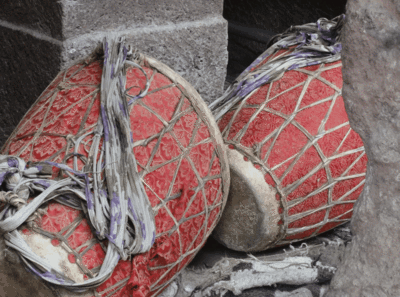 I joked in frustration at the incongruity of this industrial antithesis, to something hewed from nature to be part of nature—this monstrosity of a steel and plastic structure, in the name of protection, over the simplicity and beauty of the stone: As though even this—this clearly remarkable feat of strength and ingenuity must be emasculated in this manner of “development” and “protection.” It triggers something else in me—the false images of veils and safeguarding created in the name of respecting cultures—the meddling in the body politic of entire societies—I think of Hillary Clinton arriving in Pakistan, a couple of years ago— in a scaffolding of sorts—projecting definitions—her head covered in a long scarf, ostensibly in deference to the local culture—while the women who were there to receive her from the Pakistani Government and Foreign ministry stood beside her bemused, dressed normally without head covers.
 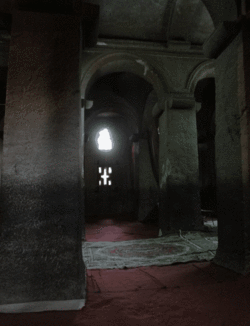 But only moments after thinking this, standing inside an Orthodox Christian church, as if to compensate for trespassing, I too covered my head and lit a candle and tried to ignore the group of Diaspora who were filming themselves, each with his or her own camera as they beat the set of drums used at Mass and as one of them lay down besides the symbolic open graves for Abraham, Isaac and Jacob and stuck her hand in while her companion videoed her. The priest who was showing them around smiled benevolently and patiently and looked on indulgently. A few minutes later at another stone church, a priest sat outside on the steps speaking loudly into his cellphone. A woman sat near him serenely, waiting patiently for him to finish. She sat reading the bible while she waited for his intervention on her behalf with the divine.
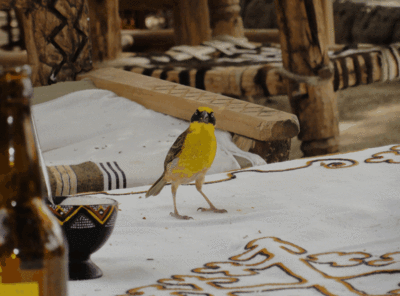
Tiny yellow orioles and birds the color of peacocks flitting in the trees, a Hemprich’s Hornbill with its long beak came to rest on a wooden post nearby, and others, hawks caught the wind currents in the ravine before us and hopping along on the cobbled pathways tiny blue and red birds picking at donkey shit. And there alongside the roadways: monkeys.
 “But if tourists come here in hoards then these sites are endangered—these churches won’t be able to bear large groups of tourists marching through them. They were not made for tourism!”
My guide looked at me askance “Didn’t you say the King should have invested in income earning projects for us?”
Other writings by Maniza Naqvi (here).
