
| ABOUT US | ARCHIVES | LINKS | RSS FEED | MONDAYS | |

3quarksdaily

An Eclectic Digest of Science, Art and Literature

« perceptions | Main | Locomotif: A short survey of trains, music & experiments »

October 22, 2012

The Problem with Voting, or Never on a Tuesday

by Akim Reinhardt

I’ve never voted for a major party presidential candidate.

1988electionIn 1988, the first time I was old enough to cast a ballot, I declined.  Just shy of my 21st birthday, I was an angry young man living in a Midwestern college town.  I was cynical. I was determined not to be anyone’s chump.  I was convinced my vote didn’t make a difference.  My older girlfriend (24) was riveted by the showdown between Michael Dukakis and George H. Bush, so I followed matters through her eyes.  I remember Lloyd Bentsen’s “You’re no Jack Kennedy” zinger to Dan Quayle in the vice presidential debates.  And I remember it not being enough to overcome Dukakis’ disastrous campaign, which squandered a 17-point summertime lead.  After it was all over, I eventually came to feel that there had to be a better way.  Perhaps I shouldn’t simply sit on my thumbs just because I didn’t like either candidate.

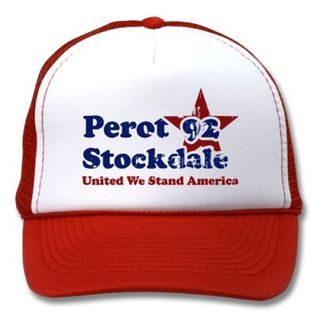
By 1992, living back home in New York City, I was more engaged.  But not in the manner that drove so many twenty-somethings into the arms of a young, smiling Bill Clinton, who was so keen to feel everyone’s pain, to “rap” with the kids on MTV, and barely kinda cop to maybe having once smoked cannabis.  No, when I say I was more engaged, I mean I attended a Halloween costume party dressed as a young James Stockdale.  For those of you who don’t remember, Stockdale was independent billionaire H. Ross Perot’s running mate.  And long before John McCain ever made a run at the national ticket, Stockdale already had “Survived a Vietnam Prison Camp” on his resumé.   At the time, Perot and Stockdale looked like the perfect vehicle for expressing my disgust with a broken, homogenized political system, and they got my vote.

In 1996, while living in Nebraska, I again voted for Perot.  This time, however, it was more out of desperation than inspiration.  The first time around I was eager to throw a monkey wrench at Washington.  More than anything, I'd wanted to shake things up.  I also hadn’t been alone.  Perot scooped nearly a fifth of the popular Perot_stockdale_92 vote in 1992, essentially clinching the election for Clinton.  But in 1996, I punched his ticket out of exasperation.  His crazy uncle routine, which had seemed charming in 1992, was tired and annoying by then (and apparently it’s since gotten worse).
And so I went into the booth, sighed, and pulled Perot's lever mostly because I just couldn’t bring myself to vote for either Clinton or Bob Dole.  It was obvious long before Clinton ever stepped into the White House that he was a lying piece of shit.  Four years in the White House had only further exposed him as a pandering, philandering, center-right, NAFTA-whoring scumbag (There truly is no joy in saying “I told you so.”).  And back then, before the Republican Party went completely bat shit crazy, guys like Bob Dole and George H. Bush seemed pretty goddamned awful.  Nowadays, by comparison they seem like old, white versions of Barack Obama.

In 2000, while living in Arizona, I voted for Ralph Nader.  If you have a problem with that, you can go straight the fuck to hell.  First of all, Arizona wasn’t in play.  None of the states I’ve lived in ever were.  Secondly, and much more important, the Democrats don’t own my vote.  I own my vote.  And I vote with my conscience, not yours or anyone else’s.  That year my conscience was firmly dedicated to building a viable Green Party in the United States.  In fact, I’m still a registered Green. 

Of course George W. Bush turned out to be a disaster in most every way imaginable.  And yes, Gore would probably have taken Florida if Nader hadn’t been on the ballot there.  But Gore also would have taken Florida if the U.S. Supreme Court hadn’t issued a partisan 5-4 decision that handed the White House over to G.H.W.B.’s idiot son by a margin of just one electoral vote.  Or, you know, maybe Gore could’ve just won his own home state of Tennessee, instead of losing it by 4 points.  Or maybe he could’ve won any number of states where Nader was not remotely a factor.  All he had to do was embrace his popular Clintonian antecedents instead of running from them, or take credit for a booming economy instead of the internet.  I’m sorry, but that shit’s all on him, not Ralph Nader.  Regardless, the bottom line is I’m not interested in those or any other what-if bellyaches.  You got a problem with how thRalph_Nadare 2000 election turned out and wanna blame someone?  Try laying it on the tens of millions of people who actually voted for Bush, if you’ve got the balls to have an actual conversation with any of the ones who aren’t related to you.  I’m still proud to have voted for Nader in 2000.
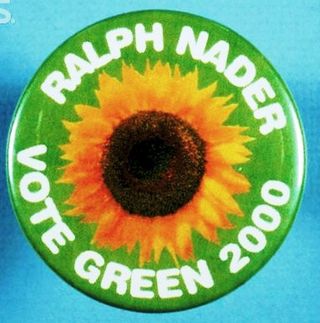
However, I’m not so proud to have voted for him again in 2004.  I wasn’t even proud of it at the time.  By then we knew just what a monumental jerk-off Little Boy Bush was, dancing on the strings pulled by Dick Cheney, Don Rumsfeld, and the other neo-conservative blowhards.  But I was living in Maryland, so once again it made no difference whatsoever.  John Kerry won that state by a wide margin.  So why was I reticent to vote for Nader again?  Because he no longer was part of building something.  If he’d taken 5% of the popular vote in 2000, the Green Party would have become eligible for public campaign funding.  That was the real goal.  Because if we’re ever going to have a viable national third party of any stripe, that will probably be the first step.  But in 2004, Nader wasn’t running as a Green anymore.  They’d moved on, yet he was determined to keep going.  With no hope of winning and no party behind him, it seemed more like a vanity project than a candidacy with a larger purpose.  Then again, Nader represented my beliefs far more than Kerry ever did, does, or will, so I shook my head and voted for Ralph one last time.

In 2008, there was no intriguing non-major party candidate.  And I won’t cast a ballot for any candidate whose platform I don’t agree with just to make a point.  Libertarian Bob Barr?  Not a chance.  Green candidate Cynthia McKinney?  In my view she’s a prima dona with horrific priorities and a tenuous grasp on reality.  And Nader’s third consecutive run was just pathetic.  So I made a gift of my votes.  

A dear friend of mine who had moved to the United States from Scotland in 1992, and was by then well on the path to citizenship (which he has since attained), had never been eligible to vote for the politicians who’d been spending his tax money lo these many years.  So in 2008, I put a ribbon on my Giftfranchise and gave it to him.  All of it.  I brought him a sample ballot and had him fill it out completely, from President and Congress all the way down the line to local ballot initiatives and bond measures.  He checked a box for every candidate and referendum, and on Election Day I cast votes according to his wishes.  Whom we voted for that day shall forever remain between me and him.

Okay, it was for Barack Obama. 

I watched the election at said friend’s house, cheering as one state after another fell to his column.  It was truly remarkable.  Even North Carolina?  Indiana!  The route was on.  And afterwards we went to a great local bar where, as people danced in the streets, we had a toast and shed a tear.

Of course Obama’s been completely fucking mediocre since then.  There have been some important accomplishments on gay rights and healthcare to name acouple.  But then again, if you’re willing to look past his willingness to slaughter Afghani civilians, then your moral compass is so askew that I don’t really care what you think.  Not that it has to preclude you from voting for him, but it is one glaring and horrific example of him falling far short of what I expect from an elected official.

However, at the time, Obama's 2008 victory was an important moment that we were honored to have played a small part in.  It symbolized an incredible turning point in the sordid history of American race relations.  I don’t regret the toast, and I’m still proud of that tear.

Anyway, I still think of it as my friend’s vote, not mine.  I was going to do whatever he said no matter what, so as far as I’m concerned, I’ve still never voted for a major party candidate.  And I’m proud of that too.  But not for the same reasons as when this all began almost a quarter-century ago.

I no longer believe there aren’t any substantive difference between the Democrats and Republicans.  During the late 1980s and early 1990s, the differences were not terribly great except for a few select social policy issues like abortion and gun control.  The Republicans were largely a center-right party and Ponies toastthe Democrats were largely a centrist party.  And with a government system predicated on compromise and dominated by a somewhat rational duopoly, policy shifts in most areas were often minimal regardless of who held power.  

However, during the last decade, and particularly during the last several years, the Republican Party has gone off the rails.  There’s no denying it anymore.  And the scariest part is it’s not even issue-driven.  This isn’t about the war in Iraq, or the economy, or abortion, or any of the other issues that generally contribute to the blue-red divide.  This is about one of America’s major parties being overtaken by a wave of dogmatic anti-intellectualism.  It’s about populism running amok.  It’s about the lowest common denominator hitting rock bottom.

So will I finally vote, in earnestness and of my own volition, for a Democratic presidential candidate on November 6?

Probably not.  I still live in Maryland, so it just doesn’t matter.  Obama’s inevitable victory here may very come by a nearly 2:1 margin.

I don’t live in Florida or Ohio.  Nothing’s riding on my presidential ballot.  And that allows me the luxury of running with that small fraction of Americans still calling themselves “undecided.”  However, unlike many undecided voters, my indecision doesn’t stem from not paying attention or having trouble figuring out whom I like better.  I’ve already thought it through.  

Truthfully, I don’t actually think Romney would be much worse than Obama if he came to Washington a split Congress.  Mostly I think the guy stands for nothing; he’s a vain, shallow suit who’ll sign almost anything you put in front of him, and another split Congress would likely offer legislation very similar to most of the stuff Obama has rolled over for these last two years.  

But then again, if Romney wins, it also probably means the Republicans have recaptured the Senate, or at least locked up 50 seats with V.P. Paul Ryan deciding tie votes.  And that could be an utter disaster on No to dronesmany levels.  So If you put a gun to my head, I’d punch a ballot for Obama in a heartbeat.  But then again, it just doesn’t matter in Maryland, one of the bluest states in the nation.

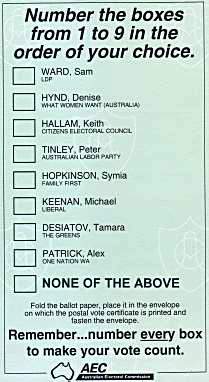
So my undecided status isn’t the result of carelessness or confusion.  Rather, it’s born from anxiety and ennui.  Currently no candidate, major or minor, has captured my imagination.  If we had a None of the Above choice on the ballot, as they do in Australia, I might very well go with that.

I do realize that the two parties are in fact drifting further and further apart on basic issues.  Furthermore, I believe that the Republicans are not only championing very bad economic policies, but are also increasingly giving themselves over to lunatics and ignoramuses.  And for the record, I’m talking primarily about their candidates, not their voters.

At the same time, however, none of that changes the larger, systemic problem: Both parties are still part of a lockstep duopoloy that maintains a vicious stranglehold on American politics.  

So while for many people, the Republicans’ ongoing descent into madness reinforces the need to support the Democrats, I’m not there yet.  Because I still think, at least for now, that the bigger problem than the Republicans themselves is the larger system: the Coke/Pepsi style duopoloy that the Republicans and Democrats mutually maintain, enriching themselves at the expense of the nation.  I believe the ideological split between them is not yet as important as the endemic incompetence and malfeasance that they jointly propagate.

The problem isn’t that the two parties are the same.  They’re not.  The problem is that both parties belong to and thoroughly dominate the same broken system.  I really do believe that their actions and interactions with each other are a big, perhaps even the biggest, obstacle to fixing the American political system.  Together they form the tragic dialectic of American politics.

Of course there are limits.  If the Republicans continue spiraling out of control, eventually I’ll come over to the Democrats as a practical matter of responsible behavior.  However, I’m not quite there yet.  I have yet to reach the point where I think we need the Democrats to ride in on their white horses to save us.  Far from it.

Perhaps that’s because I’ve never, ever bought into the fear mongering that both parties love to indulge in: Vote for us because the alternative is too grim to consider.
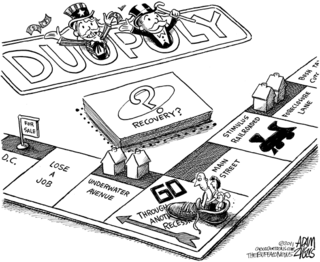
DuopolyI’ve never voted out of fear, much less the blind loyalty by which too many citizens treat politics like sports, supporting their team come hell or high water.  Rather, I think it’s better to assess the situation with some courage and sobriety.  I’d rather be pensive than panicked.  

Of course that approach doesn’t make me right about any of the individual issues.  But it does make me less likely to ignore just how broken the duopolistic American political system really is.  I’m very troubled that it is still all but impossible for a third party candidate to get anywhere in American politics.  That this remains truer than ever, even as one of the two major parties becomes a haven for the ignorant and the unhinged, only underscores the problem: The system is so thoroughly rigged in favor of the two major parties that the obstacles to entry are nearly insurmountable.  

Most every other functioning democracy in the world has multiple parties represented in its national and regional legislatures, instead of just the same two over and over and over and over and over and over and over again.  At the most basic level, there’s something very wrong with American politics, and voting for the Democrats won’t fix it.  

But many people will continue to vote Democratic because they see it as a vote against the enemy.  To me, at least for now, it’s just another vote in favor of a broken system.

If you live in a swing state, that’s one thing.  But I don’t and neither do a large majority of  Americans.  Most of us can vote for whomever we want on Tuesday, including a smattering of minor league candidates, comfortable in the knowledge that it won’t affect the electoral outcome at all.  Though if enough people do so, it has the potential to contribute to fundamental changes down the road.  Sadly, however, most folks, even those unhappy with both the Dems and the Reps, just keep tossing votes at candidates and parties that don’t inspire them.

And boy are there a lot of Americans unhappy with both parties.

Get this.  Nearly HALF of all Americans polled in July said they would be voting for “the lesser of two evils” in the upcoming election.  Forty-six percent of them to be exact.  That was one percentage point more than the amount of people who said they were actually excited to vote for one candidate or the other (the margin of error was 3%).

Despite everything, including the growing divergence between the parties, this is how half of the nation feels.  And I’m with them.  But the difference between most of them and myself is, I just can’t bring myself to do it.  I can’t pull the lever for Barack Obama on November 6.  Because not only has he been a mediocre president, but as a loyal Democrat he’s a big part of the duopolistic nightmare that is forever plaguing American politics.

Voting for the lesser of evils is still a vote for evil.  And voting means too much to me to do that.  I’d rather go back to being cynical and disengaged than vote for a candidate or a party that I don’t believe in to save me from exaggeratAustralian balloted nightmare scenarios.
I’m not looking for purity or perfection.  I understand that electoral politics is about compromise.  But I simply refuse to vote for a party that I think is mostly hurting the country and degrading the political system, even if it’s better than the other party.

The system is broken and I refuse to contribute to its ongoing decline by voting for any of the perpetrators.  Yes, the Republicans are doing more damage than the Democrats right now, I firmly believe that.  But they’re both bad.  And tens of millions of voters agree with me, even if we disagree on the solution.

But the current duopoly is not the solution.  It’s the problem.

--

Akim Reinhardt blogs regluarly at The Public Professor.

Posted by Akim Reinhardt at 12:25 AM | Permalink

Comments

"But then again, if you’re willing to look past his willingness to slaughter Afghani civilians, then your moral compass is so askew that I don’t really care what you think. "


My feelings exactly.

Posted by: Pepito | Oct 22, 2012 7:56:32 AM

A sobering post! The more reason for me to vote...

Posted by: Félix E. F. Larocca, MD | Oct 22, 2012 8:28:08 AM

Golly, what a great article! It's always good when the smart people write about electoral politics.

Posted by: Louise Gordon | Oct 22, 2012 10:39:14 AM

Mr. Reinhardt is a prime example of the lazy lap dog, content to snap at others while serving no useful purpose of his own. He should find a candidate, perhaps himself, who cares about the issues Mr. Reinhardt is devoted to, at the local level and help promote that person. We work for what we believe in and in even a democratic republic that work includes the political. bstr

Posted by: bstr | Oct 22, 2012 11:15:08 AM

bstr,

HOPE you're not indefinitely detained.

Posted by: Louise Gordon | Oct 22, 2012 11:47:55 AM

Louise, and perchance not in Guantanamo, since the incumbent shut it down four years ago --- or am I dreaming of 'the false paladin of the broken promises'?

Posted by: Félix E. F. Larocca, MD | Oct 22, 2012 12:23:39 PM

If you toss a coin enough times the probability of either side approaches 50-50. That's what the two party system has become after all these years and that's what the polls show. Finally, it is the 5% independent voters who will be the deciding factor, but not for their candidate, for the candidate on the opposite side of the spectrum! It is a stalemate till you bring in the independents into the mainstream by voting for them no matter who wins as long as the percentage of independent voters keeps on increasing. This may take decades but what social and political change has not taken decades.

Akim, very articulate article!

Posted by: Raza Husain | Oct 22, 2012 12:53:11 PM

nice to see. i've never voted either, and don't plan on starting. i was just arguing these points with someone last night, expecting the usual crushing rebuttal when i found i'd touched a nerve ... of accord.

a vote is also a show of confidence in a system. this system has been in slow decline since Eisenhower's day, and before. but today it is most definitely an unapologetic sham, a professional sports match, winner take all. i cant support it.

grassroots mobilization will change all this? good luck.

Posted by: ed | Oct 22, 2012 1:03:07 PM

It speaks volumes (to me at least) that you've never voted for a third-party presidential candidate in a swing state situation. I have to disagree about voting for a lesser evil being evil--since good and evil are relative terms, voting for a lesser evil is actually the same as voting for the good. I don't consider this fear-mongering as much as mature reality-checking. As adults, we are often faced with situations where no option seems ideal. But we must still choose, and face the consequences of our choices.

I take your larger point about a two-party system not providing enough choice. But voting for a third party will do nothing to change the system. Our two-party politics emerge directly from our first-past-the-post elections (per Duverger's law). Voting for a third party, or abstaining for that matter, will not change our electoral system.

Like it or not, decisions will be made, and our lives will be affected. Unless you are truly indifferent regarding the result, you have an ethical responsibility to do your part to prevent the greater evil, to the extent that you can with your one vote.

Posted by: Eli | Oct 22, 2012 2:32:09 PM

Well said, Eli. Many people of voting age -- including some who read and write for 3QD -- are genuinely more concerned with their process, and with how the choices play to their idea of who they are, and with how they will answer to themselves, if they vote for Obama, than with the fall-out on the nation and the world of a Romney victory. They are simply too disgusted to want to be personally dirtied by voting for the lesser of two evils. Or they are too complex for that choice to feel binding upon them -- other considerations loom larger. While most of them would instinctively act for the greatest good of the greatest number in ordinary times, these are special times. By not voting, or by voting for someone who cannot win, thereby opening the door wider to Mitt Romney, these people of voting age have, for the nonce, retreated with honor, and satisfied themselves. This is their best answer to how to exercise a civic responsibility that, elsewhere in the world, people are still laying down their lives for -- if it were not their best answer, they wouldn't respond with it. I am 100% certain they think they are brave, clear-sighted, and doing no harm that will not be done anyway, come what may. And I hope they are few enough in number to make the very same "no difference" they believe they will make.

Posted by: Elatia Harris | Oct 22, 2012 4:38:18 PM

Fellow commentators, i remind you that elections are not only about the President, but about a host of offices and issues. Harris writes correctly. Voting is a civic responsibility. Do your bit. It may be nothing but a bit, but it needs to be done. bstr

Posted by: bstr | Oct 22, 2012 10:51:07 PM

I no longer believe there aren’t any substantive difference between the Democrats and Republicans.


The policy differences between the two parties on "womens's issues" are stark.

Posted by: joel hanes | Oct 23, 2012 1:27:45 AM

Actually. we in Australia don't have an option of "none of the above" on our ballot papers, that image seems to come from the blog Graham's Paddock (http://www.feargod.net/wordpress/archives/137). Our electoral system is however overwhelmingly superior to the American system - preferential voting, electoral boundaries set by an independent commission, non-discriminatory enrolment, see http://www.aec.gov.au for more. But we also suffer from having two main parties that accept the neo-liberal view of the world.

Posted by: Joe Goozeff | Oct 23, 2012 5:20:22 AM

Here, here Joel. The future balance of the Supreme Court alone is enough reason to cast a ballot in this election. From Ellsberg's account of why progressives in swing states need to vote for Obama, despite his serious failings: "The traditional third-party mantra, “There’s no significant difference between the major parties” amounts to saying: “The Republicans are no worse, overall .” And that’s absurd. It constitutes shameless apologetics for the Republicans, however unintended. It’s crazily divorced from present reality. "
http://www.alternet.org/news-amp-politics/ellsberg-lets-not-have-illusions-about-which-two-major-candidates-would-be-better?page=0%2C0&fb_action_ids=4847188737072&fb_action_types=og.likes&fb_source=other_multiline&action_object_map={%224847188737072%22%3A153353281477815}&action_type_map={%224847188737072%22%3A%22og.likes%22}&action_ref_map=[]&paging=off

Posted by: Emily | Oct 23, 2012 9:45:01 AM

So many words, but only 6 devoted to the Libertarian party. Why so dismissive? Libertarians have offered a consistent and viable choice for decades, are on the ballot in 48 states (still waiting on Michigan and Oklahoma), and fit well to the common American position of "fiscally conservative but socially liberal".

Posted by: David | Oct 23, 2012 10:36:02 AM

"But I simply refuse to vote for a party that I think is mostly hurting the country and degrading the political system, even if it’s better than the other party."

Well, Akim, may I be the first to hope that justice is served and that you get rewarded with a Romney victory. Then, with any luck, you might just lose insurance coverage for having some pre-existing condition. If not that, perhaps a woman in your life can be denied some vital health care because of religious reasons! Barring that, perhaps you'll lose whatever meager unemployement you would otherwise get after you lose your job in this ongoing economic apocalypse. Or, just maybe, you can get drafted into a never-ending war with Iran! That'd be fun, eh?

But however it happens, I truly, truly hope that you get to experience the difference between having the two major parties in charge. I really, really do. Because I am really, really sick of hearing this "the two parties are equally evil" crap.

Posted by: L2P | Oct 23, 2012 5:50:30 PM

L2P: "I am really, really sick of hearing this "the two parties are equally evil" crap"

The polls show the two candidates are less than 5% apart and the voting will probably be the same. So equally evil or equally good, you cannot dispute that they are equally the same, taking the population as a whole.

Posted by: Raza Husain | Oct 23, 2012 8:02:15 PM

Voting for a third party in a two-party system where one of the parties is the Republicans is immoral.

Based on the tone of this article, I think you already know that. Stop trying to rationalize your previous bad decisions. Less evil is LESS evil. More evil is MORE evil. It's not rocket science.

Posted by: X | Oct 24, 2012 8:43:14 AM

Jeez, I hate trotting this out every four years for these in-it-but-not-of-it types. Look, sit out the election if you want to, AR, but don't pretend your decision is based on sustainable or logical moral principles. It's not. You're abdicating responsibility for decisions that affect all the rest of us here in reality-land. Now since you're in a solidly blue state, that's no big deal. Just spare us the I'm-too-good-to-vote-for-one-of-these-losers rationalization.

Posted by: beejeez | Nov 2, 2012 2:48:03 PM

Post a comment


Subscribe to this blog's feed  

PayAnywhere with iphone credit card swiper

Android Tablet

Bluetooth Headset

2013 New Style Dresses

Compare Car Rental Prices

DHgate.com Wholesale

3QD on Facebook

3QD on Kindle

3QD by Daily Email

Receive all blogposts at the same time every day.

Enter your Email:


Preview 3QD Email

3QD on Twitter

Miscellany

Lijit Search

AddThis Social Bookmark Button

Add to Google

Recent Comments

Sundar on If Only We Had A Leader Like Chavez, Who Solved Real Problems -- Instead Of Debating Fake Ones Like The Deficit

flowers rainbows on Lift up your voices: The century-long battle for women's freedom

mr.ed on wagner in new york?

mirel on Here’s how to change the world

mirel on If Only We Had A Leader Like Chavez, Who Solved Real Problems -- Instead Of Debating Fake Ones Like The Deficit

X on Getting Smarter

Ross Williams on Getting Smarter

oroboe on Lennon's "Imagine" and McCartney/Wings' "Band on the Run" overlaid: One way of reuniting (some of) the Beatles

Richard H. Randall on Obama must Make Fighting Climate Change National Project, or Die the death of a thousand Scandals

seth edenbaum on The First New Atheist? Kierkegaard

waqnis on Mortify Our Wolves

nogodrod on KFC smugglers bring buckets of chicken through Gaza tunnels

waqnis on Here’s how to change the world

Fernando on Mortify Our Wolves

seth edenbaum on The case against empathy

Dredd on Mortify Our Wolves

Max on Here’s how to change the world

Rohana on Mortify Our Wolves

Raza Husain on If Only We Had A Leader Like Chavez, Who Solved Real Problems -- Instead Of Debating Fake Ones Like The Deficit

mirel on If Only We Had A Leader Like Chavez, Who Solved Real Problems -- Instead Of Debating Fake Ones Like The Deficit

araldo on Here’s how to change the world

Elatia Harris on Here’s how to change the world

Sundar on Here’s how to change the world

araldo on Here’s how to change the world

prasad on Here’s how to change the world

Acclaim For 3QD


"I couldn't tear myself away from 3 Quarks Daily, to the point of neglecting my work. Congratulations on this superb site."—Steven Pinker, Johnstone Professor of Psychology, Harvard University.

"I have placed 3 Quarks Daily at the head of my list of web bookmarks."—Richard Dawkins, Charles Simonyi Professor of the Public Understanding of Science at Oxford University.

"Just wanted you to know I’m one of many who reads and enjoys 3 Quarks....almost daily."—David Byrne, musician, former lead-singer of the Talking Heads, artist, intellectual.

Read more here.

The 3QD Prizes

Subscribe to this blog's feed