
October 01, 2012
Poetry in Translation: Agha Shahid Ali and I do two couplets by Faiz Ahmed Faiz
by S. Abbas Raza
Once again, I present my own translation of two lovely couplets by Faiz Ahmed Faiz side by side with a translation of the same by the late Agha Shahid Ali. I do this not to criticize Shahid's translation in any way but actually to pay tribute to him as well as to Faiz and to show how very different translations can both, I hope, work. I have indulged in this sort of exercise before. You may see that previous effort here. This time, my translation is deliberately not as literal as it could be (although more so than Shahid's) and I have tried to retain the rhyme scheme and even, to some extent, the meter of the original Urdu. The original has no title, by the way (it just says "Couplets"), and Shahid and I have both made up our own. (My translation on the left; Shahid's on the right.)
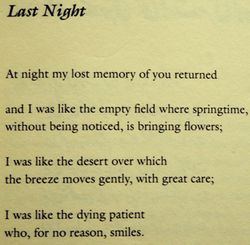
Last night my heart recovered a lost memory of you,
As if a desolate place had impetuously bloomed,
As if a moist breeze had washed over a parched desert,
As if a man, suffering, had a sudden peace assumed.
And here is an informal Urdu transliteration as well as the original:
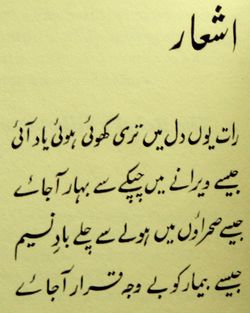
Raat yoon dil mein teree khoee hoee yaad aaee
Jaisay veeranay mein chupkay say bahaar aajaaey
Jaisay sehraaon mein hollay say chalay baad-e-naseem
Jaisay beemar ko bay-wajah qaraar aajaaey
I await suggestions for improvement from my Urdu-speaking (and other) readers!
Posted by S. Abbas Raza at 12:05 AM | Permalink


Comments
Last night a lost memory of you returned to me
As if in desolate place spring arrived silently
As if a cool breeze blew gently in the desert
As if without reason strength came to one ailing
Posted by: Lala Khan Pekhawree | Oct 1, 2012 6:19:07 AM
A lovely attempt Abbasi. I like both but am partial to rhyme. As Walter Benjamin wisely observed, “Just as the manifestations of life are intimately connected with the phenomenon of life without being of importance to it, a translation issues from the original -- not so much for its life as from its afterlife.” Love, Aps.
Posted by: Azra Raza | Oct 1, 2012 6:29:53 AM
I love your translation's fine concision, Abbas.
I have to trust you on its faithfulness to the original, but what you've written stands very beautifully on it's own.
Posted by: Jim | Oct 1, 2012 7:19:45 AM
Lala, I like your translation except for the unnecessary substitution of "strength" for "qaraar".
Aps and Jim: thanks.
Posted by: Abbas Raza | Oct 1, 2012 8:34:08 AM
That's beautiful, Abbas!
Posted by: Elatia Harris | Oct 1, 2012 8:42:45 AM
The ways of the heart
Last night my heart remembered a lost memory of you,
The way a barren wilderness can mysteriously bloom,
The way a healing breeze can whisper across a desert,
The way a patient's suffering can suddenly ease.
With many apologies for my impertinence
Posted by: FHN | Oct 1, 2012 9:15:33 AM
I am not an Urdu expert -- my education in Urdu comes largely from the Bollywood of Salim-Javed, Gulzar, Kaifi Azmi, Sahir Ludhianvi. So my only claim to any insight here is my love for Faiz' poetry.
In a general sense, I think the starkness of Faiz' verse is lost when translators attempt to rhyme the translation, or embellish it with extra words/descriptions to "explain" to a non-South-Asia audience. That has been my major complaint with Shahid's translations (Shahid's original poetry in English, on the other hand, is spectacular).
So my personal preference is for a more literal translation: the active voice for the first three lines: in the original, the memory enters the poet's mind, spring comes into the desolate land, the breeze walks across the desert; the present tense for the last three lines.
Frances Pritchett of Columbia has written about how repetition in the original can be retained to good effect in the translation (hard to repeat "aa jaaye" when it means different things in each of the lines). I'm just trying a quick translation here that addresses the repetition and the tense (you kept the repetition of "jaise", so just trying to add that of "aa jaaye").
Last night a lost memory of you appeared
As appears spring, quietly, to a desolate land
As appears the breeze, softly, across the desert
As appears rest, without cause, to the sick.
For translations of this verse by many others, and many more Faiz resources, see: http://blogs.outlookindia.com/posts.aspx?ddm=18&kid=7690
Posted by: plv | Oct 1, 2012 11:45:02 AM
Thanks Raza - without any prejudice, I liked your translation. Agha's translation is more professional and less poetic (in this case).
Posted by: Anwar | Oct 1, 2012 12:32:06 PM
I don't speak / read Urdu, so I can't comment on the translations, but, as an English speaker:
the word moist is considered to be very unpleasant by a large number of people. Has an awkward quality.
A comma between man and suffering would help comprehension, too.
I thoroughly enjoyed this post, and the comments it engendered.
Posted by: Margaret | Oct 1, 2012 12:55:15 PM
I had always thought the "lost" memory was a loss of the poet's, and its recovery was much like the pleasantness of breezes in deserts and spring in the barren areas. Long-unexperienced pleasures that are recovered.
On second thoughts, though, "khoyee hui" could also refer to: the memory had lost its way and found itself in the poet's mind, in error. In the same way that breezes are in deserts though they shouldn't be, or spring comes to a place where everything is dead. Not so much that these things come to contexts where they are very longed-for, but that they themselves show up there "by mistake". Just like this unexplained recovery of a sick person.
Maybe everyone around is saying "duh" but this just occurred to me :-)
Posted by: plv | Oct 1, 2012 1:35:16 PM
abbas I like your translation a lot, and more than the other one ithink it delivers urdu essence to a great nearness ti that of faiz
Posted by: tariq | Oct 1, 2012 9:00:03 PM
Last night you came suddenly to mind --
Like a blossom springing in the wild,
Like a gentle breeze within the desert,
Like sudden relief to this suffering heart.
Posted by: aditya | Oct 1, 2012 10:52:09 PM
I suspect I am, therefore, in the minority in quite liking the word "moist". What a great poem! I am committing it to memory. I enjoyed the various translation attempts in the comments too. Thanks.
Posted by: Liam | Oct 1, 2012 10:58:50 PM
Last night my heart recalled the memory of you
And I felt as if spring had suddenly arrived in a desolate place
And I felt as if a cool breeze had gentle wafted in the deserts
And I felt as if the sick had recovered without reason
Note on "yoon":
The second word in the first line - "yoon" - which Abbas has aptly translated "as if", controls the meaning of the next 3 verses. In English "as if" must be repeated each time, whereas in Urdu that the first 'yoon' is sufficient.
Posted by: Ali | Oct 2, 2012 3:55:17 AM
Margaret,
I went back and forth a few times trying to decide whether to add a comma between "man" and "suffering" in the last line and decided against it. But reading your comment now I am adding it! Thanks.
Thanks also to everyone else for the very interesting comments and various translations.
Posted by: Abbas Raza | Oct 2, 2012 4:37:19 AM
Abbas, you have to take care when translating to avoid cultural bias. The following example is Wordsworth's poem translated into Cokney rhyming slang:
"I wandered lonely as a cloud that floats on 'igh o'er vales and 'ills,
when aw at once I Bear's Paw a crowd, a Pillar and Post, of golden daffodils
beside the bloody lake, beneaf the bleedin' trees, flutterin' and freakin' in the breeze."
Posted by: aguy109 | Oct 2, 2012 7:18:50 AM
Beautifully translated, Abbas Raza!
Victor Kiernan translated it this way:
I- LAST NIGHT
Last night your faded memory filled my heart
Like spring's calm advent in the wilderness,
Like the soft desert footalls of the breeze,
Like peace somehow coming to one in sickness.
Verses
1 Last night your lost memory so came into the heart
As spring comes in the wilderness quietly,
As the zephyr moves slowly in deserts,
As rest comes without cause to a sick man.
Posted by: Ayesha Iqbal | Oct 4, 2012 3:25:00 AM
Very nice, Abbasi! distinctly less awkward and more true to the original than Shahid's. My only suggestion in the first line is to substitute the active verb recovered with something that conveys the unexpected or passive popping in of a long lost memory.
Love, Ga
Posted by: Ga | Oct 5, 2012 6:27:51 AM
The word ''appears " does not give the sense of "aajaye" in all the three lines of the original text.The renderings given here suffer from typical shortcomings.
Posted by: suhail Ahmad Farooqi | Nov 17, 2012 6:45:24 AM
Faiz was a humble person with an optimistic approach towards life. His love for humanity was free of the prejudice of race, color or nationality. Apart from being an innovative poet, he was the poet of beauty and love, and for him, there was no difference between the three; love, beauty, and revolution.
Posted by: Sarwan Muzzafar | Nov 30, 2012 5:23:42 AM
Post a comment