
by Gautam Pemmaraju
I have always loved locomotives passionately. For me they are living creatures and I love them as others love women or horses.
—Arthur Honegger
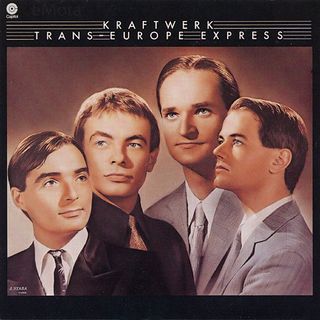
We were much more interested in it at that time than being Germans because we had been confronted by this German identity so much in the States, with everyone greeting us with the 'heil Hitler' salutes. They were just making fun and jokes and not being very serious but we'd had enough of this idea.
The chugging beat, “ripe with unlikely hooks, and hypnotic, minimalist arrangements” is in ways an ideological amplification of the idea of Autobahn, referencing the transport networks of Germany, and seeking in its “propulsive proto electro groove…a high speed velocity transit away from the horrors of Nazism and World War II”. There was, however, as Pascal Bussy writes in Kraftwerk: Man, Machine, Music (1993), a formidable nationalism underlying their somewhat nebulous politics. Kraftwerk believed, as Hütter is quoted saying to the American journalist Lester Bangs in 1975, that they were unlike other contemporary German bands which tended to be Anglo-American; they wanted instead to be known as German since the “the German mentality, which is more advanced, will always be part of our behaviour”.
Drawing quite a bit of inspiration from pioneering avant-garde artists such as Karl Heinz Stockhausen, the Italian composer Russolo & the Fluxus Group (which included La Monte Young, Jon Hassel & Tony Conrad), it was actually the Frenchman Pierre Schaeffer that they were directly indebted to, in some manner, with regard to their electronic transport music. As Karl Batos reveals in the aforementioned interview, they were ‘following his path’, since it was the Schaeffer’s Musique Concrète piece using only train sounds that they were referencing.
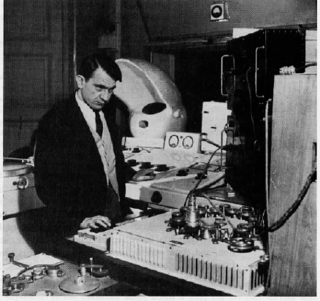
Musique Concrète was a Schaeffer’s way of ‘turning his back on music’. It was a method of empirically gathering environmental sounds and creating sonic envelopes using those sources. In doing so it was in “an opposition with the way musical work usually goes”, Schaeffer believed, and the process of collecting sounds, ‘concrete sounds’, whatever their origin be, was “to abstract the musical values they were potentially containing”. It was a way of ‘freeing’ composition from its formalist shackles and reformulating the process of composition, ‘a new mental framework’, which saw the shaping of music as a more ‘plastic’ process. In a 1986 interview (read here), the broadcast engineer who worked for the radio station ORTF, says that having successfully driven out the German invasion in the years after the war, music was still ‘under an occupying power’ – Austrian, 12 tone music of the Vienna School. It was this that he wished to reject and seek instead, “…salvation, liberation if possible”. He, along with Pierre Henry, in contrast to purely electronic music, developed pioneering modes and techniques of electroacoustic improvisation, wherein naturally occurring and other environmental sounds, ‘any and all sounds’, were recorded and then manipulated to create musical compositions.
Etudes aux Chemins du Fer (Railroad Study) is often described as an early example of an audio mash-up, and the first one of railroad sounds – engines, track sounds, whistles and other associate sounds. Described here as “audio portraits for the end of the machine age and the beginning of the electronic age”, Schaeffer was drawn to “external events and impressive machines”. He recorded these sounds at several locations, his intention in part, was to ‘remove the original meaning’ of the sounds. Then using reverse, loop, speed change edit techniques, the final composition became then a surrealist sonic reconfiguration, a sonic collage of sounds, freely collected and organized.
Schaeffer’s ideas were influenced in part by Luigi Russolo, who propounded an elaborate aesthetic theory of noise (see also intonarumori instruments). John Cage’s thoughts on noise are also quite extensive, and as Paul Hegarty points out here, “all noises can be brought into the realm of something like music, and will drastically increase the remit of sound making and listening”. It is this principle, of a broader, unexplored universe of sounds and noise open to exploration and experimentation that underscores the thoughts of Russolo, Cage, Schaeffer, amongst many others. Hegarty further points to Cage’s increased liking for noise, ‘more than intervals’ and ‘just as much as single sounds’, and Russolo’s belief in the richness of noise. In his seminal futurist manifesto, The Arts of Noise (1913), Russolo states that hitherto, “musical art had looked for the soft and limpid purity of sound” and then sought to caress “the ear with sauve harmonies”, but it is noise-sound that has brought radical change for,
This revolution in music is paralleled by the increasing proliferation of machinery sharing in human labor. In the pounding atmosphere of great cities as well as in the formerly silent countryside, machines create today such a large number of varied noises that pure sound, with its littleness and monotony, now fails to arouse any emotion.
His evangelical zeal of noise aside, Russolo’s points to his belief in the grandness of the machine age, its ability to bring large, transformative change, and of course, the grandness of human endeavour gloriously and emphatically reflected in the image (and noise-sounds) of machines. There is more pleasure, he contends, in “the sounds of trolleys, autos and other vehicles…than heroic or pastoral symphonies”. Though Beethoven and Wagner “have deliciously shaken our hearts” in the past, “now we are fed up with them”, Russolo explicates in his grand manifesto.
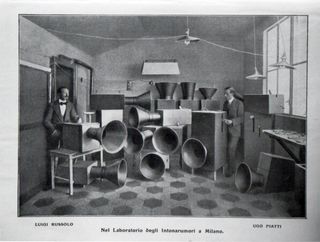
All great radical modern music made by humans and machines mixing noise and nature is Russolo's great dream of industrial sound come to life. Everything in his head could eventually be produced in a modern recording studio.
Russolo was far more flexible than the futurist guru Filippo Marinetti, Morely points out, who rejected the musical (and artistic) past with great ceremony. Marinetti’s intense nationalist fervour, his militant, fascist tone, the base upon which his ideas were formed, are more than evident in this translation of the founding of Futurism and the writing of the manifesto, wherein after a sleepless night of discussions and drafting with friends when for “hours we had trampled our atavistic ennui into rich oriental rugs, arguing up to the last confines of logic”, having written that they would “destroy the museums, libraries, academies…every opportunistic and utilitarian cowardice”, the last point of their ‘incendiary’ manifesto declares,
We will sing of great crowds excited by work, by pleasure, and by riot; we will sing of the multicolored, polyphonic tides of revolution in the modern capitals; we will sing of the vibrant nightly fervor of arsenals and shipyards blazing with violent electric moons; greedy railway stations that devour smoke-plumed serpents; factories hung on clouds by the crooked lines of their smoke; bridges that stride the rivers like giant gymnasts, flashing in the sun with a glitter of knives; adventurous steamers that sniff the horizon; deep-chested locomotives whose wheels paw the tracks like the hooves of enormous steel horses bridled by tubing; and the sleek flight of planes whose propellers chatter in the wind like banners and seem to cheer like an enthusiastic crowd.
Equally dissatisfied with traditional music, and also desiring some kind of ‘freedom from the shackles’, Feruccio Busoni authored a paper titled Sketch of a New Aesthetic of Music in 1907. As Thom Holmes writes in Electronic and Experimental Music (2008), after encountering Thaddeus Cahill’s prescient electronic musical device the Telharmonium, he “immediately grasped the relevance of the achievement to his own quest for a means of creating microtonal music”. Besides, he also immediately understood, Holmes reveals further, “the special relationship between inventors and musicians”:
I almost think that in the new great music, machines will be necessary and will be assigned a share in it. Perhaps industry, too, will bring forth her share in the artistic ascent.
Francesco Pratella, another futurist ideologue, in 1911, wrote his own manifesto against traditionalism, “intellectual mediocrity and commercial baseness”, and unfurling “to the freedom of the air and sun the red flag of futurism”, he thereby issued a call to young composers to embrace adventure and new ideas. As Holmes points out, Pratella was interested in atonality, the use of semitones, and to “crush the domination of dance rhythms”, but it would be his follower Russolo who would take this thought further, and build his noise-making machines.
Amongst the Intonanumori that Russolo built in collaboration with painter Ugo Piatta, which produced a “families” of sounds, from roars, whistles, whispers, screeches, material noises, and voices, there was one, which Holmes writes of, that was meant to imitate the sound of an automobile engine starting. Russolo and Marinetti staged the first futurist concert in 1914, and described the reaction of the ‘incredulous public’ as “showing the first steam engine to a herd of cows”. As Holmes writes, in a 1922 interview Russolo had said, “speed and synthesis are the characteristics of our epoch”, once again pointing to the “the likely marriage of electronics with music”.
Russolo’s ideas caught the fancy of many, who saw great possibilities of experimentation. Arthur Honegger’s 1923 orchestral work, Pacific 231, inspired by a steam locomotive, is an early example of the fusing of some of these ideas. Edgard Varèse (from Charlie Parker to Frank Zappa, he had a long list of admirers; see here) who knew both Marinetti and Russolo, took the cue. Holmes points out that although disappointed by the iconoclastic music being made by the futurists, he was very taken by the possibilities. Using dissonance and atonality, his musical experiments was ‘energized’, Holmes writes on, with “striking rhythms, clash of timbres, and unusual combinations of instruments”, and the underlying thought is revealed in this quote:
I prefer to use the expression “organized sound” and avoid the monotonous question: “But is it music?” “Organized sound” seems better to take in the dual aspect of music as an art-science, with all the recent laboratory discoveries, which permit us to hope for the unconditional liberation of music, as well as covering, without dispute, my own music in progress and its requirements.
Composers and inventors alike were seeking such liberating ideas, and what with the likes of Lee De Forest, Vladimir Baranoff Rossiné, Jorg Mager, Leon Theremin, Maurice Martenot and Robert Moog who created exciting new inventions, and experimentalists such as George Antheil (see Ballet Mécanique), John Cage and Stockhausen, but a few stars in the grand firmament of musical argonauts, these adolescent promiscuous entanglements between music, art and technology were to eventually, over the decades, result in furtive couplings and noisy fornication in the open alike. The programmatic futurism of the early 20th century is now a distant problematic, moderated by the unfolding of history; and the wars, the onset of the electronic age, the digital age, have radically transformed these early experiments, extricating them in some sense, from their original ideological moorings. Simplistic attributes have given way for keen and oftentimes, playful conceptualism.
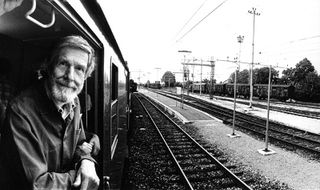
‘In search of lost silence’, John Cage embarked on a musical train journey in 1978, creating an improvised concert on a train over two days in Bologna. Alvin Curran reconstructed this in 2008. Steve Reich’s piece for strings and tape, Different Trains, first performed by the Kronos Quartet, uses recorded voices as melodic elements, aside from other experimental techniques. It plays with memory reconstruction and the composer has mentioned holocaust trains in association. There are several other interesting experiments linked to trains, not merely evocations of memory, sensory experience, or reflected abstractions, but also quirky conceptual formulations. A more ‘one dimensional concept’, is Entfernte Züge, or Distant Trains (1983), a ‘musical sculpture’ by Bill Fontana, set in a field where once stood one of the busiest pre-war train stations of Europe, the Anhalter Bahnhof. There is also Australian scientist and sonic artist Alan Lamb’s 2006 installation Loco Motivus project, which involved a ‘found’ Aeolian harp (see my piece on aural mapping and 'found' instruments) using wayside telephone wires at Pindari, a farm near Wagga, NSW. The ‘performance’ was conducted on an eight-carriage train, and as it entered a silo sliding, the sounds of the wires were transmitted to the train via CB radio. Lokofon is another notable example by Norwegian musician/artist Espen Sommer Eide, which involved a set of soundworks by different artists on the northernmost train railroad in the world. One artist, Anton Nikkelä, the creator of this work informs me, lectured on Russian railroad construction while propaganda music was playing in the background. Alexander Chen’s reimagining of the NY Subway Map (Massimo Vignelli’s 1972 diagram) as a set of strings, is a fabulous interactive work, wherein the trains (or imagined graphic ones at least), become the performers, as the artist puts it. The subway train is recreated in another visually provocative and striking motion graphic art piece, titled Dynamics of the Subway, by Japanese artist/designer Keita Onishi, wherein geometric shapes propel the formation of the composite sound and visual.
Trains have long inspired great music (not to mention art and literature as well). From classic American railroad folk songs and ballads, blues, jazz, rock and pop (see this exhaustive list and this Smithsonian Folkways collection), not to mention Hindi film songs, there is a vast array of music linked to trains (alert readers will possibly point to more). Emory Cook, the inventor and recording engineer, made a series of recording of trains in New York, titled Rail Dyanamics (1950). A Japanese express train is called Sonic. There has been a long fascination with the great machines, and what trains have represented and inspired, has been in part, the ability to metaphorically travel with pulsating vigour, a sort of propulsive, percussive march onward to newer ground. With freight and fireball, express and bullet, electric and ghost, it is perhaps the freedom train that is most obviously emblematic of the journey to newer artistic thought and expression.