
October 15, 2012
Cynicism and Argument
by Scott F. Aikin and Robert B. Talisse
In
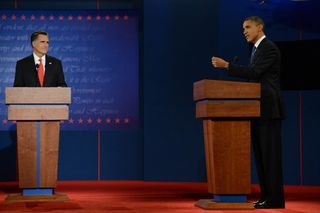
the wake of the first Presidential Debate between President Obama and Mitt
Romney, two assessments have come to be widely accepted. The first is that Mitt Romney handily won the
debate. The second is that Mitt Romney’s
key claims in the debate were demonstrably inaccurate. Neither assessment taken on its own looks
particularly noteworthy. But when they
are affirmed together, they sound dissonant.
Here’s why. Debates are argumentative settings where one’s performance should be assessed on the basis of the relative quality of the arguments one presents. The quality of an argument depends on the truth of the information presented as premises and the relevance of that information to its conclusion. So if we know that an arguer is employing premises containing important inaccuracies, we should not judge his or her arguments as successful. Therefore we should not think he or she did well in the debate. Yet this is precisely what the conjunction of the two prevalent assessments of the Presidential Debate contends: Romney won the debate, but his central arguments were failures. There’s the dissonance.
We can anticipate what our critics will say: What Pollyannas these guys are! They may then continue: Academics are so naïve! Political debates aren’t about arguments, but rather cutting a striking pose, displaying one’s personality, connecting with an audience, and making one’s opponents look dumb. The critics might then raise the example of the Nixon/Kennedy debates in 1960, where Nixon was considered the winner by those listening on the radio, but Kennedy won with those who watched on TV. Nixon looked tired, but Kennedy looked, well, like a Kennedy. This leads our imagined critics to conclude: Winning over an audience, looking “presidential,” taking a commanding tone -- that’s what political debate is really about. Everything else is just Ivory Tower chatter. And so goes a popular interpretation of democracy’s deliberative moments. This is a resolutely cynical stance concerning democracy, and in fact it takes its cynicism to be a kind of virtue. Let’s call it “just is” cynicism.
It should be confessed that we academics have our own version of “just is” cynicism. It begins just like the popular version: Politics just is the effective exercise of power. Democracy just is civil war by other means. Argument just is the process of eliciting assent. And so on. But then the academic version adds an additional layer of cynicism: saying non-cynical things -- such as that politics is about justice, democracy is about self-government, and argument is about rationality -- just is idealistic claptrap at best, and more likely just is one further exercise of power and manipulation. That is, academic “just is” cynicism claims not merely that non-cynics are delusional; it claims that in fact we’re all cynics, with criticism of cynicism being the most cynical posture of all. Any argument against cynicism just is cynicism, because it’s just cynicism all the way down. Non-cynicism is false-consciousness. This is “just is” cynicism gone global.
In recent posts here on 3Quarks [Here and Here], we’ve given reasons why we resist the cynical turn when it comes to democracy, and here we will explain why we resist it when it comes to argument and reason more generally. The short version of our case against global cynicism is simply this: the view that argument and reasoning just is cynical manipulation is itself the product of non-cynical argument and reasoning. The “just is” cynical view about reason and argument is parasitic upon an exercise of non-cynical reasoning and argument; therefore, the cynic must admit that non-cynical argument and reasoning is possible. Therefore “just is” cynicism about argument is self-defeating.
The self-defeat problem for cynical views of argument actually comes in two forms. Recall that argumentative cynics claim that argument just is rhetorical manipulation. One problem concerns the role that argument must play if there is going to be a case for adopting argumentative cynicism; the other has to do with the way one must see the reasons for the cynical view once one has come to adopt it.
First, if one believes that argument just is about getting others to believe one’s conclusions, rather than about showing their truth or providing conditions for knowledge, then one must take it that this cynical view of argument itself is supported by good reasons, reasons that show – or at least suggest - that the cynical view is true. Accordingly, in assessing the reasons in favor of cynicism as strong enough to support the view, argumentative cynics supply killer counter-examples to their view. They are “hoist with their own petard,” as Shakespeare might have put it.
Second, if one believes that argument is just about getting others to believe one’s conclusions, then one must view one’s own arguments, even for that very view, as self-imposed verbal manipulation. But then the cynic must admit in his or her own case that he or she has no better reason to be a cynic than not, as there are no reasons to be had for any view. And, further, the cynic’s critique of non-cynicism falls apart. The cynic’s charge that non-cynicism is false consciousness depends precisely on the idea that there is a correct view about things, one that acknowledges the evidence of the terrible truth of cynicism – namely, that nobody believes for good reasons, or anything like reasons at all. The trouble is that once “just is” cynicism has gone global, it must adopt a cynicism about argument and reason, and this in turn means that it must take a cynical posture on its own reasons. Hence it must admit that “just is” cynicism about argument and reason is also false consciousness. But then that admission would itself be subject to the cynical assessment: the evaluation of something as false consciousness is also false consciousness. Oh, the petards!
It doesn’t make one a naïve professor to uphold the idea that debates are supposed to be about reasons, evidence, and truth. We all know that the election-time events that are called “debates” are actually national campaign-stops, where candidates compete on one stage by means of zingers and other rhetorical tactics for sound-bites, media coverage, and poll numbers. But winning at a debate is nonetheless distinct from winning a debate, and the world of high-stakes professional politics knows it, otherwise they would not invest so much time, effort, and energy into training candidates to achieve the former by appearing to achieve the latter.
Posted by Scott F. Aikin and Robert B. Talisse at 12:15 AM | Permalink


Comments
Willard Mitt Romney was born to George W. Romney and his wife in 1947. What moral and ethical values did son Mitt possibly receive from his parents, especially his distinguished Father?
The following enlightening article about the rags to riches story of George W. Romney, Mitt's Father, sheds light on the subject here, followed with a few quotes from the article:
http://en.wikipedia.org/wiki/George_W._Romney
“George Wilcken Romney ( July 8, 1907 – July 26, 1995) was a Mexican-born American businessman and Republican Party politician. He was chairman and president of American Motors Corporation from 1954 to 1962, the 43rd Governor of Michigan from 1963 to 1969, and the United States Secretary of Housing and Urban Development from 1969 to 1973. He is the father of former Governor of Massachusetts and 2012 Republican presidential nominee Mitt Romney and was the husband of former Michigan U.S. Senate candidate Lenore Romney.”
“Romney was born to American parents living in the Mormon colonies in Mexico; events during the Mexican Revolution forced his family to flee back to the United States when he was a child. The family lived in several states and ended up in Salt Lake City, Utah, where they struggled during the Great Depression. Romney worked in a number of jobs, served as a Mormon missionary in England and Scotland, and attended several colleges in the U.S. but did not graduate from any. In 1939 he moved to Detroit and joined the American Automobile Manufacturers Association, where he served as the chief spokesman for the automobile industry during World War II and headed a cooperative arrangement in which companies could share production improvements. He joined Nash-Kelvinator in 1948, and became the chief executive of its successor, American Motors Corporation, in 1954. There he turned around the struggling firm by focusing all efforts on the compact Rambler car. Romney mocked the products of the "Big Three" automakers as "gas-guzzling dinosaurs" and became one of the first high-profile, media-savvy business executives. Devoutly religious, Romney presided over the Detroit Stake of The Church of Jesus Christ of Latter-day Saints”
“Romney supported the American Civil Rights Movement while governor.[119] Although he belonged to a church that did not allow black people in its lay clergy, Romney's hardscrabble background and subsequent life experiences led him to support the movement.[19] He reflected, "It was only after I got to Detroit that I got to know Negroes and began to be able to evaluate them and I began to recognize that some Negroes are better and more capable than lots of whites."[96] During his first State of the State address in January 1963, Romney declared that "Michigan's most urgent human rights problem is racial discrimination—in housing, public accommodations, education, administration of justice, and employment."[120] Romney helped create the state's first civil rights commission.[121]
The governor (shirt sleeves) walking in the first rank of an NAACP march, 600-strong, in protest of housing discrimination, June 1963[122]
When Martin Luther King, Jr. came to Detroit in June 1963 and led the 120,000-strong[123] Great March on Detroit, Romney designated the occasion Freedom March Day in Michigan, and sent state senator Stanley Thayer to march with King as his emissary, but did not attend himself because it was on Sunday.[119][124][125] Romney did participate in a much smaller march protesting housing discrimination the following Saturday in Grosse Pointe, after King had left.[119][122][123] Romney's advocacy of civil rights brought him criticism from some in his own church;[97] in January 1964, Quorum of the Twelve Apostles member Delbert L. Stapley wrote him that a proposed civil rights bill was "vicious legislation" and telling him that "the Lord had placed the curse upon the Negro" and men should not seek its removal.[35][126] Romney refused to change his position and increased his efforts towards civil rights.[35][126] Regarding the church policy itself, Romney was among those liberal Mormons who hoped the church leadership would revise the theological interpretation that underlay it,[127] but Romney did not believe in publicly criticizing the church, subsequently saying that fellow Mormon Stewart Udall's 1967 published denunciation of the policy "cannot serve any useful religious purpose".[128][129]”
After becoming an elder, Romney earned enough money working to fund himself as a Mormon missionary.[39] In October 1926, he sailed to Great Britain and was first assigned to preach in a Glasgow, Scotland, slum.[39] The abject poverty and hopelessness he saw there affected him greatly,[10] but he was ineffective in gaining converts and temporarily suffered a crisis of faith.[40]
In February 1927, he was shifted to Edinburgh and in February 1928 to London,[41] where he kept track of mission finances.[42] He worked under renowned Quorum of the Twelve Apostles intellectuals James E. Talmage and John A. Widtsoe; the latter's admonitions to "Live mightily today, the greatest day of all time is today" made a lasting impression on him.[10][42] Romney experienced British sights and culture and was introduced to members of the peerage and the Oxford Group.[43]
“In August 1928, Romney became president of the Scottish missionary district.[43] Operating in a whisky-centric region was difficult, and he developed a new "task force" approach of sending more missionaries to a single location at a time; this successfully drew local press attention and several hundred new recruits.[42][43] Romney's frequent public proselytizing – from Edinburgh's Mound and in London from soap boxes at Speakers' Corner in Hyde Park and from a platform at Trafalgar Square – developed his gifts for debate and sales, which he would use the rest of his career.[29][30][41] Three decades later, Romney said that his missionary time had meant more to him in developing his career than any other experience” All quotes taken from the above article.
Now compare these ethical values with those instilled in the current President by his parents. Observe the significance of religion in instilling ethical and moral values in children.
Posted by: w.j.abbe | Oct 15, 2012 7:44:36 AM
Yeah, transcendental arguments are fun, but demanding. In this case, there is a move open to the global cynic on your terms: to simply assert cynicism as something he or she sees in the way people act and talk. There will be no argumentative "case" made, no premise-conclusion reasoning designed to persuade anyone.
In my experience, y'all don't read or respond to comments on here, so, rather ironically, this particular discussion is not going to blossom into a rationally responsible give and take. But I thought I'd just point out this logical possibility.
Posted by: Joe | Oct 15, 2012 8:18:17 AM
It's been awhile since I read Kant, but I'm sure there's no transcendental arguments in the article. Asserting cynicism in the way you describe is to make a non-cynical argument based on the premise that one (accurately) sees cynicism in the ways people act and talk. Cynicism again can't be absolute. So the authors are right.
Posted by: Stiv | Oct 15, 2012 10:00:27 AM
Something here tells me the authors might be at least reading the comments on these posts, if not responding directly.
On substance, all I will say is that one philosopher's cynicism is another's realism.
Posted by: Eli | Oct 15, 2012 12:14:07 PM
w.j.abbe, how does quoting some polished turd of a biography in any way respond to the fact that Williard lied over and over during the debate? I'm pretty sure you are also one of the cyics that this article tries to address.
Posted by: HydrogenBond | Oct 15, 2012 1:42:25 PM
Joe, you're on to something. But the mistake is in saying that the global cynic would simply assert that cynicism is the case, and therefore not have argued that it is case. The problem is that by even simply asserting that cynicism just is, they are still making a case. Since to even assert is to put forward a claim of some sort. And any claim has within it the implication of the idea of truth or an assumed claim about knowledge. Because when an agent asserts any claim they are also making an implied argument about how their perceptive faculties, combined with their agency, has allowed them to report a state of the world. Which then opens us up to all the questions about epistemology that have plagued philosophers for centuries.
Now, again the thought here would be to say that when a global cynic makes an assertion or a claim about something being the case, they are not making an actual argument because they view all arguments as rhetoric and therefore view their own assertions as simply tools of coercion, not as persuasive reportage about states of the world. But this means that they are not "asserting" or "claiming" in any way that we understand those terms. At best, they are doing something more like a command or imperative, a raw speech act. At worst, they are not making an assertion at all, since the content of the assertion is either completely arbitrary or simply nonexistent. Thus, it would be the equivalent of making no assertion at all. And this is the final conclusion for the global cynic, removing themselves completely from the world of claims/assertions. There is no room for claims of any sort, because all claims have within them minimum assumptions about knowledge and agency. And this is fine if that's what the global cynic finds acceptable, but there's not going to be much opportunity for debate in their life.
HydrogenBond, pay no attention to w.j.abbe, he/she does nothing but troll these pages.
Posted by: Ben Schwartz | Oct 15, 2012 2:13:45 PM
Cynicism is only intellectual sloth.- Henry Rollins
Posted by: Marc | Oct 16, 2012 1:29:16 AM
By debate time 90% already have their favorites and a debate doesn't change their minds. They are the ones who argue passionately and rationalize if they see their guy has not doe well and risks losing the election. The undecided doesn't care that much to write or comment about it. So cynicism or argument, it hardly matters.
Posted by: Raza Husain | Oct 16, 2012 7:28:28 AM
Post a comment