
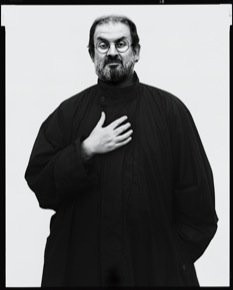
At the CBS offices, he was the big story of the day. People in the newsroom and on various monitors were already using the word that would soon be hung around his neck like a millstone. “Fatwa.”
I inform the proud Muslim people of the world that the author of the “Satanic Verses” book, which is against Islam, the Prophet and the Koran, and all those involved in its publication who were aware of its content, are sentenced to death. I ask all the Muslims to execute them wherever they find them.
Somebody gave him a printout of the text as he was escorted to the studio for his interview. His old self wanted to argue with the word “sentenced.” This was not a sentence handed down by any court that he recognized, or that had any jurisdiction over him. But he also knew that his old self’s habits were of no use anymore. He was a new self now. He was the person in the eye of the storm, no longer the Salman his friends knew but the Rushdie who was the author of “Satanic Verses,” a title that had been subtly distorted by the omission of the initial “The.” “The Satanic Verses” was a novel. “Satanic Verses” were verses that were satanic, and he was their satanic author. How easy it was to erase a man’s past and to construct a new version of him, an overwhelming version, against which it seemed impossible to fight.He looked at the journalists looking at him and he wondered if this was how people looked at men being taken to the gallows or the electric chair. One foreign correspondent came over to him to be friendly. He asked this man what he should make of Khomeini’s pronouncement. Was it just a rhetorical flourish, or something genuinely dangerous? “Oh, don’t worry too much,” the journalist said. “Khomeini sentences the President of the United States to death every Friday afternoon.”
On air, when he was asked for a response to the threat, he said, “I wish I’d written a more critical book.” He was proud, then and always, that he had said this. It was the truth. He did not feel that his book was especially critical of Islam, but, as he said on American television that morning, a religion whose leaders behaved in this way could probably use a little criticism.