
| ABOUT US | ARCHIVES | LINKS | RSS FEED | MONDAYS | |

3quarksdaily

An Eclectic Digest of Science, Art and Literature

« strom | Main | On Early Warning Signs »

September 29, 2012

Quick Intuitive Decisions Foster More Charity and Cooperation than Slow Calculated Ones

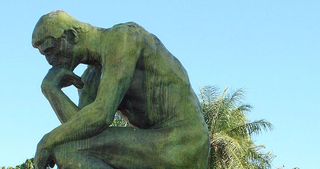
ThinkerEd Yong over at Not Exactly Rocket Science:

Our lives are governed by both fast and slow – by quick, intuitive decisions based on our gut feelings; and by deliberate, ponderous ones based on careful reflection. How do these varying speeds affect our choices? Consider the many situations when we must put our own self-interest against the public good, from giving to charity to paying out taxes. Are we naturally prone to selfishness, behaving altruistically only through slow acts of self-control? Or do we intuitively reveal our better angels, giving way to self-interest as we take time to think?

According to David Rand from Harvard University, it’s the latter. Through a series of experiments, he has found that, on average, people behave more selflessly if they make decisions quickly and intuitively. If they take time to weigh things up, cooperation gives way to selfishness. The title of his paper – “Spontaneous giving and calculated greed” – says it all.

Working with Joshua Greene and Martin Nowak, Rand asked volunteers to play the sort of games that economists have used for years. They have to decide how to divvy, steal, invest or monopolise a pot of money, sometimes with the option to reward or punish other players. These games are useful research tools, but there’s an unspoken simplicity to them. Sure, the size of the payoffs or the number of rounds may vary, but experiments assume that people play consistently depending on their personal preferences. We know from personal experience that this is unlikely to be true, and Rand’s experiments confirm as much. They show that speed matters.

Rand started with a simple public goods game, where players decide how much money to put into a pot. The pot is then doubled and split evenly among them. The group gets the best returns if everyone goes all-in, but each individual does best if they withhold their money and reap the rewards nonetheless.

Posted by Robin Varghese at 05:02 PM | Permalink

Comments

"There's nothing one regrets so much as one's thoughtless acts of generosity."

Iris Murdoch
An Accidental Man

Posted by: Andrew Averill | Sep 29, 2012 6:24:38 PM

Post a comment


Subscribe to this blog's feed  

PayAnywhere with iphone credit card swiper

Android Tablet

Bluetooth Headset

2013 New Style Dresses

Compare Car Rental Prices

DHgate.com Wholesale

3QD on Facebook

3QD on Kindle

3QD by Daily Email

Receive all blogposts at the same time every day.

Enter your Email:


Preview 3QD Email

3QD on Twitter

Miscellany

Lijit Search

AddThis Social Bookmark Button

Add to Google

Recent Comments

Dr. Smith on Race Is Not Biology

Sundar on Daniel Dennett's seven tools for thinking

Sundar on Daniel Dennett's seven tools for thinking

Sundar on Why race as a biological construct matters

Sundar on Race Is Not Biology

Joel Grant on Why Rational People Buy Into Conspiracy Theories

khaled on Evolution shapes new rules for ant behavior

musafir on Mohsin Hamid: 'Islam is not a monolith'

araldo on Mohsin Hamid: 'Islam is not a monolith'

JM on Physicists Create Quantum Link Between Photons That Don't Exist at the Same Time

SteveRR on Daniel Dennett's seven tools for thinking

jo smith on Mohsin Hamid: 'Islam is not a monolith'

Grace on Daniel Dennett's seven tools for thinking

Elatia Harris on Daniel Dennett's seven tools for thinking

Abbas Raza on Daniel Dennett's seven tools for thinking

Jonathan on Daniel Dennett's seven tools for thinking

Bill on Daniel Dennett's seven tools for thinking

Louise Gordon on The need for critical science journalism

omar on Mohsin Hamid: 'Islam is not a monolith'

Jonathan on Daniel Dennett's seven tools for thinking

Bill on Daniel Dennett's seven tools for thinking

jo smith on Mohsin Hamid: 'Islam is not a monolith'

carlos on Daniel Dennett's seven tools for thinking

freddie on Daniel Dennett's seven tools for thinking

Eli on "Everybody Hurts" by Sachal Studios, Lahore, Pakistan

Acclaim For 3QD


"I couldn't tear myself away from 3 Quarks Daily, to the point of neglecting my work. Congratulations on this superb site."—Steven Pinker, Johnstone Professor of Psychology, Harvard University.

"I have placed 3 Quarks Daily at the head of my list of web bookmarks."—Richard Dawkins, Charles Simonyi Professor of the Public Understanding of Science at Oxford University.

"Just wanted you to know I’m one of many who reads and enjoys 3 Quarks....almost daily."—David Byrne, musician, former lead-singer of the Talking Heads, artist, intellectual.

Read more here.

The 3QD Prizes

Subscribe to this blog's feed