Pankaj Mishra in The New Yorker:
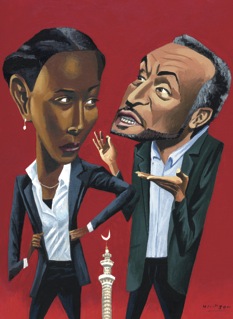 Was the prophet Muhammad a pervert and a tyrant? Does Islam promote terrorism and enslave women? Does Islam oblige its followers to wage jihad on Westerners whose roots lie in the secular Enlightenment? Should Muslims consider converting to Christianity? For the Somali-born writer Ayaan Hirsi Ali, the answer to all these questions is a resounding “Yes!” Hirsi Ali, who renounced Islam in her thirties, speaks from experience of bigotry and intolerance among her former co-religionists: she was genitally mutilated as a child in Somalia, briefly radicalized by a preacher of jihad in Kenya, nearly forced into a marriage, threatened with death in the Netherlands by the Muslim assassin of her collaborator, the filmmaker Theo van Gogh, and is still hounded by murderous fanatics in her new home, America. In her latest book, “Nomad: From Islam to America” (Free Press; $27), she reminds her readers of the West’s tradition of intellectual revolt against clerical tyranny and warns of the insidious, intransigent enemies in their midst. “The Muslim mind today seems to be in the grip of jihad,” she writes. She is not hopeful that Americans will heed her warning. Her initial job interviews in the United States were discouraging: the Brookings Institution, she writes, worried that she might offend Arab Muslims. (The conservative American Enterprise Institute, however, immediately appointed her as a fellow.) On college campuses, Muslim students accuse her of wanting to “trash” Islam, while Western feminists, convinced that white men are “the ultimate and only oppressors,” lack the “courage or clarity of vision” to help her knock down the mental “hovels” of the East. Pointing to Major Nidal Malik Hasan’s murderous rampage in Texas, last November, she deplores the “conspiracy to ignore the religious motivation for these killings” in America. Muslims today, Hirsi Ali believes, must be forced to choose between the darkness of Islam and the light of the modern secular West.
…Nomad” is unlikely to earn Hirsi Ali many Muslim admirers. Neither will her recent support for the proposed French ban on face veils and the Swiss referendum outlawing minarets. In denouncing Islam unreservedly, she has claimed a precedent in Voltaire—though the eighteenth-century scourge of the Catholic Church might have been perplexed by her proposal that Muslims embrace the “Christianity of love and tolerance.” In another respect, however, the invocation of Voltaire is more apt than Hirsi Ali seems to realize. Voltaire despised the faith and identity of Europe’s religious minority: the Jews, who, he declared, “are, all of them, born with raging fanaticism in their hearts,” who had “surpassed all nations in impertinent fables, in bad conduct and in barbarism,” and who “deserve to be punished.” Voltaire’s denunciations remind us that the Enlightenment was a much more complex and multifaceted phenomenon than the dawn of reason and freedom that Hirsi Ali evokes. Many followed Voltaire in viewing the Jews as backward, an Oriental abscess in the heart of Europe. Hirsi Ali, recording her horror of ghettoized Muslim life in Whitechapel, seems unaware of the similarly contemptuous accounts of Jewish refugees who made the East End of London their home after fleeing the pogroms.
More here.
