
by Elatia Harris
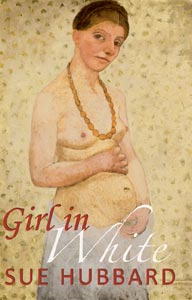
L., Cover, Girl in White, by Sue Hubbard, Cinnamon, 2012. The painting is Portrait of Myself on my Fifth Wedding Annivesary, by Paula Modersohn Becker, 1906, the Boettcherstrasse Museum, Bremen.
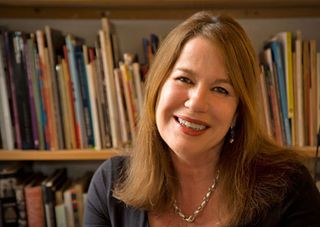
R., Sue Hubbard, photo by Derek Adams, suehubbard.com
Sue Hubbard is an award-winning poet, novelist and critic, based in London, who has written about contemporary art for 3 Quarks Daily since 2008. She is the author of Girl in White, a newly published work of fiction based on the life of Paula Modersohn Becker, a pioneering German painter who died in 1907 at age 31, a few days after giving birth. In her short time, Becker worked with enormous dedication to paint authentically, and to focus on subjects outside the usual range of German painting of her era. She did not live to see the great transition of which she was a part. Rather, questioning everything, demanding love and fulfillment as a woman as well as freedom as a painter, she was among those who got to the very edge of the Modern. At her death, over 400 paintings and hundreds of drawings were found in her studio.
ELATIA HARRIS: I am struck by how, as a critic and writer about art, you are very much in the trenches, illuminating the sometimes quite difficult art that is happening right now. Yet Girl in White is set in the early years of the 20th century. Did not only Paula Modersohn Becker but her era attract you?
SUE HUBBARD: It’s true I do write about contemporary art but I’m not a conventional art critic or an academic art historian. My first practice is as a poet. I started writing about art about 20 years ago, when a small magazine that published both art and poetry asked me to write about some artists. I have always seen art and poetry primarily as a form of exploration, a voyage of discovery to uncover the essential self. I am interested in artists and writers who push the boundaries, not for their own sake but to discover new things about the human condition. I’m attracted to the Romantics as well as to the early Moderns and existentialists, so I am quite at home with Paula, who was hungry to discover new things about herself and the possibilities of art.
EH: It used to be that Paula was most often mentioned as a young painter who possibly had an affair — if not, then a very intense relationship — with Rilke. I began to see around 1980 that she was becoming almost iconic on her own in Europe, perhaps less so in the US.
SH: Actually I would not say iconic. Except among art historians, particularly feminist art historians, she has been largely overlooked, which is a real pity considering her paintings and her life. Her coming together with Rilke was interesting. He was a deep, lyrical, psychological and iconoclastic poet. And Paula had her own highly developed observational language.
EH: Your treatment of their friendship is wonderful to read. Is the Rilke connection how you learned about Paula?
SH: Not really, although I do love and have been deeply influenced as a poet by Rilke’s poetry. I discovered Paula in the mid 90s when my first poetry collection, Everything Begins with the Skin, was published. I was invited to give a reading in Bremen and visited Worpswede, the village where she lived in an artists' community on the north German moors. I was taken by the landscape and the directness of the paintings and began to find out about her. There were many parallels in our lives. As a young woman in my 20s, I had lived in a remote part of Somerset in the west of England. At the same age, Paula went to live on the north German moors among artists to discover a form of freedom.
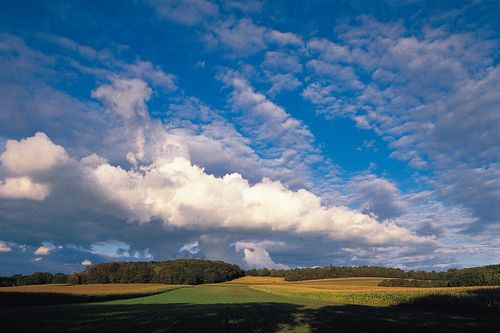
The Weyerberg at Worpswede, photo by Fritz Dressler
EH: Did she find it?
SH: At first she probably thought that she had. She had come from a loving but bourgeois family and she was very young. In Worpswede she met and married the older Otto Modersohn, a rather academic painter whom she respected. She also met the young poet Rilke and was very attracted to him, as he was to her. Paula was in many ways more intuitively free in her approach to painting than Rilke was, at this point, in his poetry, which was still rather flowery. I think he learnt a lot from her. She was complicated in that she was following her own heart and ideas, as an artist, but also wanted very much to be a woman with a woman's experiences. Rilke on the other hand was a difficult, egotistical and neurotic man for whom poetry came before everything. It was perhaps because of this friendship that Paula, a passionate, restless and inquisitive young woman, began to find her relationship with Otto stifling and sexually unrewarding.
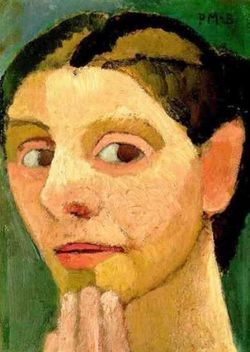
Self-portrait with Hand on Chin, 1906, Paula Modersohn Becker, Niedersachsisches Landesmuseum Hannover
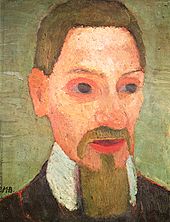
L, Portrait of Rainer Maria Rilke, 1906, by Paula Modersohn Becker, Ludwig Roselius Collection, Bremen
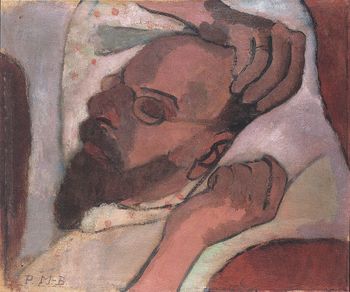
R, Portrait of Otto Modersohn, Sleeping, 1906, by Paula Modersohn Becker, Paula Modersohn Becker Museum, Bremen
EH: Timeless! But she didn’t just bottle it up and stay put on the moors.
SH: She longed to go to Paris to be part of the burgeoning modern art scene there. She left her marriage several times to do just that. She knew that if she was going to grow as an artist that she needed to go where innovation was happening. She had a tremendous hunger for life. She felt a pull between her Romantic love of landscape and being in the thick of a nitty-gritty urban existence, between wanting to be a good wife and mother and an innovative artist. Paula's life was full of binaries and oppositions that I recognize. She was a Romantic as well as a Modernist, she wanted a career but also wanted to experience love and have a child.
EH: She was ahead of her time in owning those desires, as opposed to sensing them and never, ever giving them voice. At marriage, Paula became an instant stepmother – a huge responsibility she put her heart into. The scenes in Girl in White between her and Elsbeth Modersohn, of whom she took beautiful care, were so well done. A kind efficient mother who had her mind on the studio before breakfast, a child who wanted more — that must be deeply familiar to every young ambitious mother. You were a very young mother, Sue.
SH: Yes, I got married at 21 to an academic and lived in the west of England — being an earth mother, baking bread, growing vegetables and having three children. I loved it in many ways. I suppose some of this lead me to recognise in Paula a longing for romantic fulfilment and love as well as the desire to 'be somebody' as an artist, as she rather naively kept saying. I recognised too the disjunction between the Utopian life in Worpswede and the pull of dystopian Paris – in my case London. I felt connected to the countryside but also needed the debates thrown up by the city. It is interesting that part of west Somerset near where I lived is also peat bog with wetlands just like Worpswede.
EH: That’s a bit like your pattern even now – wild unplugged country, the wilder the better, alternating with the city.
SH: It is. I need both and escape when I can from the city, mostly to the west coast of Ireland these days to get away from the demands of being an art critic, the Internet and emails and other distractions. There like Paula, I walk a great deal. That is a great aid to creativity. I admire Paula. I think she was brave. I think she was also a good person. Love mattered to her. She was principled but she was also ambitious. She had to come to terms with the fact that life was not how she imagined it would be. So in the end my writing about her is nothing to do with eras, or periods or ‘isms’ but with a human story, with the struggle for self determination as a woman and an artist.
EH: The story of so many creative women is cut short by childbirth, either because they died of the complications, or because that was the end of them as artists. In 1906, the risk of dying in childbirth could not have been far from any woman's mind. In raising three kids, were you a poet already?
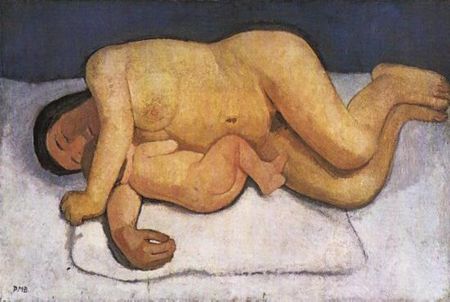
Reclining Mother and Child, 1905, by Paula Modersohn Becker, Ludvig Roselius Collection, Bremen
SH: In a sense. I have written poetry ever since I was very young. But being a serious writer came later than that. I had to claim that for myself. It was only slowly, slowly that I thought I had the right, or the time to consider that I might be a writer. After the first few years of marriage I was left to raise my children on my own and that was very hard on both them and on me. My relationship with my children — all adults with kids of their own now — is very real and living and matters to me a great deal. I feel that the compassion it gave me — having to consider others and not always me — helped me as a writer, though they might not see it like that!
EH: Paula had that active interest in others, that instinct to nurture. I am thinking of her portraits of peasants, especially peasant children. In her lifetime, she was following her star as an artist. And despite one devastating early review, she had the respect of most people who knew her. But her fame is posthumous. You represent so well in the book what it is to keep going doggedly, deepening your own art, not caring enough what others think to change yourself to suit them – but certainly capable of being hurt by their condescension and disregard.
SH: Paula was interested in others, the peasants, the quality of their life, the landscape and above all in art and its transformative power. But she died so young. I also think being German was a disadvantage. It is not so sexy as being French, is it? If she had been born a bit later it might have been different, she might have been part of all that Weimar republic stuff, or part of the Blaue Reiter. But she came before the great movements of psychoanalysis and women's suffrage. But as I said earlier, she was brave, and her life does demonstrate that being an artist is mostly about doggedness, about finding the strength to keep going even though you are not sure exactly what you are doing or whether it will work.
EH: She got to me because she was painting ahead of her time, ahead of the art culture that produced her. She came before the Salon d’Automne of 1906, and died the next year. There’s the Paula in art history, and the Paula that no academic reading will ever truly uncover. Because I knew you first through your writing about art, I might have been a little surprised at Girl in White – it’s not primarily a novel driven by art history, nor is it a biographical novel. Indeed, it would be a wonderful novel if it were about a wholly fictional character, a dedicated painter who worked hard and died in the classically tragic way for young women just as she was getting things off the ground. I'm fascinated by how you incorporated her letters.
SH: I can almost not remember now how much was the letters and how much was me. Certainly the letters gave me facts and structure but an awful lot of the 'relationships' and the nitty gritty atmosphere comes from my imagination. The point of using the letters was to give me a narrative arc – the hardest thing for a poet. What comes most easily to me is atmosphere, texture, color, and psychological insight. But as a poet you have to learn to push the plot and story along. It was “my” Paula who interested me, in any case — not the art historical one.
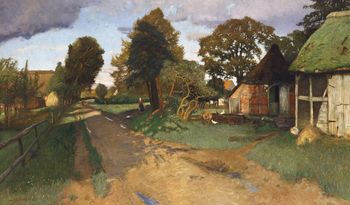
Dorfstraße in Worpswede, 1897, by Otto Modersohn, Otto Modersohn Museum, Fischerhude
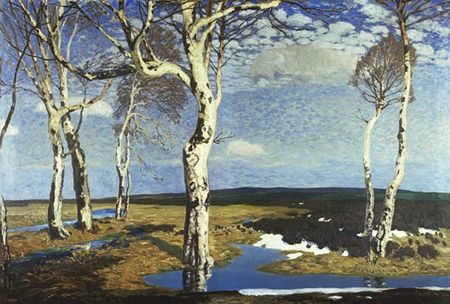
Birches in Worpswede, 1908, by Fritz Overbeck, Landessmueum, Oldenburg
EH: There's a deep theme in Girl in White that I want to ask you about. You explore it through Mathilde, Paula's grown daughter in the Germany of the 1930s — a historical character of whom not much can be learned. Worpswede represented some Utopian ideals that were a current in Germany from the Romantic era through the turn of the century — communitarianism, simplicity in living, the exaltation of the soil and the folk. Mathilde lived long enough to see the end game. Was engaging with this really frightening material part of what drew you to write Girl in White?
SH: In the late 19th century there was a sense of being subsumed by mechanization and industrialism, which is why the artists went to Worspwede, returning to the land and the peasants and the soil. By 1933 it had turned into something much nastier under National Socialism. 'Blood and Soil' and the peasants came to represent not something essential, as they did for Millais, but something Aryan. So this corruption of ideals does interest me.
I was not frightened by the material exactly, but rather wanted to consider that Romanticism to which I am drawn, which should be about things that are non-materialistic, about love, about essence, etc., has in it the seeds of its own destruction. It was so easy to take an 'alternative' approach and believe that the rural is better than the industrial for example, and to end up thinking 'blood and soil'. I am interested that the fault line between the idealistic and the hideously dogmatic and cultish is so thin. One has to keep bringing oneself back to the center from extremes somehow. I suppose what interests me with Paula was that at that point it was all so apparently innocent. Could anyone have seen that German Romanticism would have led to the gas chambers? Yet within a generation it had done. I don't think the Worpswede lot were proto-Fascists, except perhaps Carl Vinnen, who espoused what now seem rather unpalatable ideas, as can be seen in his interest in Langbehen's revisionist book on Rembrandt. But did that mean he wanted to kill Jews and homosexuals? It is the slow slippage between states that is interesting.
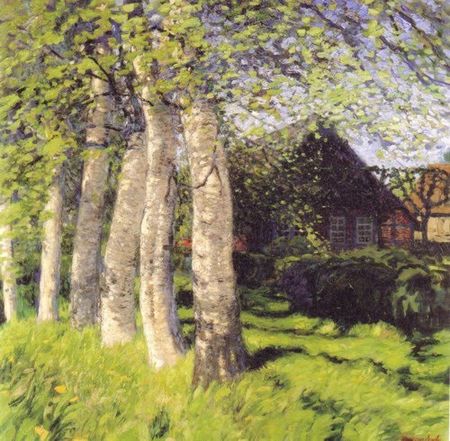
Hans am Ende, Spring Day in Worpswede, 1898, location unknown
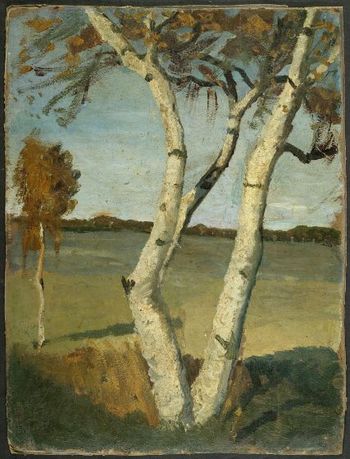
Birch Trees in a Landscape, 1899, by Paula Modersohn Becker, Harvard University Art Museums
EH: Over the course of the novel, the image of the girl in white suggests many things. The way men first look at a girl — and perhaps paint her — on the cusp of adulthood, when she is most choosable, by their lights, for a wifely destiny. The way that a young woman, especially if she's an artist, is always becoming her next self, always an initiate with worlds within and without yet to discover. Between the whiteness of the dresses and the birches at Worpswede, it's hard not to feel the girl in white is the burgeoning Germany, too, that will soon lay its monstrous claims in the name of fancied purity. Deeply embedded in the novel are images which do multiple duty this way, reflecting the spirit of the age, convention in thinking about women, and also foreshadowing a very far territory beyond Germany — where the herding of young women into a costumed flock for a single appropriate fate is fundamental to an authoritarian society.
So you are writing like a poet in prose, with the most powerful and enduring images being those that deliver contradictions. I sense a particular dialogue between Girl in White and your upcoming poetry collection, The Forgetting and Remembering of Air. Thank you for letting me read the poems — they are ravishing. I hope one day to be able to write about them. The collection will be out be out within a few months of Girl in White.
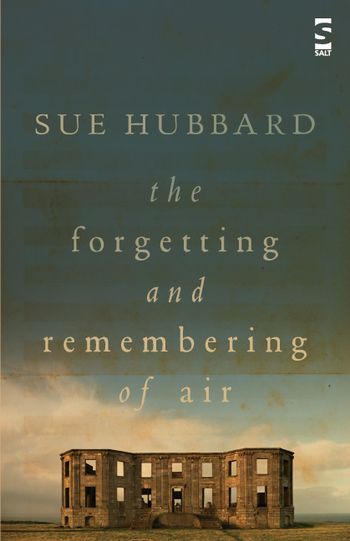
The Forgetting and Remembering of Air, poetry collection by Sue Hubbard, Salt Publishing, 2013. Cover painting by Chris Hamilton Emery
SH: I think they are both imbued with longing, with a sense of grief and loss, of what might have been. A struggle to reconcile with the world as it is, an acceptance that is not necessarily passive but is, to some extent, a giving up of anguish. And I am a sucker for unrequited loved – because it has so often been my experience. I think that there is this sense of longing in everything I write.
EH: I think so too! The longing on the part of Mathilde, Paula's daughter, for a mother she never knew, whose death her birth occasioned, and whose existence was hushed up in Otto Modersohn's subsequent marriage, is painfully moving to read about. And how Paula longed — for personal significance, for fulfillment. She didn't just long for it from a sofa, either, but knew how to pay the price of pursuing it — the disapproval of family and society, the loss of security, comfort, and even the means to stay warm and keep to a proper diet. So much loneliness is involved too. One senses this in The Forgetting and Remembering of Air, as well.
SH: I think in the Yeats sense, as a writer, I am always looking for an appropriate mask, a persona that I can adopt through which I can explore my concerns, which tend to be loss, love, memory, how we create a sense of self, how we fall short of what it is we feel ourselves and want to be.
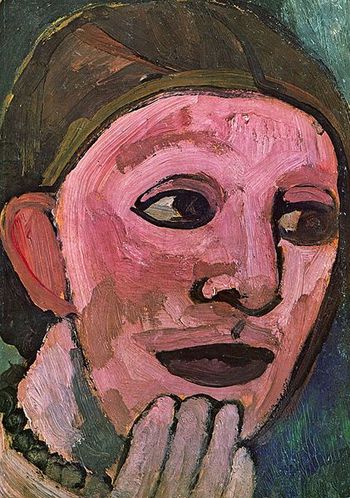
Self-portrait, 1906-7, Paula Modersohn Becker, private collection
EH: That Paula needed mask after mask to finally reveal herself to herself as an artist is compelling — there's even one self portrait in which she seems about to remove a very thick mask that has shaken a bit loose! You have chosen a subject that illuminates these dilemmas, that have figured large in your own life, and that every reader who longs for anything, and sacrifices for it, will recognize.
Reading Girl in White had me thinking how much had changed, and had not, in a century, for women in the arts. In particular, there is Paula's absolute refusal to seek the easy-on-the-eye in art, and her refusal to pander. Refusal to pander is a great attitude for any artist at any time — but 100 years ago it was not the selling point it is now. When you see a woman artist standing firm about that, so long ago, you know it goes absolutely against how she was acculturated. It's awe-inspiring.
SH: 'Refusal to pander' is often the selling point for art now. We are not innocents. We live in a globalized, knowing, postmodern age. Saatchi didn't call his exhibition Sensation for nothing. The transgressive IS often the new academy.
EH: And gender?
SH: I don't think gender dictates everything now. An unmarried woman — Tracey Emin for example — can do just as well as a man. The problem is having a family, having to care about the needs of others. Art is selfish – Rilke understood that. It is a hard mistress, it is demanding. It is being single minded that is important.
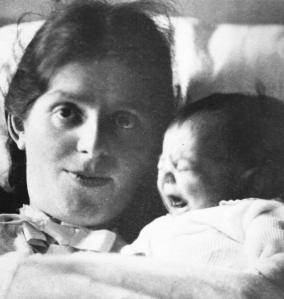
Paula Modersohn Becker, and her daughter, Mathilde, 1907. Last photo.
Web Resources
Site for Sue Hubbard suehubbard.com
A complete collection of Sue Hubbard's books and broadcasts — poetry, fiction and criticism
About Cinnamon Press
http://www.literaturewales.org/publishers/i/129461/desc/cinnamon-press/
About Salt Publishing
http://www.saltpublishing.com/
To purchase Girl in White at Amazon.com
To purchase Girl in White at Amazon.co.uk