
| ABOUT US | ARCHIVES | LINKS | RSS FEED | MONDAYS | |

3quarksdaily

An Eclectic Digest of Science, Art and Literature

« Modi’s Teflon Is Wearing Off | Main | Beyond a joke: the truth about why we laugh »

September 01, 2012

Eulogy for a Sex Radical: Shulamith Firestone's Forgotten Feminism

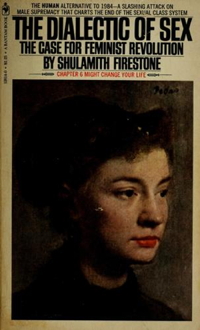
Dialecticofsex-smallerEmily Chertoff in The Atlantic:

It's hard to imagine that Shulamith Firestone and Helen Gurley Brown thought very highly of each other. Gurley Brown wore immaculate make-up and had a driver. There were needlepoint pillows in her office. She had sex. She told other women that they should have sex, too.

Firestone, on the other hand, did not have sex. In fact, she was a political celibate. She encouraged other women to become celibate. Some of them did. She wore owl glasses; she looked like the 70s radical she was.

Firestone, whose death was reported yesterday, will not receive a fraction of the encomia Gurley Brown did after her death earlier this month. Why? Both women were feminist pioneers. Both wrote canonical feminist texts that became bestsellers when they were published about a half century ago. Both shaped absolutely the ways we think about gender, education, and the family today. Both put sex at the center of their analyses.

Yet Gurley Brown became one of the most successful magazine editors of all time. Firestone became a hermit and suffered from mental illness. She'd been dead for a weekwhen neighbors found her. But her reclusiveness isn't the only reason we don't remember her.

Here's the main reason. Firestone wanted to eliminate the following things: sex roles, procreative sex, gender, childhood, monogamy, mothering, the family unit, capitalism, the government, and especially the physiological phenomena of pregnancy and childbirth. She wanted to mechanize reproduction -- gestating fetuses in artificial wombs -- and raise the offspring communally, treating them no differently from adults at the earliest possible age. Sound crazy? It was certainly extreme. But it's surprising how many ideas that are now starting to gain currency can be found in kernel form in her 1970 book The Dialectic of Sex.

Posted by Robin Varghese at 10:31 AM | Permalink

Comments

I think it's obvious that mental illness informed her "theory". It's appalling that anyone published this obviously disturbed woman. She was not a radical. She was a lunatic.

Posted by: raybutlers | Sep 1, 2012 12:28:04 PM

Excuse me, raybutlers -- I think you may not understand.

There's a difference between a dystopian vision that, for all its weirdness, confers certain freedoms on everyone -- even children -- and a lunatic scheme. The freedoms "enjoyed" at present by women and girls in developed Western nations have not been more at risk in my lifetime that they are now. If we made many fewer distinctions between genders than we do, then many threats to equality for women would be baseless. As it is, these threats are based on men being bigger and able to injure or kill women who don't do their bidding, and on the fact that women become pregnant and, in many parts of the world, dependent on the largesse of men for their child-rearing years. Firestone asked some sharp questions to enable herself and others to see an alternate future in which the fundamentals of repression and violence would cease to hold sway. This kind of thing was the job of Second Wave feminism -- seeking alternatives to what most people of the 60s and 70s took as read.

Firestone deserves to be read for the foundational feminist text she wrote at 25 years of age. If you become mentally ill at midlife, I hope no one would decide the achievements of your youth were colored by that. That's a horrible thought, isn't it?

Posted by: Elatia Harris | Sep 1, 2012 1:08:01 PM

So she wrote: "Men can't love." I just need someone to explain that to me.

Posted by: hairlessOrphan | Sep 1, 2012 1:34:56 PM

hairlessOrphan, if you are old enough to recall the era, that rhetoric is actually rather tame. If you were not here for it, you need to realize that many women then were hideously distressed that not a few men seemed unable to discern the difference between loving, owning, being turned on, and being obeyed. If a woman ceded decisions to her man, ceded ownership of her body and her fate to him, and turned him on real good too, then he would probably love her and pay for her and her children to live. There were women at that time who questioned whether that was love. I think most women now know that it isn't.

Posted by: Elatia Harris | Sep 1, 2012 1:54:37 PM

This isn't a question about the rhetorical excesses of an era. This is a question of the legitimacy of an assertion. Let's not excuse the 18th century declarations that "Negros can't be civilized" as merely a product of the era. It may in fact be that kind of thing was acceptable "back then," but it was nonetheless factually inaccurate - that is: wrong.

If you're saying that she deserves to be read merely as a historical artifact to remind us of a zeitgeist, but that her arguments shouldn't be taken seriously, then say no more. But if her arguments are to stand today, then someone needs to defend the assertion: "men can't love." If not, then someone needs to trace her logic back to the erroneous foundational assumption that lead to such a statement and then isolate that error from any other arguments she might have made. Otherwise, garbage in garbage out; that is: if she was right about anything else, she was only accidentally so.

Posted by: hairlessOrphan | Sep 1, 2012 2:08:57 PM

Dein aschenes haar Sulamith wir schaufeln ein Grab in den Luften da liegt man nicht eng

Your ashen hair Shulamith we shovel a grave in the air where you won't lie too cramped

Paul Celan (trans. John Festiner)

Posted by: thomyris | Sep 1, 2012 3:39:19 PM

@hairless orhpan -- I think there is something off in your reasoning -- if someone makes a rhetorical statement that you disagree with it does not make everything and anything else she says only "accidentally" correct. For example, James Madison could be a slave holder, but that did not make all his writings garbage.

Posted by: thomyris | Sep 1, 2012 3:43:22 PM

@thomyris, first let's make a distinction between "a rhetorical statement that [I] disagree with" and declarations intended as credible. If you're saying her statement, "men can't love" was never meant to be credible, then say no more.

Otherwise: No, it doesn't make all her arguments wrong. It merely makes all of her related arguments suspect until the error can be identified and isolated. If there was some false premise that lead her to conclude "men can't love," and that premise was also used in formulating other conclusions, then those other conclusions are also incorrect.

If her other conclusions were not founded on whatever error she made that lead her to conclude "men can't love," - that is, if her other conclusions are isolated from the errors either of assumption or reasoning - then they can stand independently. So, again: someone needs to do that. Someone needs to isolate that error from her other statements.

Posted by: hairlessOrphan | Sep 1, 2012 4:32:58 PM

did you even bother to understand what Elatia wrote, or are you simply trying to take a single statement out of its context in a broader work? a work that you don't seem to have read. read the damn book if you want to understand (though i doubt understanding anything is your motivation here).

Posted by: chris | Sep 1, 2012 4:59:45 PM

@chris, I have not read the book, and don't intend to until I come across a reasonable argument that it makes a credible case. This isn't a personal attack on Elatia, Shulamith, or you. There are simply too many reasonable books that need reading; I don't have think I'll live long enough to get to the unreasonable ones.

I understand Elatia's apologia, and it is the same as the argument that was made that "Negros can't be civilized." That is: "well, *we* didn't see any [civilized] [Negros] / [loving] [men]." That simply isn't a logically sound argument, nor do I believe it to be true. Really? For an entire generation, not one male displayed the characteristics of love? Not even one guy, anywhere?

As far as my motivation: you are welcome to guess at it, but at the point where you take your, let's say "ungenerous" guess as a fact and attack me for it is when you're making your own error.

Posted by: hairlessOrphan | Sep 1, 2012 5:19:31 PM

hairlessOrphan, there is lots wrong with what you say, and not because you disagree with me -- which you are encouraged to do, since the rigor of your arguments is disappointing, and I do not solicit your agreement.

You are admittedly not going to read the foundational works of feminism in the late 60s and early 70s -- that's the end of serious dialogue about what those writers meant. What you are doing is cherrypicking statements to disagree with, having no understanding of the context, and seeking none. In every era, people are full of contradictions, because progressive and regressive forces are not only at war at all times in all societies but within in every individual. (Well, maybe not in The Borg...) I hope you will soon learn the difference between rhetoric and blanket statements and painful revelations -- you'll be more fun then.

Dr. Johnson once recommended a conversation partner to consider how much greater was the evidence that Christ is our Savior than that Canada was taken. Using your logic, that would make him a liar and a fool, and not one of the most learned and humane figures of the 18th century. To understand his remark, you must see that with no newspapers and no cameras and no telecommunications, knowing what one needed to know about whether a distant battle had been decisive was quite difficult. Dr. Johnson was "making a point," not playing dumb.

Unless you trouble to understand context, history cannot live for you, and human utterances of any era will always be reduced to statements you either agree or disagree with. This is a solipsistic way to understand what happened and what may happen. May you tire of that method.

Posted by: Elatia Harris | Sep 1, 2012 6:51:29 PM

Elatia, interesting exhange, but surely the retreat that was widely observed in the Women's Movement in the late 70s and 80s (assertions of the centrality of motherhood, The Cosmopolitan type of mindset mentioned in the article and so on) was partly a result of women rejecting the kinds of extreme views expressed by Firestone [perhaps they tyred of her] so Hairlessorphan does have a point, no?

Posted by: aguy109 | Sep 1, 2012 7:14:48 PM

Aguy109, I honestly don't see hairlessOrphan's point. By the early mid-80s many things that had disgusted radical feminists of 10 to 15 years earlier were politically correct again. Being a hard line radical feminist for 45 years in a row is too difficult for most people -- certainly too difficult for me. But, as people who have remained unapologetic Marxists will tell you, the Marxist prophecy of the two-tiered society is coming to be reality, for all you may say in criticism of applied Marxism in the last century. And, the people who were climate hawks since 1970 -- tiring many a listener, oh yes -- were and are, um, correct. The X-treme Feminism of Firestone and others of her era did indeed give way -- and one result of that is that the rights of women and girls are now more under threat than at any time since Roe v. Wade. I see women's rights in the larger context of human rights, and I see that human rights crimes are on the ascent, too -- not an accident or a coincidence.

Posted by: Elatia Harris | Sep 1, 2012 8:03:01 PM

@Elatia, while trying to broaden the conversation is certainly an admirable move - and one I approve of in general - you can not misuse it as an escape hatch. Your post is little more than that.

The only defense so far of the statement, "men can't love" is "that's the kind of thing people said," - which I honestly think is an accurate paraphrase of your first response to me - and now you are saying "it's ok to just say things to make a point." At what point in that process do we introduce "rigor," as you call it? The simplest step in conceiving a rational argument - rigor - is the sanity check. And statements like "men can't love" demand sanity checks. And, in fact, my request for a defense of that statement *is* a request for the context that allows it to pass a sanity check. "That's the kind of thing people said" does not allow it to pass a sanity check, it only asserts that the entire era was so caught up in the volume of the argument that sanity stopped mattering.

That doesn't strike me as something worth celebrating.

If in fact you are arguing that "men can't love" doesn't require passing a sanity check because it was never meant to be a truthful, logical assertion, then: say no more.

In the broader conversation, there is an overwhelming number of reasonable attacks on the institution of patriarchy. "Men can't love" isn't one of them. And, while I have my own problems with Cosmo's conception of feminism (which I would argue still cedes the definition of women's qualities to men's conception - that is, to the patriarchal institution - and in so doing makes itself inherently subordinate), I can not see "men can't love" as a reasonable refutation. I would go on to argue that - with a nod to aguy109's comment above - contrasting the two makes Cosmo the lesser of two crazies. Can it be that "just saying things to make a point" does more harm than good?

Also: my logic would make Samuel Johnson wrong about the proof of God. That makes him neither a fool nor a liar. It makes him wrong about the proof of God. And history bears this out: to this day there is no rigorous proof of God's existence. Rather, belief in God's existence is predicated on faith - the very opposite of rigorous proof. To understand his remark - and why he's wrong - you have to understand that reasoning and logic is not predicated on mere quantity. Yes, I am admittedly charging Samuel Johnson with also being wrong about what constitutes adequate proof - and that has broad implications. Only, I don't know enough about his larger conception of "logical proof" to expand the accusation beyond religion, which - like gender relations - tends to make people less rigorous than they would otherwise prefer.

Posted by: hairlessOrphan | Sep 1, 2012 8:22:34 PM

We are really talking at cross purposes, hairlessO. You keep repeating yourself, I try to find new ways to reach you by citing "out there" things said in a context that has nothing to do with feminism, and then that is subjected to the same type of non-analysis by you. Broadening the conversation as you call it is not a subterfuge but a way to get the other person to detach from the immediate material, when the immediate material pushes their hot buttons, and look at what overstatement, for example, may accomplish in another context. Yes, to say "men can't love" is to overstate, to generalize, to provoke, to hyperbolize. It's like saying "Republicans are ass-hats" when only most of them are, certainly not all of them. Yet, those who are, if they vote or donate money, constitute a danger to the nation. Can you sort of see?

Firestone was nothing if not an explosive thinker -- might as well let her open your mind. If you want everything to be either/or and "sanity-tested," you won't be able to read much longer -- it will wear you out. Setting up as the arbiter of sanity for anything less literal-minded than crossing a street safely is not the most productive attitude to reading and life that I can think of, either. People who "can love" do have to flunk the sanity test regularly, by the way.

Twice, you have summed up inaccurately my words and meaning and then directed me to "say no more" if that's my point. Not so great, unless you're in a high school debating society, where such tricks might get you to a regional meet. They do discourage dialogue, however, without making you look more intelligent -- that's winning?

Posted by: Elatia Harris | Sep 1, 2012 10:36:35 PM

My apologies. My purpose was neither to encourage nor discourage dialogue, nor to win or lose. It was only to understand the rationale behind the assertion. Which is exactly why I said, twice, if [condition], then say no more. These were the two conditions:

1) If the assertion is not meant to be taken seriously
2) If it was not meant to be a truthful, logical assertion

The assertion, "Republicans are asshats" fits both of those conditions. Don't get me wrong: I have no love for the Republican platform. Nonetheless, the assertion is not a reasoned argument. It's an outburst. If that's the spirit in which "men can't love" was asserted, then...

No, ok. I won't say it. Suffice to say: the assertion has been explained.

Don't get me wrong. It's not that I don't understand the impetus behind, as you say, "overstating, generalizing, provoking, hyperbolizing." It feels satisfying; it feels like courage. I happen to think it is also, ultimately, an unproductive level of discourse if used improperly - that is, if it's given a facade of "rigor" and not washed out by satire. And while that level of discourse has its time and place, it should never be taken seriously. It leads to... well, the entire Republican campaign strategy.

As for love and sanity? I disagree with the statement that love demands insanity. After all, not all love is healthy. Witness: abusive husbands. But then, we are only overstating, generalizing, provoking again.

Posted by: hairlessOrphan | Sep 2, 2012 1:11:57 AM

Did Firestone really write "men cannot love"?

Of course she's a product of her era. That explains to some degree but does not excuse, and hairlessO is right to point it out, and Elatia is wrong to make excuses for her along the lines of that really was the way men were those days. It's relevant, too, because it's an almost perfect expression of a thread can still be found in feminism today sometimes (not always), and it's even more toxic than tilting at the biology of one's own body. If this woman didn't, someone started it.

There's something that bothers me more, though, and it's the way that we (all of us, I do this too) minimalise and "contextualise" obviously offensive ideas made by "our side" rather than appreciating the damage they do to the others, then scream blue murder when the same is done to us. I mean, if you like explosive thinkers, I adore Nietzsche, but he says some very... overstated, generalising, provocative, hyperbolic (and frankly bitchy) things about women...

Posted by: Sagredo | Sep 2, 2012 3:55:13 AM

"Firestone’s book can only be understood to be one of the great hedonist handbooks of the 20th-century. Consumption at the level enjoyed by Americans in the late 1960’s, she feared, was unsustainable on a world-wide level short of a severe reduction of world population. Thus she sought not only a way for women and men to achieve full equality and autonomy (including the ability to engage in sexual encounters without consequence) but also a guarantee that population would decrease so that consumption never would have to. The freedom of the current generation entails, to a great extent, liberation from concerns about future generations. The aim of life was to be personal satiation, achieved by overcoming sacrifice and love. In overcoming birth and (through cybernetics) work, we could overcome the consequences of the first sin. We could have it all.

When we are told that we must embrace a path “forward,” citizens should demand to hear more about the world envisioned in that word. Implied in the President’s claim that equality and liberty hinges on government mandated provision of contraception are worrisome echoes to what many would regard as a dystopian future. The technological sterility of Shulamith Firestone’s progressive vision has been variously tried and found wanting—even at its worst, inhuman. The only proper way “forward” needs to include a world filled with children and parents who embrace and love nature—a continuous nature, without and within."

http://www.firstthings.com/onthesquare/2012/06/ldquoforwardrdquo-into-a-sterile-future

Posted by: Sundar | Sep 2, 2012 10:07:45 AM

Finally (March 2013) got round to obtaining loaner from the library of The Dialectic which I only read about through this page's link provided on Twitter. -- Thanks!

Firestone wanted first to find a way to vent women's anger; to eliminate the biological oppression imposed on women by pregnancy and the psychology of power. But lastly -- and for me the work's saving grace -- to allow 'the love to flow' for everyone.

Thanks again for recommending this important work.

Posted by: Maurice Moriarity | Mar 20, 2013 4:08:34 PM

Post a comment


Subscribe to this blog's feed  

PayAnywhere with iphone credit card swiper

Android Tablet

Bluetooth Headset

2013 New Style Dresses

Compare Car Rental Prices

DHgate.com Wholesale

3QD on Facebook

3QD on Kindle

3QD by Daily Email

Receive all blogposts at the same time every day.

Enter your Email:


Preview 3QD Email

3QD on Twitter

Miscellany

Lijit Search

AddThis Social Bookmark Button

Add to Google

Recent Comments

musafir on Tuesday Poem

soubriquet on Tuesday Poem

Eli on Unknown Mathematician Proves Elusive Property of Prime Numbers

Jim on Tuesday Poem

Josef Stern on Unknown Mathematician Proves Elusive Property of Prime Numbers

Shelley on Is the Brain No Different From a Light Switch? The Uncomfortable Ideas of the Philosopher Daniel Dennett

Bill on The Beautiful German Language

Eleutheria on The Bystander Effect in Medical Care. Why Do I Have So Many Doctors Not Taking Care of Me?

Eleutheria on Tuesday Poem

Raza Husain on the culture animal

musafir on The Bystander Effect in Medical Care. Why Do I Have So Many Doctors Not Taking Care of Me?

KRS on Tuesday Poem

Félix E. F. Larocca, MD on Tuesday Poem

LWR on Tuesday Poem

Joss on Tuesday Poem

LWR on POETRY IN TRANSLATION: CORDOBA

Rashid on Aftermath: Pakistan Elections 2013

Yoann on The Bystander Effect in Medical Care. Why Do I Have So Many Doctors Not Taking Care of Me?

Dave Ranning on Aftermath: Pakistan Elections 2013

sadhana on Aftermath: Pakistan Elections 2013

Carol Westbrook on The Bystander Effect in Medical Care. Why Do I Have So Many Doctors Not Taking Care of Me?

Ken Bryant on Aftermath: Pakistan Elections 2013

Umer Vakil on POETRY IN TRANSLATION: CORDOBA

Kabir on Aftermath: Pakistan Elections 2013

seth edenbaum on Aftermath: Pakistan Elections 2013

Acclaim For 3QD


"I couldn't tear myself away from 3 Quarks Daily, to the point of neglecting my work. Congratulations on this superb site."—Steven Pinker, Johnstone Professor of Psychology, Harvard University.

"I have placed 3 Quarks Daily at the head of my list of web bookmarks."—Richard Dawkins, Charles Simonyi Professor of the Public Understanding of Science at Oxford University.

"Just wanted you to know I’m one of many who reads and enjoys 3 Quarks....almost daily."—David Byrne, musician, former lead-singer of the Talking Heads, artist, intellectual.

Read more here.

The 3QD Prizes

Subscribe to this blog's feed