From Scientific American:
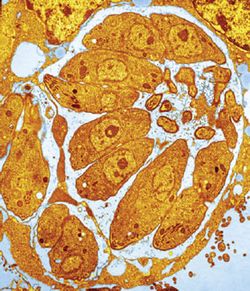 Feeling sociable or reckless? You might have toxoplasmosis, an infection caused by the microscopic parasite Toxoplasma gondii, which the CDC estimates has infected about 22.5 percent of Americans older than 12 years old. Researchers tested participants for T. gondii infection and had them complete a personality questionnaire. They found that both men and women infected with T. gondii were more extroverted and less conscientious than the infection-free participants. These changes are thought to result from the parasite's influence on brain chemicals, the scientists write in the May/June issue of the European Journal of Personality. “Toxoplasma manipulates the behavior of its animal host by increasing the concentration of dopamine and by changing levels of certain hormones,” says study author Jaroslav Flegr of Charles University in Prague, Czech Republic.
Although humans can carry the parasite, its life cycle must play out in cats and rodents. Infected mice and rats lose their fear of cats, increasing the chance they will be eaten, so that the parasite can then reproduce in a cat's body and spread through its feces. In humans, T. gondii's effects are more subtle; the infected population has a slightly higher rate of traffic accidents, studies have shown, and people with schizophrenia have higher rates of infection—but until recent years, the parasite was not thought to affect most people's daily lives.
More here.
