
August 30, 2012
What a plant knows
Andrea Wills in American Scientist:
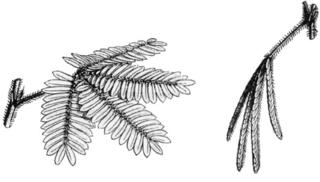
In grassy areas along the equator lives a tiny plant, Mimosa pudica, that has the captivating property of closing its leaves in response to touch. Rest a finger on one leaf, and that leaf and its neighbor will fold abruptly toward the stem. Brush your finger along the length of the stem and every pair of leaves will collapse in turn. For everyone who has wondered at Mimosa, the suddenly snapping Venus flytrap or the way a sunflower’s head unerringly turns to follow the sun, Daniel Chamovitz has written the perfect book.
What a Plant Knows: A Field Guide to the Senses examines the parallels and differences between plant senses and human senses by first considering how we interpret sensory inputs and then exploring how plants respond to similar inputs. Each chapter covers one sense—sight, smell, touch and hearing are covered, along with “How a Plant Knows Where It Is” and “What a Plant Remembers”—and each examines a wide taxonomical range of flora and a complementary historical range of experiments. In the book’s introduction, Chamovitz is careful to clarify his intentions in using language that might be considered anthropomorphic to explore the world of plants:
When I explore what a plant sees or smells, I am not claiming that plants have eyes or noses (or a brain that colors all sensory input with emotion). But I believe this terminology will help challenge us to think in new ways about sight, smell, what a plant is, and ultimately what we are.
A plant biologist who has held positions at Columbia and Yale and is now director of the Manna Center for Plant Biosciences at Tel Aviv University, Chamovitz is well qualified to present an archive of research on plant perception. Happily, he also has narrative dexterity: The book is delightful and a fast read.
More here.
Posted by S. Abbas Raza at 07:39 AM | Permalink


Comments
It seems strange that we have to worry not to offend a human sentient being by admiring some traits of plants that seem to display some cognitive ability.
At least in the sense that they are arguably smarter than some politicians.
The 2012 Republican platform states: "The environment is getting cleaner and healthier. The nation’s air and waterways, as a whole, are much healthier than they were just a few decades ago. Efforts to reduce pollution, encourage recycling, educate the public, and avoid ecological degradation have been a success." (The Right Is Wrong - 3).
What planet are they on?
Posted by: Dredd | Aug 30, 2012 12:46:53 PM
also, read the seminal book "The Secret Life of Plants" - Tompkins/Bird as well as check out the the work of Cleve Backster
Posted by: Kim Cascone | Aug 30, 2012 2:39:00 PM
Everything living or non living has some form of cognitive ability. They are attracted to each other, water freezes or evaporates and so on responding to temperature. This is no different.
Posted by: Raza | Aug 30, 2012 3:04:59 PM
This plant is 'Choooee Moooee ' called in Urdu , do remember teasing it in Peshawar and Rawalpindi. What fun---, little adventures growing up .
Posted by: Nasreen R | Aug 30, 2012 5:20:18 PM
If water freezing or evaporating is a form of cognition, then I submit that one's definition of cognition is so, um, watered down as to be meaningless. (Usually the example is the bimetallic strip in an old-style thermostat, but this is even more absurd.)
Posted by: Kai Matthews | Aug 31, 2012 8:00:24 AM
Kai, you must believe in free will in humans and plants. I don't. It is all matter, energy and laws of physics and other natural sciences at work. Some people find it absurd, some don't. I don't.
Posted by: Raza | Aug 31, 2012 10:14:22 AM
Free will is not so cut and dry (all or nothing) as current discussions in the sciences seem to suggest. It’s more complicated. Sentience in living systems is tied to the purposes of living systems (continued life) and living systems display a will toward adaptive solutions to the problems of self-preservation/self-promotion. Much like other significant cognitive concepts (self/world boundary, awareness of dimensionality and a causal context, awareness of time as linear and one-directional, etc. all specific to living systems) free will does not fit into a physics based description of reality and yet it is an important component of understanding cognition in general (regardless of whether or not free-will, linear time, causation, etc. are just impressions formed within the cognitive reality of a living entity). The ability to react to the environment requires a cognitive flexibility that is best described in terms of will and willingness, linear narratives, causal concepts, etc. even if these no longer fit into 20th and 21st century physicalist beliefs.
In that sense (the sense in which there is a specific traditional physicalist context for ‘rational’ scientific analysis) the publication of this article in mainstream scientific journal is a good sign. The acceptance of cognition in other living systems is a step toward incorporating the cognitive dimension of living systems into our general concept of reality. We are in an historical moment where we are expanding the causal-physicalist context to include awareness and intention as key features of our construction of and experience of ‘reality’. Awareness of the specific purposes and uses of our awareness is as important to a description of the quantum and cosmological realms as it is to a description of the living world, especially since we tend to try to describe the quantum and cosmological in relation to the limited format (three dimensions and a time line) that we are inevitably caught in as living systems.
Posted by: Christopher Holvenstot | Aug 31, 2012 10:57:59 AM
Interesting. Have come across them in north-eastern India. The Bengalis call them 'Lajyabati'. Literal translation would be 'shy lady'.
Posted by: waqnis | Aug 31, 2012 11:13:57 AM
Chris H: "Sentience in living systems is tied to the purposes of living systems (continued life)"
Somewhat circular. That living systems want to continue living is definition of "living" and not a "purpose"
"The ability to react to the environment requires a cognitive flexibility that is best described in terms of will and willingness."
Somewhat metaphysical. Every object living or non living offers resistance to change in its state and when it does it is exactly according to its physical and chemical properties and that of the environment it is reacting with.
The only difference between living and non living systems is one of complexity of arrangement of matter and our present understanding of such arrangements.
Posted by: Raza | Aug 31, 2012 7:26:15 PM
Hey Buddy (AR);
Epistemologically speaking (ha) ALL explanations are circular; they refer back to the context created for the explanation, i.e. physicalism refers back to physical principles, spiritualism to spiritual principles, psychology to psychological principles, sociology to sociological principles, etc. Whilst explaining living systems one is obliged to expand the physicalist explanatory context to include awareness and intention (key features of this category of phenomena). All creatures, including cells, are aware (of one another and their environment). This awareness forms a context in which intentions are possible. While the hardware for awareness and intention can be pinned down in certain organisms, the manifestation of awareness and intention however, are NOT usefully explained by physicalist principles. Awareness and intention manifest as awareness for a purpose and intentions about something. The purposes and the aboutness do not reduce physically or causally and when one tries to reduce them in pursuit of an easy explanation of living systems the realm of cognition is inadvertently obfuscated. One gets the easy explanation (of life as mechanical systems) at the expense of a richer and more complete explanation (life as interrelationship and inter-accommodation for example). Cognition, sentience, consciousness, etc. beckon a different explanatory context. Ergo, life (which inescapably includes these) can, should, and will fall under a wider explanatory rubric.
This of course opens a can of worms in consciousness studies. People confuse explanatory systems with personal beliefs about reality in general and end up arguing from a fixed (and brittle) position. It turns out that in consciousness studies it is better to think of all of our explanatory systems as tools that work for certain kinds of things rather than as providing fixed and absolute truths about ‘reality’ in general. There is no way around this. All versions of reality (physical, spiritual, psychological, sociological, etc,) have their basis in cognitive processes so an understanding of reality is going to have to include the cognitive context.
Cheers.
Posted by: Christopher Holvenstot | Sep 2, 2012 8:22:06 AM
Chris H: If you believe in free will, that is fine with me. To each his own.
If there is some scientific basis for free will, let me know what it is.
If you don't know or don't want to know, that is fine with me too.
If you want to know, try doing some root cause analysis
PS: your "free will" is made possible by a continuos supply of oxygen and will disappear if the supply is cut off for one minute. Do you think that there is some link between your free will and two atoms of oxygen further described here http://en.wikipedia.org/wiki/Oxygen.
Cheers!
Posted by: Raza | Sep 2, 2012 10:56:35 AM
Use this link instead of one in previous comment
http://en.wikipedia.org/wiki/Oxygen
Posted by: Raza | Sep 2, 2012 11:10:23 AM
Hello, Raza.
My apologies for mistaking you for Abbas Raza and vice versa. I see you are missing my point altogether. This may not be the proper forum in which to clarify the distinction between beliefs and explanatory processes but thank you for the exchange.
Best, CH.
Posted by: Christopher Holvenstot | Sep 3, 2012 8:18:34 AM
Raza,
Since this has happened several times now (people have confused you for me), would you mind using your full name "Raza Husain" when leaving comments?
Thank you.
Best wishes, Abbas
Posted by: Abbas Raza | Sep 3, 2012 12:07:47 PM
Sure Abbas, no problem.
Posted by: Raza Husain | Sep 3, 2012 1:15:01 PM
Danke schön, Raza. :-)
Posted by: Abbas Raza | Sep 3, 2012 1:17:51 PM
The Indian scientist Professor Jagadish Chandra Bose had done pioneering research in this field in the late 19th and early 20th century. Some were skeptical but his claims were later shown to be correct. (Look up JC's research with wireless communication also).
I am glad the Raza-Raza confusion has been cleared up at last! And Waqnis knows Bengali?
Posted by: Ruchira | Sep 3, 2012 8:04:20 PM
Post a comment