
by Hasan Altaf
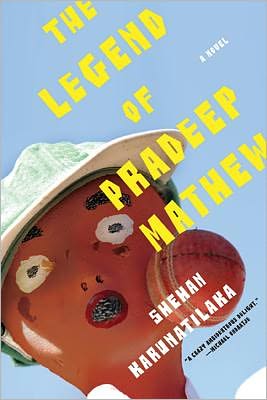
Pradeep Mathew is in some ways like the great rock novels, the great books about Hollywood: From a specialized world, in this case that of cricket, it's adopted a jargon, a built-in store of legends and myths and stories. It's also very much in the vein of Moby-Dick or Don Quixote, a quest book – Wije's attempt to give the world (before liver and family fail him) what it really needs, “a half-decent documentary on Sri Lankan cricket,” and his obsession with the titular Mathew, whom he considers the greatest bowler of all time, are a kind of reversal of Ahab's hunt for the whale, Don Q. fighting for the honor of Dulcinea. Wije has his own Sancho Panza in his friend Ari, and for tilting at, the windmills of Sri Lankan TV, the mysteries and bureaucracies of power political and athletic, the bottle and the family (in particular, his son, Garfield – named for a cricketer and not, unfortunately, the cat; the depiction of this mostly nonexistent father-son relationship is among the finest I've seen in fiction recently: one of the final scenes in the novel, as Wije lies in the hospital, is absolutely perfect and perfectly-rendered).
In all such novels, of course, the real quest is personal, and so it is here; more than about tracking down a brilliant athlete who disappeared from history, this is a book about that last attempt to make good on your promises yourself. It becomes even more so because of the parallels between the whale and the captain. Wije, despite twice winning Ceylon Sportswriter of the Year, by this point is like his liver, something of a failure; Mathew, when he was good, was brilliant, a bowler whose amazingness I cannot properly describe, since for the language of cricket I still require a translator (I can tell you that he once bowled 10 for 51, and that according to a knowledgeable source I consulted, this would be considered “remarkable” and “very unusual”). He did not, however, play much, representing Sri Lanka in only a few matches, undone by his temperament and his times and his personal fate, and then disappeared – not quite a flash in the pan, more a firework that very few others will admit to having seen. After the half-decent documentary is made and aired, Wije decides to write a book about Mathew, an attempt to give the bowler the position he feels he deserves; but it's a fight for his own position, too.
Given this echo, and especially the self-aware, self-conscious writing, the metafictional twist Karunatilaka takes at the end of the novel is disappointing, not just easy but also obvious, unnecessary. It is clear to the reader by that scene I mentioned that this is a book that is in some ways about cricket, in some ways about writing, but mostly about creation, about creating yourself; making that explicit seems something of a convenient trick, a gamble for extra credit. In an otherwise wonderfully written book, however, this is one of the rare missteps (another would be the female characters; Wije and his friends Ari and Jonny are wonderful, but the women are one-note, not caricatures but not quite fully real, either), and for the most part Pradeep Mathew offers gifts on every page. You read Catcher in the Rye if you find Holden an interesting character, or Infinite Jest if Wallace's polyphony appeals; you read this book if you really want to listen to irrepressible, unreliable and possibly drunk Wije ramble on about cricket, about family, about nation. This is one of those voices the reader just wants to sit back and follow, to see where he takes you and what he has to say about it.
After spending so much time with Wije, I remembered what one of my professors defined as the greatest strength of fiction, particularly the novel, as compared to the other arts. Literature will never let you “see” as accurately as a painting or a photograph; the gift of time belongs to cinema as well. What fiction does best is consciousness: You are invited to be completely in someone else's head, for a little while, and there is always a little bit of carryover once the book is done (we are all a little bit Wije; we all have a cat-monkey somewhere inside us). By the time I put down The Legend of Pradeep Mathew, it was hard not to remember Wije's manifesto on the value of sport as an argument for literature: Novelists may have no real practical use, but on occasion the very best of them can deliver something that brings us to our feet and offers to all of us something we can enjoy, something we had forgotten, something we needed. And to this “there is most certainly value.”