
August 24, 2012
The subtle perils of Eurocentrism
Mihir S. Sharma in the Business Standard:
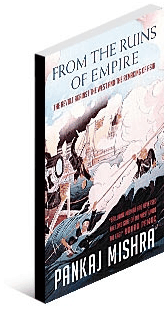
Few events have so up-ended the established order as Japan’s crushing victory over the Russians at the Battle of Tsushima in 1905. This, the first salvo in the long war to push back the subjugation of the East by the West, was heard around the colonised world; and it is where Pankaj Mishra begins From the Ruins of Empire, which purports to be a history of the ways in which the East imagined that war. Sadly, the glaring flaws that populate Mishra’s book, reducing it even from pop history to puerile polemic, begin there, too. Misleading quotes, for example: he says Gandhi responds by recognising it was “self-respect” that won Japan the battle, except most of Gandhi’s writing on Tsushima actually praised Japan’s patriotism and national unity, a considerably more inward-looking and less reactive claim.
Mishra’s treatment of attitudes to Japanese ambition, in fact, is just one instance of the double standards – which match those of the most devoted apologist of empire -- that riddle this book. The Russo-Japanese war was a battle of empires for land in Manchuria; but throughout, Mishra insists on describing the horrors of Japanese imperialism as “but a reaction”. So, too, could the British Empire be a “reaction” to the Spanish Empire, and the German Empire a “reaction” to the British. But white people are granted agency by Mishra, and people of colour are not – one of the many, many ways in which this book fits squarely into the Eurocentric, mentally colonised framework which Mishra wants us to believe he is helping us escape. Later on in the book, the moral blindness that comes with such double-standards is hideously exposed in his description of Japanese expansionism, where the Rape of Nanking is hastily glossed over, and that empire’s brutality against fellow-Asians is excused as “revenge for decades of racial humiliation.” Indeed, he goes on to say essentially that the occupied should be thankful for this good, Asian, empire: it allowed them to imagine what freedom from the West would be like.
More here.
Posted by S. Abbas Raza at 03:01 PM | Permalink


Comments
This is an excellent review.
Posted by: Ruchira | Aug 24, 2012 4:53:43 PM
Great review.
Poor Punkaj seems to be carrying a huge chip on his Hindu shoulder. I am not a Hindu so I dont claim to understand the psychology behind it all that well, but this seems to be a fairly common problem on the Indian Left. One detects intense Islam-envy and "China-envy" and behind it all one can smell the aroma of a distinct inferiority complex. Its a very fascist impulse and has much to do with the worship of power. Pankaj and his ilk seem to want an India that has the "coherence" and "resistance" they imagine they can detect in Muslims and Chinese and Japanese. Its fundamentally fascist and its based on serious misconceptions about Muslims and Chinese strenghts, not to mention Indian ones.
I know, I am descending into psychological bullshit, but Pankaj brings out the worst in me.
I do wish I had written this excellent review.
Posted by: omar | Aug 24, 2012 5:23:55 PM
Excellent review...
@Omar, Mishra will have a conniption if he reads your comment about his "Hindu shoulder". :)
Posted by: Sundar | Aug 24, 2012 6:00:16 PM
LOL. Thats the other funny thing. Unlike Hindutvadis (who can be frankly and proudly fascist) the Pankaj crowd is easily (too easily) impressed by "strength" in other brown nations (their resentment is surprisingly racist as well...another story) but not by the "strength-worship" of fellow Indians on the right.
Its a very confused concoction. I guess most human ideas are, but the Indian Left and postmodern European ideas and god knows what else met in a dark room and created a truly confused baby.
Still, I guess as brother Kabir would say, I am not the one getting paid (much) for my writings. Pankaj must be more intelligent than I am.
Posted by: omar | Aug 24, 2012 6:11:50 PM
It appears the book reviewer is nitpicking on words (self respect vs patriotism) and indulging in whataboutthatism when clearly the book is about Asia's resistance to the West and not a history of all the empires.
I will have to read the book myself. In fact I will get two, one for Omar.
Posted by: Raza | Aug 24, 2012 7:30:13 PM
Hmm.. Dr. Omar Ali. That sounds awfully similar to another better known "envy" often associated with little girls! But you think that's what it is? That they are seeking the evidence of strength in non-white communities other than their own - a combination of misplaced hero worship and self hatred? In that case it's more complicated than I thought:-)
Doesn't it then mean that at the core of all this muscle flexing by proxy lies the grudging admiration for the strength of the colonialists themselves, as the reviwer implies? Something like calling on the neighborhood bully to deal with the impressive and scary stranger?
Posted by: Ruchira | Aug 24, 2012 7:48:09 PM
Ruchira, Bingo!
Raza, I would love to have that book. And I refuse to pay money for it, so I would have waited till it came to the library. I look forward to your donation. If serious, find me on twitter (omarali50) and I will send you my email and my address!
btw, completely tangential; I love this song and its picturization in this classic movie. I like to think its completely unfascist and exhibits absolutely Zero muscle envy...in that sense its rather Indian (good Indian, not bad Indian..we ARE human, so there is such a thing as "bad Indian"): http://www.youtube.com/watch?v=OyLdgQinxpY
Posted by: omar | Aug 24, 2012 11:05:15 PM
Omar, please check your yahoo mail. You will have to do a serious book review of this though. Deal?
Posted by: Raza | Aug 25, 2012 12:53:37 AM
(begin rant)
You know, I've never yet read a single article or review by Pankaj Mishra that impressed, and this book sounds like more of the same. Arundhati Roy I can understand - she's very fiery, paints in bright colors, and is extremely angry. When you read her you are not edified, but the popcorn disappears at a decent rate. Amartya Sen I can definitely understand - he's a bit too pious and right-thinking, but he's also a genuinely clever fellow.
My theory of Pankaj Mishra is that he's the bad kind of cross of Amartya Sen and Arundhati Roy. He combines the literary technique and piety of Sen with the intellectual depth of Roy. His stuff is boring -and- mediocre. What contribution has he made that he interminably draws upon? Why do people keep asking him to think? Was Butter chicken in Ludhiana -such- a good book? (haven't read it)
Posted by: prasad | Aug 25, 2012 7:17:28 AM
He is the love child of Amartya Sen and Arundhati Roy, except that he is even more vapid and shallow than the both of them. But, like them, he has successfully tapped into the Western leftist media clique, and even earned his keep through his kerfuffle with Niall Ferguson.
Omar, does Tariq Ali also carry a huge chip on his "Muslim shoulder"? Mishra's Islam- and China-envy stem entirely from his leftist leanings, and there is nothing Hindu (or Buddhist, or Jain, or Sikh) about them.
Posted by: Sam | Aug 26, 2012 2:28:12 PM
Wow,
Look at the Mishra hate here! I had the book at home and hadn't read it but looking at how fiercely you all are criticizing him, I figured I had to check it out. So far, I've only read the introduction and chapter 1, but he seems to be basically making sense.... where is the intense dislike coming from?
Posted by: Kabir | Aug 26, 2012 2:34:51 PM
Sam, you are right that the chip of resentment is not specifically Hindu at all (and of course, not all or even most Hindus have the chips....one needs to be educated in a specific way to get the particular brand of chip carried by Tariq Ali and Arundhati Roy, etc). Looking back, I can think of two reasons for my use of the word "Hindu shoulder":
1. The generic chip carried by Tariq ali (for example) does not include a dose of embarrassment about his own heritage. In fact, comrade Tariq (if his pomegranate books are any guide) has a rather positive view of his Islamic heritage and nowadays regards his Islamic Mujahedeen brethren as fellow anti-imperialist warriors (lacking proper Trotskyite perspective, but still, proudly and heroically anti-imperialist). Pankaj wouldnt be caught dead defending any Hindu Zealot (or even Hinduism in general).
2. Some vague awareness that Punkaj would feel somehow embarrassed at the "Hindu shoulder" bit, as accurately identified by Sundar.
Still, not the best choice of words.
Posted by: omar | Aug 26, 2012 3:43:16 PM
The book has been reviewed positively in "The Independent" and "The Guardian" and received a more mixed review from "The Telegraph"
I don't understand why their is so much Mishra hate on 3QD. I can see why someone like Sam, who is a right-wing Indian who hates Roy and Sen would dislike Mishra. But Omar has never struck me as being particularly right-wing? So where is this intense dislike coming from? Is it a dislike of the confusions of the "Indian left"?
And Omar, I wouldn't say that Mishra is "more intelligent" than you, but he's certainly had a very successful career as an analyst and commenter on these issues so he must be doing something right!
Posted by: Kabir | Aug 26, 2012 4:05:17 PM
Kabir,
Gandhi warned about "English rule without the Englishman” which you see in the ABCD type comments here.
Posted by: Raza | Aug 26, 2012 4:55:39 PM
Raza,
Some of us commenting here grew up in India and have a pretty good handle on things Indian, current and past. Who in your opinion is of the ABCD type here?
Posted by: Ruchira | Aug 26, 2012 5:39:48 PM
Raza,
I for one find the central thesis of the book very plausible. Mishra writes that his book "does not seek to replace a Euro-centric or West-centric perspective with an equally problematic Asia-centric one. Rather it seeks to open up multiple perspectives on the past and present" (8). I also find it fascinating to read about little-known figures like Jamal al din al-Afghani and how he started using pan-Islamism as an anti-imperialist response. To me, the book seems to be well-researched.
Perhaps, people here don't like it because Mishra seems to be glorifying Muslim empires?
Posted by: Kabir | Aug 26, 2012 7:18:30 PM
I dont think a few determined commentators mean 3QD is mostly anti-Mishra. My guess is that most readers of this blog would find Mishra perfectly reasonable....his worldview is the dominant Western liberal worldview (especially in academia and amongst the elite Left...both categories likely to be overrepresented on a liberal blog).
In short, we are the brave subalterns, subtly subverting the dominant narrative and problematizing the complex multidimensional concept of White supremacy.
I am, of course, mostly kidding. Dont shoot.
Posted by: omar | Aug 26, 2012 8:06:44 PM
Perhaps, people here don't like it because Mishra seems to be glorifying Muslim empires? Kabir
Kabir, be careful before you project your own parochialism on to others.
Posted by: Ruchira | Aug 26, 2012 10:50:59 PM
Ruchira,
You're accusing me of parochialism?! I got that impression from these words of Dr. Omar Ali:
"Pankaj and his ilk seem to want an India that has the "coherence" and "resistance" they imagine they can detect in Muslims and Chinese and Japanese. Its fundamentally fascist and its based on serious misconceptions about Muslims and Chinese strenghts, not to mention Indian ones."
Why else does Omar Ali despise Mishra?
Don't be snide with me. It's not appreciated.
Posted by: Kabir | Aug 26, 2012 10:57:45 PM
I don't like Mishra because he knows where his toast is buttered. I've never known him to say a single thing that wouldn't make his target reader (a. well meaning Indian liberal b. New York Times. a/b do a resonating dance of mutual reinforcement) nod in approval. People that predictable need to be really solid to be worthwhile, and it doesn't feel like Mishra is.
Posted by: prasad | Aug 26, 2012 11:31:48 PM
@Kabir: It is not snide to ask you to desist from narrow minded complaints and paranoid reading of other people's intent and perceptions.
Posted by: Ruchira | Aug 27, 2012 12:22:06 AM
@Kabir#2: If your fight is with Omar, pick your nits with him directly. Don't use sweeping generalized statements like "people here."
Posted by: Ruchira | Aug 27, 2012 12:25:52 AM
Ruchira, if you will take a moment to understand what Gandhi meant by "English rule without the Englishman” you will know what I meant by ABCD type. Perhaps I should have used self hating desis instead.
You may be an exception and have a pretty good handle on things Indian, but most desis who go to English speaking schools (even back home) have very little in common with the vast majority of their countrymen and live in bubbles in their own country.
Posted by: Raza | Aug 27, 2012 1:28:47 AM
Ruchira,
Why single me out? There are many many examples on this blog of people being "paranoid' about other people's intentions.
I have no interest in engaging with someone like you and this will be the last time I respond to a comment of yours.
Posted by: Kabir | Aug 27, 2012 6:53:57 AM
Hey @Omar, Whats with the passive aggressive mis-spelling of "Punk"-aj's name? :)
I have to agree though, he is a Punk.
Posted by: Sundar | Aug 27, 2012 7:35:02 AM
@Sundar
You'd have to be a Rushdie groupie to catch the reference
Posted by: MS | Aug 27, 2012 8:32:51 AM
Hahaha thanks for the link @MS
Posted by: Sundar | Aug 27, 2012 10:04:32 AM
Prasad,
Is there something wrong with knowing which side your bread is buttered? What is wrong with being a good salesman?
Also, is there something substantive about Mishra's thesis that you disagree with? Are you a scholar of colonialism? Do you have the same credentials that Mishra does to have views on this topic?
Posted by: Kabir | Aug 27, 2012 10:08:06 AM
I cannot resist pointing out that the "qualifications" game is a two-edged sword. Niall Ferguson is (cut and paste from wikipedia) "He is the Laurence A. Tisch Professor of History at Harvard University. He is also a Senior Research Fellow of Jesus College, University of Oxford and a Senior Fellow of the Hoover Institution, Stanford University. His speciality is international history, economic history, particularly hyperinflation and the bond markets, and British and American imperialism.[2]".
Does that mean we should listen to him instead of Mishra Bhai, who has "a bachelor's degree in commerce from Allahabad University before earning his Master of Arts degree in English literature at the Jawaharlal Nehru University in New Delhi.[1]" ...tsk tsk, not even an assistant professor at CUNY...
Please note that I am NOT the one saying academic appointments and degrees should be checked before we permit an opinion to be voiced.
Posted by: omar | Aug 27, 2012 12:08:45 PM
Omar Sahab,
Don't misunderstand me: I'm not saying that "degrees should be checked before we permit opinions to be voiced". All I'm saying is that an informed comment depends on a certain amount of knowledge and having done a certain amount of scholarship.
Thus, Prasad, who I understand is a physicist, may not be the best person to judge issues of colonialism etc. Dr. Omar Ali, who is some sort of medical Doctor, is not the most well-placed person to discuss Jinnah and whether or not Pakistan should have been created.
By all means, have an opinion, voice it, it's a free country. But understand that your opinion may not carry a great deal of weight. I personally would be more inclined to trust Mishra's analysis than Omar Ali's, or Sam's or Ruchira's.
Of course this applies to me as well. Thus, I don't pretend to know anything about physics or electrical engineering or IT or--even Dr. Sahib-- your own field of medicine.
Posted by: Kabir | Aug 27, 2012 1:39:20 PM
> Is there something wrong with knowing which side your bread is buttered?
Honestly, I am at a loss to know how to answer such a question. Still less can I fathom what would provoke it.
> Also, is there something substantive about Mishra's thesis that you disagree with?
I haven't read this book and don't expect I shall. Going by this review and the [critical, but more positive] one by Namit earlier, I think Omar and Ruchira about covered the anti-Mishra case. FWIW, my views on Mishra have relatively little to do with Islam [*] or with colonialism. As my juxtaposing Mishra/Roy/Sen may have suggested, it's Mishra's economic output that annoys me, though I would not limit his power of exasperation to that subject. If you are interested in getting to the bottom of prasad-on-Mishra re. Indian economics as presented to the NYT, I can sketch out my view and why I think Mishra is something of a kept writer.
Also, in a friendly but irritated spirit, I'd encourage you to allow people other than you different hobby horses from yours, maybe even different ones from each other.
[*] I have attacked Mishra on Islam at this site once, after a particularly insipid offering in what Angela Merkel would call the multi kulti idiom:
http://www.3quarksdaily.com/3quarksdaily/2011/01/to-see-muslim-discourse-in-politics-as-a-vicious-anachronism-is-to-see-very-little.html
Posted by: prasad | Aug 27, 2012 3:00:49 PM
Prasad, thanks for your response. I really don't want to get into a debate here. I think it's fine for you (or anyone) to have an opinion, whatever it is. I was just wondering what your qualifications are to argue with Mishra? Have you studied and researched what he has worked on or do you just generally disagree with his politics (which is fine).
This will be my last response to you as this is pretty much a fruitless conversation.
Posted by: Kabir | Aug 27, 2012 3:46:00 PM
Kabir ji, Neither Mishra nor I have degrees in history. We both have an interest in it, or in some aspects of it. In my case, I am generally interested in history and particularly interested in the history of Pakistan and in early Islamic history. I rarely comment on other subjects or even on other areas of history (e.g. you will not see me debating the NATO intervention in Libya..i dont know too many details about contemporary Libyan history). And I try to not to get into arguments about economics because its not a subject I know in depth, though I may occasionally make snide remarks about someone who seems to know even less economics than I do and is yet supremely confident about the absolute "failure of neo-liberal economics"...in those cases I am just acting on the assumption that Mr or Ms X is mindlessly repeating fashionable sound bites and that somehow irritates me (even if the soundbite may have some truth in it).
Hope that helps.
Posted by: omar | Aug 27, 2012 4:21:54 PM
I just saw this status on a friend's FB page and I just have to share: for those who can understand Urdu (or even Hindi):
Jinnah se secularism generate krna jinnaat se electricity generate krne k mutradif hai..."
"The idea of generating secularism from Jinnah is similar to the idea of generating electricity from Jinns" (both ideas have been tried in Pakistan by a few brave people)
Posted by: omar | Aug 27, 2012 10:42:23 PM
Omar, your anti-Jinnah rant doesn't belong on this thread and just shows your obsession.
To set the record straight, here is Jinnah's views on secularism...
Jinnah, August 11, 1947 –in his address chairing the constituent assembly.
"You are free; you are free to go to your temples, you are free to go to your mosques or to any other place or worship in this state of Pakistan. You may belong to any religion or caste or creed that has nothing to do with the business of the state"
"Now I think we should keep that in front of us as our ideal and you will find that in course of time Hindus would cease to be Hindus and Muslims would cease to be Muslims, not in the religious sense, because that is the personal faith of each individual, but in the political sense as citizens of the state."
Had Pakistan come into being for the introduction of Islamic laws, Jinnah would not have named Jogendranath Mandal, a Hindu as Pakistan's first Law minister, and Victor Turner, a Christian as Pakistan's first Finance minister.
http://en.wikipedia.org/wiki/Secularism_in_Pakistan
Posted by: Raza | Aug 28, 2012 12:46:21 AM
And Omar, suggest you do a book on "Alternate History of the Subcontinent" and get it out of your system. How about if the British never left and we would have had the United States of Bharat (USB), a greater superpower than USA with a billion happy consumers. Then USB goes to war with USA to punish for breaking away from mother England and the world ends. See if you can do a better job than Pankaj.
Posted by: Raza | Aug 28, 2012 1:27:04 AM
LOL. The book idea is not my cup of tea, but you may enjoy this bit of pakistani fiction (set in the future, not the past..i always prefer speculation about the future): http://www.viewpointonline.net/lets-fly-sunni.html
Posted by: omar | Aug 28, 2012 1:35:50 AM
I guess I will fly Shia, business class ; )
Posted by: Raza | Aug 28, 2012 2:16:53 AM
@Raza, @Omar, I am only beginning to learn about Jinnah's life and thought. But it it striking that ONLY Jinnah's August 11 1947 speech is reliably trotted out by liberals when discussing secularism. What do you guys think of this:
"Many of us, under the burden of ‘patriotism’ and ‘nationalism’, fiercely argue that Jinnah stood for a secular Pakistan. To justify their stand, they often cite his speech of August 11, 1947 in which he said that everybody was free to go to their respective religious places. Unfortunately — thanks to our poor education system — we conveniently ignore the dozens of occasions before and after the creation of Pakistan when Jinnah clearly stated that Islam was going to guide the policies of the new state. In a message to the Frontier Muslim Students Federation on June 18, 1945 he says, “Pakistan not only means freedom and independence but the Muslim ideology which has to be preserved, which has come to us as a precious gift and treasure and which, we hope, others will share with us.” In his presidential address to the All India Muslim League on March 23, 1940, he invokes Islam as the basis of inspiration for action. He stated, “Come forward as servants of Islam, organise the people economically, socially, educationally and politically and I am sure that you will be a power that will be accepted by everybody.”
http://www.dailytimes.com.pk/default.asp?page=2010/06/21/story_21-6-2010_pg3_4
Posted by: Sundar | Aug 28, 2012 8:11:23 AM
Sundar,
Jinnah said a lot of things, at different times, to different audiences. Like any lawyer, he was trying to build up the case for Pakistan: that in a United India, the Muslim minority would not be free from Hindu domination.
If you are genuinely interested in the evolution of Jinnah's politics and his role in Partition, you may refer to two books:
1) "Ambassador of Hindu-Muslim Unity: Jinnah's Early Politics" by Ian Bryant Wells (Permanent Black, 2005).
2 "Jinnah: India, Partition, Independence" (Oxford University Press).
These are both objective and well-researched studies. Neither has been written by a Pakistani. Wells is as an Australian, while Singh, as you know was a member of the BJP, a Hindu Nationalist Party. There is no way either of these authors can be accused of coming in with "pro-Pakistani" prejudices.
Hope this helps.
Posted by: Kabir | Aug 28, 2012 9:18:39 AM
@Kabir, Thanks for the book recommendations.
Posted by: Sundar | Aug 28, 2012 10:06:06 AM
I would suggest a couple of other books to the reading list;
This one is NOT by a disinterested observer. Khan Abdul Wali Khan and his dad were participants and partisans in the struggle. Keeping that in mind, its still worth skimming through (I dont agree with everything written there, just like I am sure Kabir bhai doesnt agree with everything Jaswant Singh says): http://www.scribd.com/doc/2466578/Facts-are-Facts
This one is even more problematic because the author changed his position, from being a soldier of the quaid e azam to being a bitter enemy of Pakistan. His explanations for his "soldier of Pakistan" days may or may not sound credible to you. But his book has the merit of taking you through some of the local details. That too is needed: http://www.sindhudesh.com/gmsyed/case/saeen-book1-part1.htm
Posted by: omar | Aug 28, 2012 11:09:59 AM
Can't believe I forgot Ayesha Jalal's "The Sole Spokesman: Jinnah, The Muslim League and the Demand for Pakistan"
http://books.google.com/books/about/The_Sole_Spokesman.html?id=D63KMRN1SJ8C
Also, to turn to the original subject of the thread. The NYT has a lovely piece about Pankaj Bhai today:
http://www.nytimes.com/2012/08/28/books/pankaj-mishras-new-book-ruins-of-empire.html?hpw
I particularly liked the part where he is described as "for all his success, Mishra still retains a bit of the 'furious intensity of a small-town boy for whom books are the sole means of communicating with, and understanding, the larger world"
Posted by: Kabir | Aug 28, 2012 11:25:27 AM
Raza, that one incessantly-quoted speech by Jinnah, after he cynically used religion to further his ambitions and he unleashed horrendous amounts of misery and death to the subcontinent, has miraculously rendered him into a secular paragon to liberal Pakistanis. Incidentally, a speech whose recordings have equally miraculously disappeared from the archives in Pakistan, which says a lot about its current trajectory and the futile scramblings of its "liberals".
As for Mandal, do Google his resignation speech after he realized the difference between reality and fiction in Jinnah's "secular" Islamic Republic (the very definition of an oxymoron). And it wouldn't have mattered if Jinnah had lived longer. Like Robespierre, he would have certainly been consumed by the religious maelstrom that he had sought to harness.
Posted by: Sam | Aug 28, 2012 12:05:02 PM
Just to add something about reading books by members of the BJP about Pakistan. The BJP has people in it who strongly support the idea of Pakistan (while disliking the actual people in it intensely) precisely because they see Muslims as alien to India and are happy to have got rid of them.
So there is a strange situation where the right-wingers in both Pakistan and India agree that the formation of Pakistan was necessary and lament the fact that so many Muslims stayed in the "wrong" country. Of course, they have different reasons for believing that, but they are both inclined to think well of Jinnah and the founding of Pakistan.
Ultranationalists don't like complications and those people who don't behave in ways the ultranationalists think they should.
Posted by: Hektor bim | Aug 28, 2012 12:17:53 PM
Hektor,
Jaswant Singh's book was banned in Gujrat, I believe, because it lay much of the blame for the inability to compromise that led to Partition on Sardar Vallabhbhai Patel, who is something of a hero in Gujrat and among right-wing Indians. You will recall that Singh was forced out of his own party for laying blame on Nehru and Patel and supposedly "sympathizing" with Jinnah.
The conventional view as taught in Indian schools (I believe this has been so for a long time) is that Partition was the fault of the Muslim League, Jinnah was the villain and "Bharat Mata" was vivisected. I believe most objective scholarship has now pointed out that the blame for the inability to compromise should be spread all around and Jinnah was hardly the caricatured villain he often made out to be in India (see the movie "Gandhi" for example).
I generally try to avoid responding to Sam, but his remarks that Jinnah created Pakistan solely for his own ambition is so false that it cannot be let standing without a rejoinder. Many would argue that Nehru agreed to Partition solely for his own ambition. Gandhi asked Nehru to make Jinnah the first Prime Minister of an Independent India (perhaps this would have avoided Partition, we will never know) but the idea was anathema to Nehru. Much of the reason that India held so vehemently to Kashmir, was because as a Kashmiri Pandit, he couldn't bear to let it go.
You are right that "ultranationalists" don't like complications. The truth is somewhere in the middle.
Posted by: Kabir | Aug 28, 2012 1:00:47 PM
The events leading up to partition are so complex that I pretty confused about the whole period.
It doesn't help that Jinnah towards the end of his life looked a villain from central casting. Consumption? He really needed a better PR guy.
Love that he was such a natty dresser. His western clothes I mean... he didn't look too happy in a Nehru jacket and furry hat.
Posted by: Sundar | Aug 28, 2012 1:50:51 PM
Blame for partition can indeed be spread around to many parties. But as the supposed prime-mover of the scheme, the Muslim league must bear more of the blame than those who failed to find a way to compromise with them. I think thats just common sense. But yes, blame falls on many parties, not just on Jinnah's short-sighted demand for an artillery gun when he really just wanted a handgun and would have been happy with it..
Btw, I am delighted to see that even Kabir bhai agrees that there is something about partition that is blameworthy. The usual Pakistani schoolbook propaganda is to present it as a great achievement, not a tragic mistake in which many parties shared the blame.
One step at a time..
Posted by: omar | Aug 28, 2012 2:21:02 PM
Omar - what is at stake, do you think, in getting your countrymen to see partition as a mistake? I mean, I agree substantively, but I also think the creation of Israel was a mistake, that India would have been smarter to do just about anything else on Kashmir in 48, that overthrowing Mossadegh was short-sighted, that mobilizing Afghanistan against the USSR was "worth it" and so on ad inf. What follows concretely?
Posted by: prasad | Aug 28, 2012 3:00:54 PM
Omar and prasad:
In my opinion, Partition was not a "mistake". It was a failure to compromise on all parts, the Brits were too anxious to leave India, etc. The bloodshed on both sides, the refugees, all of that is truly tragic. However, the fact remains that a new country called Pakistan was born.
@prasad-- I don't think that we necessarily need to get Pakistanis to see Partition as a mistake. I don't think that the majority of them ever will. After all, that belief leads to the belief that Pakistan should never have been created and holding that belief means taking an entire nation's dentity away from them. If we are not "Pakistani" what are we? Muslim Indians? It's been 65 years, there's too much water under the bridge, and the vast majority of Pakistanis will never be comfortable with seeing themselves as simply "Indian"-- A lot of people would take great offence at that idea (as is only natural, people take offence when a core aspect of their identity is denied). Same holds for Bangladesh-- most Bangladeshis would probably be very offended if Pakistanis tell them "oh,we mishandled East Pakistan, if we'd done the right thing, you all would still be Pakistani and all would be great".
However, I don't think that we necessarily NEED to admit that "Pakistan shouldn't have been created" to have good relations with India. We now have two separate countries, we would do well to normalize relations. This of course involves settling the Kashmir dispute in some reasonable manner.
Like you say, historically the creation of Israel may have been a mistake (I too hold that view), but Israel exists now and there's no going back. Similarly, Pakistan is here and it's not going to merge into "Akhand Bharat" any time soon.
@Omar-- Please don't misunderstand me. I'm not one of those Pakistanis who thinks that we are Arab. I also don't believe that "Pakistan was created for Islam" (I've done the reading and the research and I know that if anything Pakistan was created to protect the rights of the Muslim minority and because all the Indian Nationalist leaders could not compromise on their visions for an Independent India). There were so many human factors out of anyone's control. For example, if Nehru and Jinnah had gotten along and not hated each other, Partition probably would not have occurred.
That said, however, I am proud to be Pakistani and I would be offended if someone says "we are all the same, let's be one country". Don't deny me my identity and my nationhood. This however doesn't mean that I don't recognize that ethnically I am "Indian". Where's the contradiction between nationality and ethnicity?
We have to move on from what should have happened in 1947 and focus on the kind of Pakistan we want to build today.
Posted by: Kabir | Aug 28, 2012 3:36:28 PM
Prasad,
The problem with partition history as currently presented (that it was the logical and desirable culmination of 1000 years of Muslim presence in India, that Muslims cannot live securely in a Hindu-majority India, that Hinduness and Muslimness defines two identities than cannot coexist (Jinnnahbhoy's famous "we eat beef, they worship it" speech), that other cultural identities like Punjabi, SIndhi etc are unworthy of a Muslim state, and so on) is what drives the ruling elite in Pakistan to embrace policies that are self-destructive (forget about destruction of others) and to cede space to forces that woudl otherwise be marginal e.g. nutcase causes like Zaid Hamid's Medina saani schema, GHQ's Jihadi faction and its dream of Jihadi-warfare-to-asymmetric victory etc. It provides the tools by which various subnationalities are crushed within Pakistan and their deeply rooted cultures are replaced with a shallow paknationalism that automatically tends towards islamofascism, etc etc.
Questioning this narrative is historically more accurate, but it also has practical consequences. e.g. it permits us to imagine normal relations with India (lack of such relations being the prime mover behind the insane strategic depth suicide bombing our establishment carried out on the western frontier, for example). It generally makes a lot of the determination to distance ourselves from our Indian roots seem rather silly. And it makes it easier to take back cultural and political space from paknatioanlist-islamofascist forces.
See
http://www.3quarksdaily.com/3quarksdaily/2012/04/saving-pakistan-and-india-omar-ali.html
http://www.3quarksdaily.com/3quarksdaily/2011/05/pakistan-the-narratives-come-home-to-roost-by-omar-ali-.html
http://www.3quarksdaily.com/3quarksdaily/2011/12/the-historic-task-of-the-pakistani-bourgeoisie.html
but mostly, why climb the mountain? Because its there.
The scheme led to hundreds of thousands killed, millions displaced, Bangladesh, MQM, etc. To think the scheme was a brilliant solution to real problems seems a bit of a stretch.
Oh, and perhaps, to move the Overton window a bit to the left? maybe that too (its NOT my prime motivation).
Posted by: omar | Aug 28, 2012 4:23:07 PM
Omar sahab,
What keeps us (Pakistanis) from normalizing relations with India even if we don't concede that Partition shouldn't have happened? I'm speaking practically here: After 65 years,most Pakistanis (the bulk of whom have no memory of a United India) feel distinct from Indians (whether this feeling is justified or not, it is there) In my opinion, if Kashmir is settled amicably (whatever that solution is-- internationalizing the LOC, etc)--much of the reason for pak-indian animosity disappears.
Also, let's not forget that there are a LOT of Indians (the whole right-wing Hindu element for example) who are so happy that most of those "troublesome Muslims" are out of India (they want the land mass of Pakistan back perhaps but not the people).
All this going back and forth over the history of Independence/Partition is more or less only of academic interest.
This thread has been hijacked enough but you may perhaps be interested in a review I wrote of a play produced in Washington DC recently written by an Indian-American psychologist "A Tryst With Destiny".
http://thesouthasianidea.wordpress.com/2012/05/05/a-tryst-with-destiny-reflections-on-the-partition-of-india/
P.S. I didn't go to school in Pakistan, so my views have very little to do with "Pakistani textbook propoganda".
Posted by: Kabir | Aug 28, 2012 4:46:04 PM
Pakistan is here now, and it is unlikely that it will break up or merge with some future larger Indian state.
The problem is that the Two Nation theory is self-evidently ridiculous, and leads to lingering harmful effects. Defining Pakistan as a Muslim homeland means that Islam has to be stressed as a unifying force, instead of something like Pakistani nationalism. That means local languages are repressed, diverse religious and cultural attitudes are repressed, and non-Muslims (which can include Ahmadis and even Shiites as opposed to the obvious groups) are in trouble. There needs to be a different conception of the country.
Losing Bangladesh was a benefit in the sense that the people who remain in Pakistan have a lot more in common than they ever did with the Bangladeshis, so a more cohesive state is possible.
None of this would matter if Pakistan was some sort of clear success story, but I don't think even the most ardent Pakistani nationalist can claim that things have worked out swimmingly. Things could have gone worse of course, but it doesn't seem like the current path is working out well, from an economic or human rights for the people perspective.
So it seems like a new direction is needed, and "Islam is the answer" isn't going to cut it.
Posted by: Hektor Bim | Aug 28, 2012 6:10:59 PM
Hektor,
I agree with your last statement. The problem is that those Pakistanis who would agree with that statement and argue for a secular state are a very small minority. The vast silent majority, who are not fundamentalists, are too concerned with the bread and butter issues of life to involve themselves in such abstract debates as how to secularize the country.
The other problem is that Pakistan is a democracy, no one can just secularize the state by fiat. After all the brainwashing post Zia, how does one convince people that Pakistan was not created to be an Islamic state but a Muslim-majority one with mostly secular laws? Elected politicians have to be responsive to their constituents and (at this time) Parliament would not vote to repeal the blasphemy laws for example (the party that did that would never get elected again). So what to do?
I am curious though if you would apply what you say about Pakistan to Israel? If a "Muslim homeland" is problematic is not a "Jewish State" similarly problematic? If a group of teenagers can almost beat a boy to death in the middle of Jerusalem with a crowd watching and not intervening does it not show that there are some disturbing trends in that society? If one believes in secularism, one has to believe in it universally. If their should be no Islamic Republics than there should be no "Jewish State" as well....
Posted by: Kabir | Aug 28, 2012 8:31:53 PM
There are disturbing trends in Israeli society as well. You should read up on the Canaanite movement in Israel, and how it almost took over before the occupation created a new kind of religious Zionism.
As a non Jew, of course I support a secular Israel. As do many Israelis. You might be surprised to hear this, but I would hazard to say that a much higher percentage of Israelis support a secular Israel than Pakistanis support a secular Pakistan. The founding ethos of Israel was secularist, after all.
There are big differences between Israel and Pakistan. One is that Israel is much better at taking care of its citizens and supplying life's necessities to them. It's much more of a success story than Pakistan is if one looks at basic Human Development Indices.
Another is that it occupies another people, though the treatment of the Tribal Areas in Pakistan means that those who live there are 2nd-class citizens by any measure.
I don't think a "Jewish homeland" is as equally problematic as a "South Asian Muslim homeland". (A problematic Muslim homeland already exists in Saudi Arabia, which does not allow non-Muslims to be citizens and prohibits non-Muslims from large areas of its territory.)
There are two simple reasons for that, of course.
(1) In living memory, a number of powerful governments and people worked hard to kill as many Jews as they could find. There is no parallel in South Asia.
(2) There are almost no Arab countries willing to allow Jews to remain citizens or residents. Half of the population of Israel is made up of the descendants of expelled Jewish residents of Arab countries. Again, there is no parallel with South Asia, particularly since Muslims continue to make up a large minority in India and everyone expects that situation to continue.
Maybe the people who thought Pakistan was necessary believed genocide was inevitable, but it has not happened, despite a half-century of enmity between India and Pakistan and 4 wars. The only large-scale incidents of ethnic cleansing occurred in direct response to Partition and Pakistani death squads in Bangladesh.
So it seems to me that a secular Israel is quite possible and supportable, just like a secular Pakistan would be. I don't think this is a particularly hard subject.
But I don't think this is what you are getting at. People with your political persuasion seem to want a one state solution in Israel/Palestine, while rejecting it for India/Pakistan/Bangladesh. So I'll turn the question back on you. If you support an independent Pakistan, you should support an independent Israel. It has a stronger prima facie case.
Posted by: Hektor Bim | Aug 30, 2012 10:24:40 AM
Hektor,
I disagree with you that Israel has a stronger prima facie case. The fact that Jews were persecuted in Europe does not justify the ethnic cleansing of the Palestinian people (please see Illan Pape's work on how meticulously planned the ethnic cleansing was and how the attempt was to turn an ethnically mixed area into an ethnically homogenous one).
I do support an independent Israel. I believe however that this Israel has no right to the Occupied Palestinian territories. As regards one state vs. two state-- the settlements in the West Bank are quickly making a two state solution impossible.
Therefore the only alternatives will be:
1) A binational state in which all citizens, Jews and Palestinians, have equal rights-- a "one man one vote" secular state
2) a "Jewish State" which is basically an apartheid state in which democracy exists for Jews but not for the Palestinian population whose territory they are Occupying.
I of course prefer option 1 to option 2-- I don't believe we are in disagreement on that.
As for India/Pakistan/Bangladesh-- I believe that the current national boundaries should remain but perhaps something like the European Union can be created-- visa free travel from Lahore to Calcutta.
Posted by: Kabir | Aug 30, 2012 10:56:00 AM
Hektor,
one last thing. Israel as a "Jewish homeland" allows open immigration to all Jews--allowing people with no roots in Palestine to move there.
Saudi, on the other hand, does not allow all the world's muslims to become Saudi citizens. They are quite clear on the fact that Saudi Arabia is for the Saudis, not all muslims worldwide.
Posted by: Kabir | Aug 30, 2012 10:59:33 AM
Kabir,
The distinction on "homeland" is not so clear as you would make it. The whole point of Israel was that all Jews had "roots" in Palestine, regardless of what other people thought.
Also, I fail to see how ethnic cleansing during the foundation of the state abrogates Israel's case. The ethnic cleansing involved in creating Pakistan involved much larger groups of people and continued into the 1970s with the genocidal killing of Hindus and others in what became Bangladesh, which I am sure Omar Ali can give you a lot of information on.
I don't see how the creation of Pakistan justifies the ethnic cleansing of non-Muslims in Pakistan, which was of course supported by many people in the Pakistani government and citizenry.
I also suggest that you lack imagination. The settlements aren't making a two-state solution impossible, just more unpleasant. I also maintain that people who support a one state solution almost always anticipate a Palestinian majority state and thus anticipate something like Iraq or Egypt, a state for Muslims with a non-Muslim minority that does not possess full civic equality.
I still don't see how you don't support Israel as a secular state. The population has a much more well-founded fear of extermination than Pakistan does, and has no other state in the region willing to tolerate its population as citizens. The case is prima facie stronger.
Posted by: Hektor Bim | Aug 30, 2012 6:21:33 PM
Also, Saudi Arabia tolerates extensive Muslim migration to the Hijaz, but excludes non-Muslims completely. The reason they don't take in more Muslims as citizens is because they are less humane, not less committed to a state for Muslims only.
Posted by: Hektor Bim | Aug 30, 2012 6:23:12 PM
Hektor,
I can only refer you to Illan Pappe's "The Ethnic Cleansing of Palestine" for a clear picture of exactly how systematically the local population was cleansed.
http://www.amazon.com/Ethnic-Cleansing-Palestine-Ilan-Pappe/dp/1851684670
Also what happened during Partition was not ethnic cleansing. There was no FORCED transfer of population. There were spontaneous riots and atrocities were committed on both sides.
Just to get this clear, I support the existence of Israel. I think that the creation of the state was historically a great injustice to the indigenous population and an extension of European colonialism to the Middle East.
I would also submit to you that a lot of people, besides just me (also people within Israel) are saying that the more the settlements in the West Bank increase, the less likely a two state solution. If there cannot be a viable independent state of Palestine next door to Israel (not a bunch of Bantustans), than the only solution consonant with human rights is a one-state solution in which the Palestinians in the Occupied Territories are given the right to vote. Of course this would result in a Palestinian majority, and Israel would no longer be a "Jewish" state, but it would be a democracy. The only other choice is a "Jewish" state that practices apartheid.
The other difference in the two cases is that Pakistan has fixed borders (asides from the LOC which is not yet a permanent border). Israel has still not decided where it begins and ends. It is a democracy within the Green Line (Israel proper) but certainly not in the Occupied Palestinian territories.
A truly secular Israel would be one that grants Palestinians and Jews equal rights and does not make special allowances for Jews. I am consistent in my position, I would personally see Pakistan no longer be an "Islamic Republic" and I wouldn't support a "Jewish State" of Israel.
Posted by: Kabir | Sep 1, 2012 6:03:29 PM
Hektor,
Here is another article re: Israel and Pakistan
http://tribune.com.pk/story/429773/israel-and-pakistan/
Posted by: Kabir | Sep 1, 2012 7:19:10 PM
Good one Kabir!
Posted by: Raza | Sep 1, 2012 8:12:39 PM
"If one believes in secularism, one has to believe in it universally. If their should be no Islamic Republics than there should be no "Jewish State" as well."..The point is that the Jews who etablished Israel saw themselves as a people, with its own language traditions and way of life, just as the Christian (pro and anti semites) and the Moslems, down the centuries, also saw the Jews as a People, a political entity. Even the Prophet Muhammed knew about the Jewish claim to the Land of Israel (though of course he didn't accept it). Like other peoples, the Jews wanted independance - its as simple as that. Even Securalism ( and Israeli law is mostly secular) can't wipe out national identity (who's on my side, shares some of my cultural values,etc) Now, I know that you and many others think it terribly unfair that the Arabs got only 99.8% of the former Ottoman Empire and that the fellows who got the enormous 0.02% are in the wrong, but I suggest that you leave the IP issue to one side for a momment and instead ask yourself:
How come even BEFORE the Jewish State was established in 1948, it already had financial institutions, labor unions, Hospitals with medical and nursing schools, agricultural, industrial and transport cooperatives, a forestry commission, hundreds of medium sized manufacturing busineses, a national Electricity Company, Universities, an orchestra, theaters.....all started from ZERO pre-existing infrastructure and institutions in a dry hot corner of the Middle East.
Yes, Kabir how come all those things sprung up before the Jewish state was declared, whereas, 65 years and more after Pakistan came into being, it still has a virtually feudal social and physical infrastructure, with a few cities filled with imported wealth and many millions of brilliant, sucessful sons (like yourself) living permenantly abroad?
I really don't mean to attack you by saying this, we too have major problems with ultra religious groups who want to chip away at secular institutions and laws. What I'm trying to tell you is that Zionism has largely succeeded by being able to encompass contradictions - between attachment to a 3,500 year history and tradition on the one hand and secularisation on the other.
To answer the original question, no, there is no point in teaching Pakistani children that their country was a mistake, rather they should be taught that, in order to improve their country they need to continue to believe in Allah but at the same time develop the ability to question and reject some of the key dictates of their religion.
Posted by: aguy109 | Sep 1, 2012 9:13:23 PM
aguy109,
Israel exists now (whether it should or should not have is an academic debate). The point that people in your country need to recognize is that Israel was founded on the backs of a massive ethnic cleansing campaign of the native population. (Please see Illan Pappe's well-researched book). Zionism is an inherently racist and colonialist ideology. "Oh hey, lets move Jews from Europe, with no roots in Palestine, into lands where the Palestinians have been living for generations". I do not recognize a god-given claim to land--just because scripture says so doesn't mean anything. It is not a real estate deal.
Anyway, Israel exists now. The least you guys can do is to let Palestine exist as well. Please leave the West Bank and East Jerusalem (as the whole world recognizes that those are Occupied Territory). Alternatively, give the Palestinians in the Occupied Territory the right to vote in Israel. The thing that is absolutely not acceptable is an apartheid state, ruling over a subject people.
Posted by: Kabir | Sep 1, 2012 9:21:24 PM
Just began reading SPEurocentrism. Did not get very far. Was startled to read:
"The word 'Islam', describing the range of Muslim beliefs and practices across the world, was not used before the nineteenth century"
Is this true? Anyone know?
Posted by: Sundar | Sep 5, 2012 2:47:42 PM
Post a comment